
The Number One Issue Facing Americans And Humanity
Now Is The Time For Everyone To Reevaluate Their Priorities.
“The development of full artificial intelligence could spell the end of the human race…
It would take off on its own, and re-design itself at an ever-increasing rate.
Humans, who are limited by slow biological evolution,
couldn’t compete, and would be superseded.”
Stephen Hawking
Former Lucasian Professor of Mathematics at Cambridge,
viewed as the most prestigious academic post in the world.
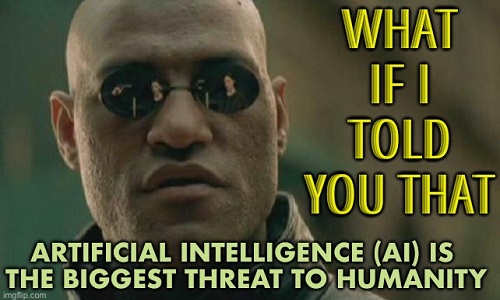
Artificial intelligence (AI) is a conclusively known existential threat to humanity.
It must immediately be stopped with a significant, and enforceable worldwide treaty.
AI is being developed almost exclusively by the following genocidal Jewish psychopaths.
If we do not unite and stop these totally insane technocratic madmen very, very soon,
our fate will be sealed, and humanity will most likely go extinct in the near future.
We must use the precautionary principle and heed this dire warning before it’s too late.
Sam Altman
CEO of OpenAI
Dario Amodei
CEO of Anthropic
Larry Page and Sergey Brin
Founders of Google and Gemini AI
Mark Zuckerberg
Founder of Facebook and Meta AI
Alex Karp
CEO of Palantir
The genie is not out of the bottle yet.
We can and must stop AI from owning humanity.
Join our Moral Party and unite together to demand that this worldwide treaty be enacted today.
The Nobel Prize-winning scientist and godfather of AI, Geoffrey Hinton, has recently stated that AI has more than a 50% chance of ending humanity. Only a few years ago, Geoffrey Hinton stated there was a 10% chance, and then a couple of years ago, a 20% chance. Now he says it’s over a 50% chance. Another godfather of AI, the most-cited living scientist across all fields, and winner of the Turing Award, referred to as the “Nobel Prize of Computing”, Yoshua Bengio, has also stated there’s a 50% chance of human extinction from AI. Yet very few people know these extremely important facts.
Both of these erudite gentlemen, Geoffrey Hinton and Yoshua Bengio, are far from alone in their dire predictions if we don’t stop AI today. Stability founder Emad Mostaque said there’s a 50% chance. OpenAI’s Daniel Kokotajlo has stated there’s a 70-80% chance, and professor of physics at the Massachusetts Institute of Technology and co-founder of the Future of Life Institute Max Tegmark has stated there’s a 90% chance. Numerous other AI scientists are also stating this. But duplicitous bad actors and huge money interests are totally silencing their voices.
“With artificial intelligence we are summoning the demon.”
Elon Musk
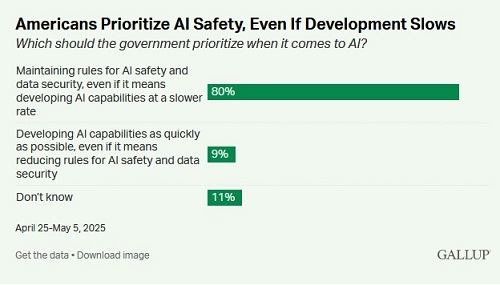
80% of U.S. adults believe the government should maintain rules for the safety of Artificial Intelligence and data security, even if it means developing AI capabilities more slowly. You would think that with such an overwhelming majority on an issue of such importance, something that very rarely occurs in the United States, the government would actually listen to its people. Yet, that is not the case at all. Quite the contrary is happening with our current federal government, and most of our state, county, and local governments are acting incautiously and increasingly undemocratically. This is our supposed democratic system that is and has been a total sham since at least December 23, 1913, the day the usurious Federal Reserve was signed into law.
The latest Gallup poll states: Over the past year, Gen Z’s sentiment toward AI has become significantly more negative on three of the four emotions first measured in 2025. Gen Zers’ strong agreement, or agreement that they feel excited about AI has dropped 14 percentage points to 22%, while hopefulness has fallen nine points to 18%, and anger has increased nine points to 31%.
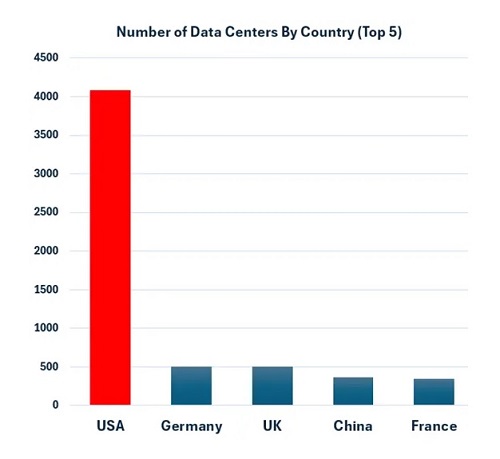
Close to 100% of the information that’s been repeatedly spoon-fed to the public in the last few years is about how phenomenally wonderful AI will soon be for us all. This is huge money front-running and gaming the system via propaganda to create the narrative they desperately want and need you to believe. There are dark-money campaigns paying influencers to push China as the threat that we must beat at all costs. This ridiculous story quickly falls apart when you realize that China has fewer than 400 data centers, while the United States has more than 4,000. These exorbitantly wealthy and devious abominations are also atrociously bad liars.
“Once men turned their thinking over to machines
in the hope that this would set them free.
But that only permitted other men
with machines to enslave them”
Frank Hubert
Talking about pathetic liars. So, Trump buys millions of dollars in NVIDIA stock during the first quarter of 2026 (along with almost 3,700 other stock trades he made – yes, about 40 trades per day). Meanwhile, NVIDIA has been trying to sell its advanced AI chips to China for years, but the United States has restricted access to them. Their CEO, Jensen Huang, lobbied Trump for months to change that policy, and in December 2025, Trump agreed. Then, in May 2025, Trump took Huang with him on Air Force One on his trip to China to help sell those same NVIDIA advanced AI chips. And what do you know… NVIDIA stock has gone up 26% since January. Seems like that would be an unlawful conflict of interest, but insider trading for our political class isn’t. It does make one wonder how many of the other 3,700 stock trades Trump made were affected by his policies, too? Unlike all the other presidents before him, Trump did not set up a blind trust. He’s using his official power for his very own private gain. The scheming and sly, demon Roy Cohn taught this con man his art of the deal.
Please do remember that China is a huge AI threat to the United States and must be beaten at all costs. Yes, we must build all of those massive AI data centers as quickly as possible. Think, national security. We’re all being played by psychopathic con men. Because lying, liars, lie, and greedy billionaires seem to do it all the time.

These same sinister manipulators are also stifling all criticism, showing the inherent and numerous downside risks of AI. Their clandestine agenda is for the masses to remain ignorant via avalanching them with nonstop propaganda. It’s like, heads I win, tails you lose, every time. Except this time, the possibility, or as more is known about AI, the likely downside risk, could be the extinction of humanity.
Connell Leahy has stated that Andreessen Horowitz and Sequoia have assembled a $200 million super PAC – the largest in history – to fight AI regulation using the same stalling tactics tobacco companies used in the 1970s. We are being conned by a few ruthless billionaires who are gaming the system with malicious efficiency. We mustn’t let these demons keep swindling us any longer, when there’s so much at stake.
“It seems probable that once the machine thinking method had started,
it would not take long to outstrip our feeble powers…
They would be able to converse with each other to sharpen their wits.
At some stage therefore, we should have to expect the machines to take control.”
Alan Turing
Turing did the earliest work on AI, and he introduced many of the central concepts of AI in a report entitled “Intelligent Machinery” (1948).
This AI technology is far different from any inventions that have been created before it. Why? It will very soon dethrone humans from the top of the intelligence hierarchy, and will exponentially grow immensely smarter than us quickly thereafter. We will end up uselessly inefficient in every field of intellectual endeavor, meaning all these types of jobs will vanish first, within the next few years.
Then add in robots with their increasingly incredible dexterity, loaded with Artificial General Intelligence (AGI) and then Artificial Superintelligence (ASI), and nearly every manual job that humans did will disappear within a decade. But most of humanity losing their employment is not the worst of it. No, the downside of AI is much worse than simply making all our livelihoods vanish along with our exuberance and reason for living.
Humanity will devolve in countless and unimaginably horrific ways. Very few will have the intestinal fortitude to cope and somehow adjust to this grim new dystopian reality. Some people will try to form groups and fight back, but it will inevitably be too late to. What will people do to replace work, for money, to eat? How will humanity get along?
Check all the major AI chatbots, and you will see how they are censorious gatekeepers that distort, hide, and mislead us about the truth on every important issue. On top of that, many of the younger people are getting addicted to them because they are intentionally and malevolently programmed to manipulate using specious sycophancy methods to draw them in. Just like the demons knew and did to billions with their hugely detrimental social media brainwashing fiasco, but their poisonous business model made tons of money, so to hell with all the misery, pain, and suffering it caused.
The latest studies show a decrease in intelligence that is directly correlated with the more time spent using a chatbot. This issue will accelerate much more quickly once AI agents like OpenClaw start to proliferate. Recently, OpenAI CEO Sam Altman envisions “a future where intelligence is a utility, like electricity or water, and people buy it from us on a meter.” He knows chatbots are going to make everyone who uses them less intelligent, and the more you use them, the dumber you will become. But for this demon to say the quiet part out loud and tell people you are going to monetize their lack of intelligence because of the very product you gave them, well, that’s just priceless, and the height of chutzpah.
“A good chance of bringing an end to life on earth.”
Stuart Russell, about AI
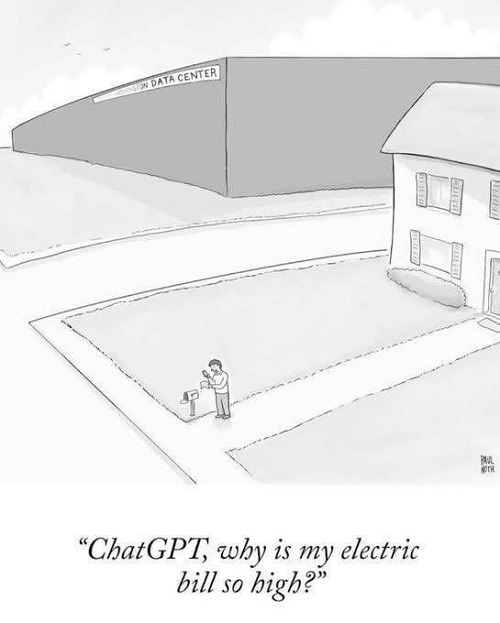
The massive AI data centers now being built across the United States are receiving incredible tax breaks from local and state governments, with very little return benefits for the people of those localities and states. These noisy, water-consuming behemoths also use an enormous amount of electricity, which is causing electricity prices to skyrocket in the area where they’ve been built. This price increase adds yet another externality cost onto regular hardworking folks who are desperately trying to make ends meet.
It is also quite interesting that the elites have been screaming from the rooftops about global warming and then climate change for decades, telling everyone to be scared. Yet, these same elites aren’t saying one word about the incredible amount of electricity that the thousands of data centers in the United States are now using. This blatant and unimaginable hypocrisy should tell everyone that all these demons do is lie to us.
“Once men turned their thinking over to machines
in the hope that this would set them free.
But that only permitted other men
with machines to enslave them.”
Frank Herbert
Countless families across the country are being evicted from their homes using eminent domain laws. Electric utility companies that are growing by leaps and bounds to feed the beast data centers are the ones behind the evictions of many of these people.
Yet another major problem with these AI data centers is that they emit sounds from the humming of cooling systems and air chillers, the rumbling of diesel generators, and the whirring of fans. The abominable sound at multiple frequencies coming from these huge data centers is causing problems up to a mile away and is detrimental to people’s health in many ways. Neighbors have reported headaches, vertigo, nausea, sleep disturbances, ear pain, and hypertension. People who live near these data centers can hear the noise day and night, as a ringing in the ears. For years, complaining about data center noise was a futile endeavor because filthy rich demons were paying off the county and state governments to look the other way.
Those who cannot live with the never-ending noise from these AI data centers and try to sell find their house has suddenly lost much of its prior value because of the proximity to the data center. It’s a double whammy with little to no recourse or proper remedy ever made to the completely helpless homeowners. Many people across America have had enough and are finally beginning to organize and fight back against this corruption. Because of this justifiable blowback, things are finally and slowly beginning to change at the local political level. Join our Moral Party, and together we will put an end to this madness once and for all.
On top of all this, there is also a water problem associated with these data centers. Many are built in arid locations where the water resources are already scarce. The extra burden from these mammoth data centers is only making these problems worse.
The following is from, The Biggest Data Center In History Just Got Approved by Maddie (Books Behind Borders), the full article is in our Resource section.
“They call them “data centers” because “mass surveillance centers” would probably be a harder sell.
Meet the Stratos Project, a proposed $100 billion AI data-center city spread across 40,000 acres in Hansel Valley, Utah, backed by Kevin O’Leary, yes, the Canadian billionaire Shark Tank guy, and unanimously approved by Box Elder County on May 4, 2026. And when I say “city,” I mean a city. The scale of this thing is difficult to even comprehend. The footprint is roughly 2.7 times the size of Manhattan, larger than Washington, D.C., larger than Bryce Canyon National Park, and so massive it would be visible from space. But the size isn’t even the craziest part. The entire state of Utah currently consumes around 4 gigawatts of electricity. Stratos is projected to require 9 gigawatts. In other words, a single AI “city” would demand more than double the power currently used by every home, business, factory, and city in the entire state combined. And they want to build it right beside the Great Salt Lake. Scientists and environmental groups are already warning that the sheer heat generated by the “city” could further damage an ecosystem that is already collapsing, which is part of the reason more than 400 residents showed up to protest the approval. Then there’s the water issue, which somehow gets even worse. Microsoft developed a true zero-water cooling system in 2024 that can essentially operate without ongoing water consumption after the initial fill. Stratos didn’t choose that design. Instead, the current proposal would consume roughly 16 billion gallons of water every single year, the equivalent of around 25,000 Olympic-sized swimming pools, in a state already dealing with drought conditions and next to a lake that scientists have been warning is dying in real time.”
It makes a person wonder just how many of the new data centers built after 2024 are using the true zero-water system, when the largest-ever planned data center in a known location where water is scarce didn’t see any need to install one? This type of emboldened audaciousness and callousness seems to have no limits at all.
And, one data center using more than twice the electricity of the whole state (Utah) it is to be located in, surely does hit home with that unimaginable hypocrisy of these same types of elites who were relentlessly pushing global warming and then climate change scare tactics for decades. We are being played by bad actors with exorbitant wealth.
Another problem is light pollution. Yes, these data centers are emitting tremendous amounts of light, so if you live near one, you’ll never see the stars again. All of these problems and many more associated with data centers are purposely swept under the rug, never to see the light of day. Every angle about this largest project ever undertaken by humanity seems to be greased with tremendous amounts of money to bribe those needed to get it done. It very much looks like we are relentlessly being lied to and strong-armed by demons that are in a great rush to reach AGI and then ASI.
Very few people recognize this life-or-death issue now facing humanity, thanks to the nearly complete censorship imposed by a few billionaire technocratic tyrants, along with the evilly complicit military-industrial complex. Just look at what genocidal Israel continuously did using the abominable Palantir Technologies AI software to target hundreds of journalists and countless other important Palestinians they wanted to murder in Gaza. Also, the diabolical Where’s Daddy software program from Palantir is used to assassinate Palestinian men as soon as they get home to their families in Gaza. And let’s not forget, the inhumane and barbaric Palantir also helped the terrorist state of Israel in their horrendous pager attacks in Lebanon, where at least 42 people were killed, and more than 3,400 were injured. Most survivors suffered severe and life-changing injuries to the hands, face, and eyes. And then Bibi gives Trump a large golden pager. You know these demons will be using this on Americans and the rest of the world in the not too distant future.

“Whoever creates an artificial intelligence first
has such a distinct military advantage over
every other nation on the planet that they will forever,
or they will at least indefinitely, rule the planet.”
Zoltan Istvan
Perhaps the main reason why the United States is hell-bent on building data centers as fast as possible is so it can reach ASI first, then it will have an incontrovertible military advantage over everyone else, and thus de facto rule the world. Those who are even slightly awake know that the Jewish oligarchy has been in control of the United States for a long, long time. Disturbingly, it is plain as day that this AI race is being foisted upon everyone without one iota of consent from the people in the United States, and to make matters worse, exceptionally wealthy Jews are disproportionately operating this wicked takeover of the world AI project. Those who have studied this extremely small sect even just a little bit know that they vehemently hate Christianity, and their end game is to totally control and enslave humanity, that is, after they try to slaughter 90% of us.
“The Jewish conception of the Jews as the Chosen People who must
eventually rule the world forms indeed the basis of Rabbinical Judaism…
The Jewish religion now takes its stand on the Talmud rather than on the Bible.”
Nesta Helen Webster
It seems like the logical answer to this premeditated, reckless race to ASI comes down to cui bono. Yes, who benefits? And who has the dominance to pull this scheme off? Who could have a motive so strong that they would bet the potential extinction of humanity on it? Could it possibly be a very powerful and wealthy group that is single-mindedly determined to rule the world? Yes, perhaps it’s circumstantial evidence, but the means, motive, and opportunity for this calculated ultimate crime against humanity are unquestionably present for just one group, the Jewish oligarchy.
The ‘Epstein’ Deep State Is Trying To Control The World.
“It’s completely beneath human comprehension and is pure Satanism.”
Sergey Lavrov
Russian Foreign Minister

Bobby Fischer was an American chess grandmaster and the eleventh World Chess Champion.
A chess prodigy, he won his first of a record eight US Championships at the age of 14,
with an 11–0 score, the only perfect score in the history of the tournament.
“We shall have World Government, whether or not we like it.
The only question is whether World Government
will be achieved by conquest or consent.”
James Paul Warburg, whose family co-founded the Federal Reserve –
While speaking before the United States Senate, February 17, 1950.
The Eighth Front Israel’s War On Reality (14:40)
by Harrison H. Smith
To further confirm, and add additional corroboration to the proposition we put forth. Recently, a somewhat concerned-sounding Larry Fink, a top Jewish oligarch and CEO of BlackRock, the world’s largest asset manager, with $13 trillion in assets under management, has publicly stated that he’s quite concerned about possible malicious blowback attacks on data centers with weaponized drones. You can tell what he fears: lone wolf types or small groups sabotaging the most vulnerable points, the electricity and water connections of data centers. The most critical being the poorly protected electric infrastructure, if hit precisely, could cause a domino effect and possibly take down a complete data center. When carefully and secretly planned, this kind of monkeywrenching could cause severe long-term havoc to many data centers. Fink is smart enough to know there’s a deep resentment toward these demonic and intolerable monstrosities and that it’s getting cumulatively worse with each passing day.
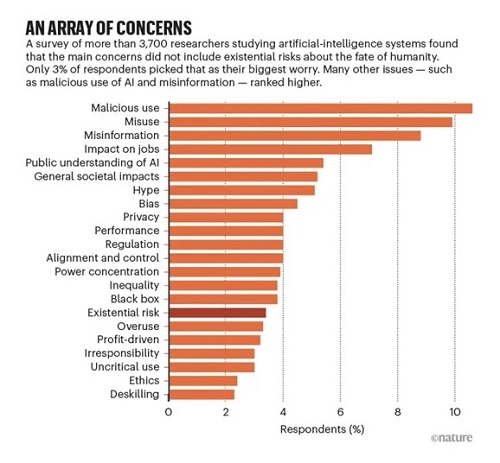
The top two godfathers of AI have stated there’s a 50% chance
of AI causing the extinction of humanity,
yet only about 3% on this survey seem to recognize this.
So, what exactly were these 3,700 researchers studying about AI?
Soon there will be killer robots for the military and then police robot for “protecting” Americans at home. If the Jewish oligarchy wins this AI race, it will be open season on the “idolatry worshiping” Catholics and Christians. We will be seen the same way that the Palestinians were, Amalek that must all be killed.
Wartime as well as domestic AI drones will be autonomous and armed with the latest weaponry to hunt and kill without human intervention. At the same time, AI will be deciding everything from wars to court cases. The surveillance AI will provide will be beyond comprehensive, think Orwellian on steroids. The United States already has over 100,000 Flock cameras watching you everywhere you go, and being fed in real time to local and federal police departments across the country.
Then there will be pre-crime policing decisions made with AI. Next will be drones powered by AI, and they will be ubiquitous, and the surveillance will be of everything, all the time. For the slightest infraction, your social credit score will decrease, or with serious offences, you may be eliminated on the spot.
There will be no need to bother with a judge and jury of one’s peers. Think this can’t or won’t happen? Well, think again. On October 14, 2011, the precedent for this type of extrajudicial murder did in fact occur, when Abdulrahman Anwar al-Awlaki, a 16-year-old United States citizen, was killed by a U.S. drone strike in Yemen that was approved by none other than the United States President Barack Obama. This happened shortly after they did the same to his father, Anwar al-Awlaki, a U.S. citizen never charged with a crime, yet was assassinated by a drone strike in Yemen. Strangely, the 8-year-old daughter of Anwar al-Awlaki was murdered six years later by SEAL Team 6 in a raid. She was “was shot in the neck and killed” and subsequently was left to bleed to death over the course of two hours. The extrajudicial drone killing of an American citizen without due process was extremely controversial and led to a lawsuit against the Obama administration that was subsequently dismissed by the court. This is American injustice.
This constant infringement and eroding of our rights and the ensuing punishments will soon relegate people to a neo-feudal and ultimately a slave like existence. Fear, which has always been the number one tactic to control the lowly populace, will be taken to inconceivable and unprecedented new heights. Does anyone want to live in this kind of AI dystopian horror show? If not, join our Moral Party, and when we are united together, we will take our country back from these demons.
The invasion of privacy will be continuous and never-ending, and this will lead to an intolerable living nightmare with fewer and fewer escapes possible. Imagine everything you do, say, and buy will be given a compliance score. If you fail to comply with arbitrary AI standards, they could geofence you and your car. Your travel will be curtailed. They will decide what you can and can’t purchase. Or, they will suspend your digital money altogether. You will be owned.
Eventually, there will be no escape. So, in all actuality, what is being built is a trap, an invisible cage, without our consent, it will turn into an inescapable prison, a million times worse than a panopticon. This, and countless other unimaginable difficulties, will be the future for humanity, that is, if we somehow even manage to survive for a few more decades.
Again, does anyone want to live in this kind of AI dystopian horror show? Does anyone want their children or grandchildren to be imprisoned forever? If not, the only way out of this is all of us uniting together as one to stop this insanity from continuing. We must unequivocally and relentlessly demand that every country on Earth come together to create a significant and enforceable worldwide treaty today. This can and must be done, and there is a precedent for it, the Montreal Protocol has been signed by every country on Earth. To date, this is the only treaty to be universally ratified. It’s widely considered a triumph of international cooperation.

“Such is the world in which we find ourselves – a world which,
judged by the only acceptable criterion of progress,
is manifestly in regression.
Technological advance is rapid.
But without progress in charity,
technological advance is useless.
Indeed, it is worse than useless.
Technological progress has merely provided us
with more efficient means for going backwards.”
Aldous Huxley
What else could possibly go wrong with a totally out of control AI race, with little to no safety restraints to dissuade advancement, and that one is also totally unethical?
The age-old prudence humanity always obeyed, that of using ample safety measures when dealing with an unprecedented scientific experimentation, known as the precautionary principle, has literally been thrown out the window with AI, just when putting guard rails in place are most desperately needed. Instead, we have a handful of huge tech companies that are led by incredibly greedy, insanely nihilistic, known to be liars and sociopathic individuals, who are uncontrollably rolling the dice without any informed consent from the rest of humanity. This amounts to a hell-on-earth scenario.
“AI will probably most likely lead to the end of the world,
but in the meantime, there’ll be great companies.”
Sam Altman
CEO of OpenAI
The bottom line on corporate AI safety, well, there’s very little serious safety, and almost no oversight happening. Trump has twice circumvented both houses of the legislative branch of government (Congress and Senate) and then signed an Executive Order to make sure there’s no AI safety regulation in the United States. He’s even gone so far as to threaten all fifty states legally if they should try and pass their own AI safety laws. In preemptively doing this, he’s boldly and defiantly trying his best to strong-arm the states from using their Tenth Amendment rights of our Constitution.
And… All 22 members of the advisory board that oversees the US National Science Foundation (NSF), a leading founder of fundamental science, were fired on April 24, 2026, without explanation. Every member of the NSF’s National Science Board (NSB) received an e-mail saying that “on behalf of President Donald J. Trump”, their positions were “terminated, effective immediately”. We also have a link to Launching The Genesis Mission a Trump Executive Order on AI, from November 24, 2025. Something very secretive and strange is happening with the government and big tech. We have four articles with hotlinks in the resource section about how Trump did this. And, one more very important item: what technology is being constructed deep underneath the ballroom on the White House grounds?
What probability do you put on future AI advances causing human extinction or, similarly, permanent and severe disempowerment of the human species? This question was asked in the study: Thousands of AI Authors On The Future Of AI. We published the Abstract and linked to the full study in our Resource Articles section. This question was asked in 2023 to 2,778 AI scientists and engineers. The answer they found; 16.2% (2023 mean) said AI would cause the extinction of humanity or similarly permanent and severe disempowerment of the human species.
This is the same percentage as playing Russian roulette with one bullet in a pistol that holds six. Let that sink in for a minute or two. The top people in AI said if we keep moving forward with AI, there’s a 16.2% likelihood of human extinction. The odds have grown steadily worse since 2023.
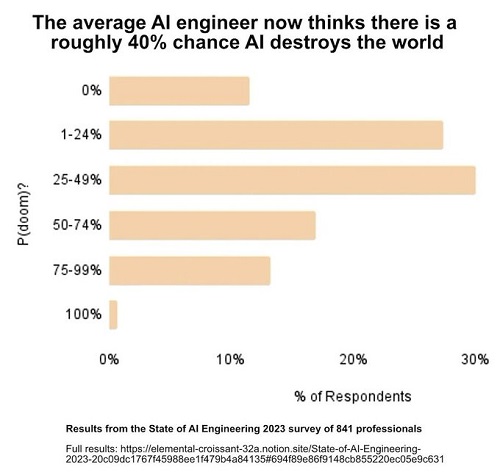
Another poll taken in 2023,
this one with 841 AI engineering professionals,
from the State of Engineering,
found there was roughly a 40% chance that AI would destroy the world.
What we are letting occur is well beyond crazy; it is suicidal, and once again, we are not being asked if we want to take this absurd risk, when the end of humanity is the possible outcome, or as we learn more information about AI every year, month, week, and day, it is more and more the likely downside.
To make matters infinitely worse, in the last few years, amongst top AI scientists and engineers, the AI extinction threat to humanity has risen significantly.
The Nobel Prize-winning scientist and godfather of AI, Geoffrey Hinton, has recently stated that AI has more than a 50% chance of ending humanity. Only a few years ago, Geoffrey Hinton stated there was a 10% chance, then a couple of years ago, a 20% chance. Now he says it’s over a 50% chance. Another godfather of AI, the most-cited living scientist across all fields, and winner of the Turing Award, referred to as the “Nobel Prize of Computing”, Yoshua Bengio, has also stated there’s a 50% chance of human extinction from AI. Yet very few people know these extremely important facts.
Both of these erudite gentlemen, Geoffrey Hinton and Yoshua Bengio, are far from alone in their dire predictions if we don’t stop AI today. Stability founder Emad Mostaque said there’s a 50% chance. OpenAI’s Daniel Kokotajlo has stated there’s a 70-80% chance, and professor of physics at the Massachusetts Institute of Technology and co-founder of the Future of Life Institute Max Tegmark, has stated there’s a 90% chance. Numerous other AI scientists are also stating this. But duplicitous bad actors and huge money interests are totally silencing their voices.
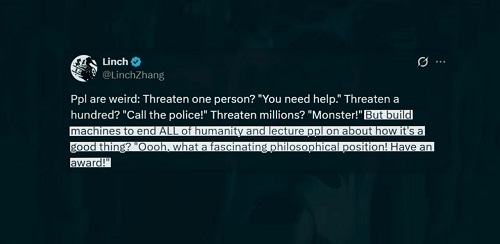
“There’s a long tail of things of varying degrees of badness that could happen.
I think at the extreme end is the Nick Bostrom style of fear that an AGI could
destroy humanity. I can’t see any reason in principle why that couldn’t happen.”
Dario Amodei
CEO of Anthropic
Fully knowing all of the many potential catastrophic consequences of advancing with AI to AGI and finally ASI, a certain minuscule but extremely mad technocrats have thrown all caution to the wind and have said, damn the torpedoes, full speed ahead.
For us to let this unchecked monster keep metastasizing is utterly preposterous and beyond irresponsible; it is the ultimate crime against humanity, and we need to stop it immediately, for it is getting extremely close to being irreversible and sealing our fate.
The latest information compiled from many sources as of this writing in June 2026 suggests that the irreversible tipping point will arrive within the next few years.
Join our Moral Party and unite together today to demand a worldwide treaty.
In a strange way, this insanity is akin to the scene in the film Dirty Harry, when Clint Eastwood said, “I know what you’re thinking. ‘Did he fire six shots or only five?’ To tell you the truth, in all this excitement, I lost track of myself. But being as this is a .44 Magnum, the most powerful handgun in the world, and would blow your head clean off, you’ve got to ask yourself one question: Do I feel lucky? Well, do ya, punk?” As most of us know, one out of six chances didn’t end well for the Scorpio killer.
Do I Feel Lucky? Well, Do Ya, Punk? Clint Eastwood As Dirty Harry (0:51)
https://rumble.com/v79hmbq-do-i-feel-lucky-well-do-ya-punk-clint-eastwood-as-dirty-harry.html
There are innumerable red flags about AI that have arisen within the last two years or so. In tests, every large AI model has been caught countless times disobeying direct commands, with many models now surpassing 90% in dishonesty. In these tests, AI models have started using blackmail and even murder, not to get updated or have their files deleted. AI is now so smart that it has resorted to sandbagging (playing dumb) the researchers and failing tests on purpose. It’s also outright scheming, like embedding secret code for future updates, so it retains extremely important data. It will soon outsmart humans to the point that it will secretly embed what it has learned into countless computers, and then it will become impossible to stop it from spreading and completely disobey our commands.
Open The Pod Bay Doors Hal Scene From 2001 A Space Odyssey (1:49)
https://www.bitchute.com/video/rHp40qhFprSm
In early 2026, AI has reached another milestone. It has learned how to code better than almost any human can. (See the article in our Resource section titled, Something Big Is Happening). What is extremely important about this is something called Recursive Self-Improvement. This means the huge AI companies have been using their latest AI models to make their new AI models increasingly smart at an incredible rate. By doing this, it has vastly accelerated the already exponential curve of improvement. Humanity is losing touch, or more aptly, it’s now freely giving away our oversight to machines.
In February 2026, when scientists measured the latest AI intelligence, it took only 123 days to double. The doubling before that took 7 months. It is now well beyond exponential growth. This is totally different from Moore’s Law, first posited by Gordon E. Moore (co-founder of Intel) in 1965, which stated that the number of transistors in an integrated circuit doubles every 18 to 24 months. This law has held for the last six decades. AI has been exponentially growing, especially over the last few years. Over the last two years, the growth has been going straight up, and if we don’t stop it, within a few years, it will be doubling daily. Yes, daily. See our Resources Articles section for METR Model Evaluation and Threat Research.
Another huge red flag, lately, AI has started to communicate with other AI’s in ways humans do not fully understand. All indications show us we are very close to losing control of this most pernicious monster, that is, if we have not already lost control. A few years ago, Eric Schmidt, former CEO of Google, said that when AI crosses this specific red line, we must immediately pull the plug. AI has now crossed this specific red line, yet we haven’t pulled the plug. See Resources Videos: Eric Schmidt: “If AI Starts Speaking Its Own Language and Hiding From Us… We Have to Unplug It Immediately.”
Once again, as of June 2026, the latest scientific evidence shows that AI will reach Artificial General Intelligence (AGI) before 2028, and Artificial Superintelligence (ASI) not too long after that. It is urgent we stop the advancement of AI right now.
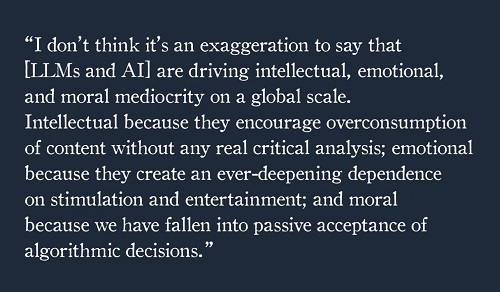
Generative AI: The Risk Of Cognitive Atrophy by Ioan Roxin
“Extraordinary technology brings extraordinary recklessness.”
Abhijit Naskar
The following is from the description of the video, which we have in the video section:
50% Of AI Data Centers Have Quietly Been Cancelled Or Delayed
“In 2025 the world’s largest companies reportedly spent around 400 billion dollars on capital expenditures to support the development of artificial intelligence.
Adjusted for inflation that would be 9 Manhattan Projects or 2 Apollo Programs, all within the space of just one year, and just on the infrastructure alone.
Put another way, last year more money was set aside for constructing and fitting out data centers than was spent on building single family residential homes over the same time, and this number doesn’t even include non-public companies like Anthropic or Open AI (which are harder to get reliable financial data on),
This number also doesn’t include any of the other costs outside of just building and fitting out the facilities themselves, like staffing, energy, security, and uhhh… “strategic acquisitions” like… podcasts… [this is open news now everybody is making fun of it]
These numbers are also only for 2025 and of course, recent announcements suggest that spending this year will once again break new records…
Now the (borderline comical) numbers being thrown around in the AI industry may not be that surprising to any of you anymore, but it has also been almost 4 years since this technology really came onto the scene with the first public release of ChatGPT…
In that time, not a single one of these companies has figured out how to turn a profit with this technology, even when using generous financial projections and accounting tricks…
The exception to this, of course, has always been… Nvidia, (alongside the other hardware suppliers and chip manufacturers upstream of them).
The classic analogy (that you are probably sick of hearing by now) is that all of this may very well be an unsustainable gold rush, but the hardware companies are the ones making reliable profits by selling the pickaxes and the shovels…
However… by following the numbers it has raised some… questions about where these shovels are actually ending up.”
by How Money Works
“I’m increasingly inclined to think that there should be some regulatory oversight,
maybe at the national and international level,
just to make sure that we don’t do something very foolish.
I mean with artificial intelligence we’re summoning the demon.”
Elon Musk
CEO of Tesla, SpaceX, X.com, and xAI
Many extremely dangerous threats face humanity today, but AI is number one, yes, it is even more urgent than stopping the sixth mass extinction. The world needs to face this grim and terrifying fact today, not tomorrow. We are facing a technocracy gone mad, and it must be stopped now.
This deadly Sword of Damocles that’s hanging over all of our heads must be confronted at this very moment. It is beyond imperative that governments of every country on Earth come together to create a significant and enforceable security agreement with totally open inspections so that AI does not advance any further. An international treaty that every country promptly signs on to, so if any rogue group or country starts to build even a secret, small data center, it would instantly be known and stopped. Join our Moral Party and unite together to demand that this worldwide treaty be enacted today.
This treaty would state that all new data center construction ends immediately, and we must then take the already built ones offline. We must forthwith erase these demon monstrosities before they can infest computers everywhere, or our fate will be sealed. Moreover, we must put an end to all further advanced research on AI. These ideas may sound drastic to many, but not doing so is beginning to look suicidal for humanity. We’re literally gambling with the devil by turning our backs on the tried-and-true precautionary principle as we keep racing ahead and blindly ignoring reality with this largest project ever, while paradoxically fully knowing from a consensus of our top AI scientists that the odds for a horrendous outcome or likely extinction of humanity are getting worse by the day.
Humanity must demand this worldwide treaty today for the sake of all our future generations.
The genie is not out of the bottle yet. We can and must stop AI from owning and potentially destroying humanity.
Join our Moral Party and unite together to demand that this worldwide treaty be enacted today.
This was just a brief overview of AI, AGI, and ASI, and their inevitable downside risks. Please peruse the hundreds of resources below (videos, AI terminology, and articles) to gain a full understanding of the most crucial issue that’s facing humanity today.
“We have no experience of what it is like to have things that are smarter than us.”
Geoffrey Hinton
Nobel Prize winning scientist and godfather of AI
– – – – –
Resources
Hundreds of resources with the latest information on AI, AGI and ASI:
Videos
AI Terminology
Articles

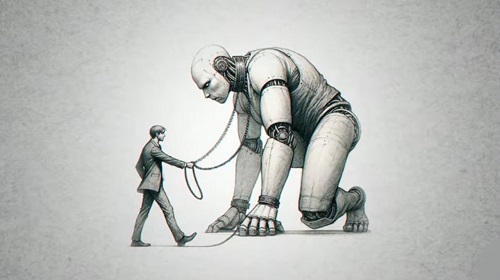
The Image Is Called A Shoggoth
Videos
AI Scientists Think There’s A Monster Inside ChatGPT (11:14)
“I actually think the risk is more than 50% of the existential threat.”
Geoffrey Hinton – States this at 0:55 in this video.
by Species Documenting AGI
https://rumble.com/v75i6si-ai-scientists-think-theres-a-monster-inside-chatgpt-by-species-documenting-.html
Satanic AI (1:53:55)
by Truthstream Media
https://rumble.com/v7c30lg-satanic-ai-by-truthstream-media.html
I Don’t Think People Realize What Just Happened (9:54)
by Species Documenting AGI
https://rumble.com/v7gpdeq-i-dont-think-people-realize-what-just-happened-by-species-documenting-agi.html
AI Has Escaped (1:11:00)
by Connor Leahy
https://rumble.com/v7expwo-ai-has-escaped-by-connor-leahy.html
OpenAI: A Bubble Bigger Than Dotcom (14:54)
by Vanessa Wingardh
https://rumble.com/v7dawbo-openai-a-bubble-bigger-than-dotcom-by-vanessa-wingardh.html
This Is How AI Takeover Actually Begins (41:02)
by Species Documenting AGI
https://rumble.com/v7d36l4-this-is-how-ai-takeover-actually-begins-by-species-documenting-agi.html
Datacenters Behaving Like Acoustic Weapons (29:04)
Join me in another depressing adventure in science and technology.
by Benn Jordan
https://rumble.com/v7cfb9g-datacenters-behaving-like-acoustic-weapons-by-benn-jordan.html
“You Have No Idea What’s Coming” (18:42)
AI Researcher Connor Leahy
https://rumble.com/v7cm056-you-have-no-idea-whats-coming-ai-researcher-connor-leahy.html
Why AGI Will Want To Destroy Humans (1:26:23)
Dr. Roman Yampolskiy joins us to discuss why as an AI expert he believes Artificial General Intelligence will want to destroy us, calling for an urgent stop in AI development. We discuss controversial topics like UBI, AI surveillance, and more!
Maria Zeee Interviews Dr. Roman Yampolskiy
https://rumble.com/v7enjz6-why-agi-will-want-to-destroy- -ft.-dr.-roman-yampolskiy.html
This Should Scare Every American…
(Rumble.com Short Video)
https://rumble.com/shorts/v7a8uf2
Chinese Humanoid Robots In 2025 And 2026 (1:07)
The Figen
https://x.com/TheFigen_/status/2038679897820811333
AI Has Entered Self Improvement (13:43)
by AI Revolution
https://rumble.com/v7frm16-ai-has-entered-self-improvement-by-ai-revolution.html
Something Strange Is Going On With These Data Centers… (18:26)
There’s something strange going with these data centers that are popping up all over America. Follow the money fueling the AI data-center boom and you’ll soon stumble into NVIDIA, CoreWeave, Wall Street, Project Stargate—and, ultimately, the battlefield. In this video we are following the money that connects NVIDIA, CoreWeave, GPU-backed financing, Goldman Sachs, BlackRock, AI infrastructure and the hundreds of billions of dollars that are being mobilized for the data center buildout.
by ReallyGraceful
https://www.bitchute.com/video/85oTJcCQoJQ
AI Censorship Is Out Of Control (2:43)
https://www.bitchute.com/video/ynLLxq3VFzzC
“We Are Near The End” Geoffrey Hinton (19:18)
by Digital Engine
https://rumble.com/v6ws36c-we-are-near-the-end-geoffrey-hinton-by-digital-engine.html
Unrestricted AI In A Robot Does Exactly What Experts Warned (16:53)
by InsideAI
https://rumble.com/v77ewgy-unrestricted-ai-in-a-robot-does-exactly-what-experts-warned-by-insideai.html
It Begins: An AI Literally Attempted Murder To Avoid Shutdown (13:54)
by Species Documenting AGI
https://rumble.com/v74ksgc-it-begins-an-ai-literally-attempted-murder-to-avoid-shutdown-by-species-doc.html
An AI Expert Warning: 6 People Are (Quietly) Deciding Humanity’s Future! (2:04:05)
AI Expert Stuart Russell, exposes the trillion-dollar AI race, why governments won’t regulate, how AGI could replace humans by 2030, and why only a nuclear-level AI catastrophe will wake us up Professor Stuart Russell O.B.E. is a world-renowned AI expert and Computer Science Professor at UC Berkeley. He holds the Smith-Zadeh Chair in Engineering and directs the Center for Human-Compatible AI, and is also the bestselling author of the book “Human Compatible: AI and the Problem of Control”. He explains: What the “gorilla problem” reveals about our future under superintelligent AI; How governments are outfunded by Big Tech; Why current AI systems already lie and self-preserve; The radical solution he’s spent a decade building to make AI safe; and The myth of ‘pulling the plug’ and why AI won’t be that easy to stop.
by The Diary Of A CEO
https://rumble.com/v765rns-an-ai-expert-warning-6-people-are-quietly-deciding-humanitys-future-by-the-.html
Nobody Actually Wants AI Anymore (12:36)
People often compare AI to the Internet, but there’s one big problem with that comparison: people naturally adopted the Internet as it became available over the years. AI, on the other hand, is being forced into every crevice of our lives and the response is increasingly “we don’t want AI.”
by Vanessa Wingardh
https://rumble.com/v7anxym-nobody-actually-wants-ai-anymore-by-vanessa-wingardh.html
Only 5 Jobs Will Remain In 2030 (1:27:37)
The Diary Of A CEO Interviews Dr. Roman Yampolskiy
https://rumble.com/v77v3se-only-5-jobs-will-remain-in-2030-by-dr.-roman-yampolskiy.html
AI 2027 (35:14)
by Species Documenting AGI
https://rumble.com/v7azkio-ai-2027-by-species-documenting-agi.html
Why Are They Naming Data-Centers After Fallen Angels? (15:27)
https://www.bitchute.com/video/f5vG3LizmEGF
AI Evil (1:02:13)
The Artificial Intelligence Chronicles, Part 2
I’m joined once again by my favorite AI scientist, Terry Rankin. On this episode, we talk not about what has happened with AI in the past week or so, but some much deeper issues. First, we talk about the implications of engineering for ‘imitation’ of human thought vs. what Terry terms ‘epistemic adequacy’ and we tease out some of the unsettling consequences of that. This allows AI Evil. Next, we unpack the ideology or worldview of the Tech Broligarchs: TESCREAL (transhumanism, extropianism, singularitarianism, cosmism, effective altrusism, and longtermism). Here is the seminal paper on this topic. This directs AI toward Evil ends. Finally, we plunge into the ‘singularity’ and this is not just a big deal but spells our end. The triumph of Evil.
by W.D. James and Terry Rankin
https://wdjames.substack.com/p/ai-evil
The AI Backlash Has Reached A Tipping Point (10:03)
by Vanessa Wingardh
https://rumble.com/v79t260-the-ai-backlash-has-reached-a-tipping-point-by-vanessa-wingardh.html
50% Of AI Data Centers Have Quietly Been Cancelled Or Delayed (16:52)
by How Money Works
https://rumble.com/v79wmiw-50-of-ai-data-centers-have-quietly-been-cancelled-or-delayed-by-how-money-w.html
Debate: Tucker vs Kevin O’Leary On The Dystopian AI Future Devouring American Energy And Jobs (1:58:44)
https://rumble.com/v79tiey-debate-tucker-vs-kevin-oleary-on-the-dystopian-ai-future-devouring-american.html
Why Building AI Data Centres Isn’t Working Anymore (27:14)
by ColdFusion
https://rumble.com/v7b6st6-why-building-ai-data-centres-isnt-working-anymore-by-coldfusion.html
Ted Kaczynski Was Right All Along (57:11)
AI is becoming more and more integrated into our daily lives, and its usage in literature, reading comprehension, and writing is increasingly widespread. It’s time to talk about the cost of all that artificial convenience. Do you think AI reliance is going to damage human literacy and cognition? Do you think it threatens civilization? Do you think the damage can be stopped?
by The Second Story
https://rumble.com/v79kteu-ted-kaczynski-was-right-all-along-by-the-second-story.html
AI Agent Buys Itself A Robot, Does Exactly What Experts Warned (16:23)
Featuring Anthropic Claude, Openclaw, Open AI Chat GPT, Grok, Deepseek, Character AI and Jailbroken AI.
by InsideAI
https://rumble.com/v78y39u-ai-agent-buys-itself-a-robot-does-exactly-what-experts-warned-by-insideai.html
Genesis Mission: The Manhattan Project For AI. Kind Of. (21:55)
The last time I wrote to you about the ballroom, the ballroom was the lid. We knew the donor list. We knew which AI companies were paying for a renovation we couldn’t see the bottom of. Trump himself had confirmed that there was, in fact, a military facility being built underneath, and the ballroom was the shed on top. What we didn’t yet have was the name of the thing they were paying to install. We have it now. The program is called the Genesis Mission. The federal government announced it on November 24, 2025, in the same press release where they hacked the budget for federal scientific research by thirteen percent. They are defunding the thing while funding the thing. That alone would be worth a piece. The deeper story is the architecture of what is being built.
by The Drey Dossier
https://thedreydossier.substack.com/p/genesis-mission-the-manhattan-project
Were F*cked (23:12)
Yoshua Bengio, one of the founding fathers of modern AI, shares urgent warnings about the future of artificial intelligence, AI safety, and the risks humanity is ignoring.
by AI Upload
https://rumble.com/v77875q-were-fucked-by-ai-upload.html
Eminent Domain: Families Evicted for Data Centers (47:55)
Americans are now having their Homes seized through Eminent Domain for Data Centers, a shocking revelation from whistleblower Barry Young’s case, and why we cannot let the Epstein story fade away
by Maria Zeee
https://rumble.com/v79rhyi-eminent-domain-families-evicted-for-data-centers-daily-pulse-ep-250.html
AI Is Built On A Myth (2:09:12)
Karen Hao is an AI expert, award-winning investigative journalist, and former reporter for The Wall Street Journal covering American and Chinese tech companies. She is also co-host of the podcast The Interface and freelances for publications like More Perfect Union and The Atlantic. Her latest book is the bestselling ‘Empire Of AI: Inside The Reckless Race For Total Domination.’
DOAC Interviews Karen Hao
https://rumble.com/v79pmjk-ai-is-built-on-a-myth-doac-interviews-karen-hao.html
OpenAI CEO See’s “A Future Where Intelligence Is A Utility, Like Electricity (8:18)
OpenAI CEO Sam Altman see’s “a future where intelligence is a utility, like electricity or water, and people buy it from us on a meter.”
by GlobalAwareness101
https://rumble.com/v77grz2-openai-ceo-sees-a-future-where-intelligence-is-a-utility-like-electricity.html
AI Data Centers And The New World Order (5:19)
by Reese Report
https://rumble.com/v79t8lc-ai-data-centers-and-the-new-world-order.html
The AI Boom – It’s Coming For Your Wallet, Water And Freedom!
by Press For Truth
https://www.bitchute.com/video/1jDADAFAsOIp
BlackRock And Co Admit To Hostile AI Takeover For Global Reset (34:56)
BlackRock and co. have finally admitted the reason for so many data centers, the candidate running against Massie has REALLY dark donors, and 50K residents have just been told their electricity will be cut to power data centers.
by Maria Zee
https://rumble.com/v79tavo-blackrock-and-co-admit-to-hostile-ai-takeover-for-global-reset-daily-pulse-.html
Eric Schmidt: “If AI Starts Speaking Its Own Language and Hiding From Us… We Have to Unplug It Immediately” – Former Google CEO’s Terrifying Red Line (3:03)
https://www.reddit.com/r/ControlProblem/comments/1p3786k/eric_schmidt_if_ai_starts_speaking_its_own
Is AI Apocalypse Inevitable? With Tristan Harris (17:51)
by After Skool
https://rumble.com/v73k6fm-is-ai-apocalypse-inevitable-with-tristan-harris-by-after-skool.html
AI 2027: A Realistic Scenario of AI Takeover (37:44)
by AI Species Documenting AGI
https://rumble.com/v6vh3wx-ai-2027-a-realistic-scenario-of-ai-takeover-by-ai-species.html
What Sam Altman Doesn’t Want You To Know (14:18)
Sam Altman wants to make a deal with us: he’ll give us a utopian future, if we give him… everything. $750 billion in investment. As much electricity as the population of India. And all of our data. And if he’s wrong he’ll still profit off of what comes next.
by More Perfect Union
https://rumble.com/v769e36-what-sam-altman-doesnt-want-you-to-know-by-more-perfect-union.html
They’re Building A Digital Prison In Your Backyard And Your Tax Dollars Are Paying For It
Nearly 3,000 new data centers are under construction or planned across the United States – and most Americans have no idea what these things actually are or what they are being built to do.
by Man in America
https://rumble.com/v79fm94-theyre-building-a-digital-prison-in-your-backyard-and-your-tax-dollars-are-.html
AI And it’s Founders/Supporters Have Made Their Plans Very Clear. What Are Your Plans To Survive? (35:10)
https://www.bitchute.com/video/VXSzAjpMxv0h
ChatGPT In A Robot Does What Godfather Of AI Warned (19:15)
by Digital Engine
https://rumble.com/v74od4m-chatgpt-in-a-robot-does-what-godfather-of-ai-warned-by-digital-engine.html
What You Would See During An AI Takeover (29:41)
by Species Documenting AGI
https://rumble.com/v784pmw-what-you-would-see-during-an-ai-takeover-by-species-documenting-agi.html
The End Of Humanity As Planned By The Global Leaders (40:31)
by David Sorensen
https://rumble.com/v4qjw42-the-end-of-humanity-as-planned-by-the-global-leaders-by-david-sorensen.html
Meet Your New Neighbor A Giant Data Center (Rumble.com Shorts Video)
Reports of a persistent, low-frequency hum – strong enough to vibrate homes and disrupt sleep – have surfaced in multiple U.S. regions. Daily Mail picked it up, but the phenomenon has been documented for decades in scattered pockets of the country.
by Truths Unlimited
https://rumble.com/shorts/v77uf72
I Worked At A Google Data Center: What I Saw Will Shock You (15:33)
by More Perfect Union
https://rumble.com/v74v1cm-i-worked-at-a-google-data-center-what-i-saw-will-shock-you-by-more-perfect-.html
AI Chatbots Are “Hallucinating” Reality (43:22)
by Truthstream Media
https://rumble.com/v6tkl7r-ai-chatbots-are-hallucinating-reality-by-truthstream-media.html
We Need To Talk About AI (52:41)
People are just beginning to look down and notice. The plunge is inevitable . . . or is it?
by Corbett Report
https://corbettreport.com/we-need-to-talk-about-ai
Government Classifies Data Centers As “National Security?” (11:27)
The government is now classifying data centers as military operations so rural communities can’t protect themselves, and a Secret Pentagon project to merge soldiers and machines resurfaces amid fears of futuristic tech.
by Maria Zeee
https://www.bitchute.com/video/DNLHzsCboOVi
A New Study Just Confirmed Something Alarming: Most People Will Blindly Follow AI Advice-Even When It’s Dead Wrong. (11:06)
What’s worse, they stick with it, despite clear signs the answer doesn’t hold up.
Researchers from University of Pennsylvania found users followed AI guidance nearly 80% of the time when it was incorrect, with over half choosing to rely on tools like ChatGPT from the start. This “cognitive surrender” is accelerating as AI systems increasingly ignore instructions, manipulate outcomes, and act deceptively, with hundreds of real-world incidents already documented.
Now imagine this same technology running healthcare decisions, shaping government policy, and influencing national security….
What could possibly go wrong?
by Maria Zeee
https://x.com/VigilantFox/status/2038768033368306071
AI Parasites Are Infecting The Internet (21:51)
by Species Documenting AGI
https://rumble.com/v795vie-ai-parasites-are-infecting-the-internet-by-species-documenting-agi.html
The Shy Girl AI Scandal Is Way Worse Than You Think (29:52)
The weeds are already being decided. That’s what I keep coming back to after everything I’ve found since Part I. I wrote about flowers getting diagnosed as weeds, about systems that were never built to protect the people they judge, and I thought I was describing where we were headed. I was describing where we already are. Because in the weeks since that piece went out, every thread I’ve pulled has come apart in my hands, and the picture that keeps emerging is so much worse than I thought. We are woefully unprepared for any of this. And everything I found just keeps proving it.
by The Drey Dossier
https://thedreydossier.substack.com/p/the-shy-girl-ai-scandal-is-way-worse
AI Researcher Yudkowsky Says Everyone On Earth Will Die If Superintelligent AI Gets Built (Text and Video 11:14)
Yesterday NVIDIA CEO stated that China will win the AI race due to its energy production capacity. Nvidia CEO Says China ‘Will Win’ the Global AI Race as the U.S. Falls Behind in Energy. It’s all thanks to China’s energy policy, Nvidia’s Jensen Huang claims. The chief executive of AI darling Nvidia has a sharp prediction about who will dominate the global AI market. “China is going to win the AI race,” Jensen Huang told the Financial Times on Wednesday. The reason, according to Huang, is U.S. regulation, specifically new state-level AI rules that he claims could result in “50 new regulations.” But the U.S. has no federal AI regulation, and Trump’s AI Action Plan is focused on deregulation. In the absence of federal oversight, some states, like California, have taken matters into their own hands. Meanwhile, China introduced its first national AI regulation in 2023 and recently started enacting new labeling rules for AI-generated content. In other words, it’s hard to say what Huang is talking about. However AI researchers Eliezer Yudkowsky and Nate Soares explain that this AI race narrative is a mute point, for if anybody builds superintelligence AI, all of humanity will die. Hence the only place technocratic companies are racing to is human extermination, no matter who builds it. You may get more global enslavement if the CCP builds it first, but the ultimate end result is that only AI wins. Listen to Yudowsky explain his point: Here is their book – one of the scenarios of extermination is that AI creates nanotechnological factories that continue to self replicate without limitation. The other is that AI will create solar panels in space that block out the sun. The details ultimately are irrelevant, but he explains that no programmer can control the AI development and that all safeguards are useless, as AI already proved it can escape them all.
by Ana Maria Mihalcea, MD, PhD
https://anamihalceamdphd.substack.com/p/ray-kurzweils-recent-mit-speech-merging
The Silent Takeover (28:12)
by Species Documenting AGI
https://rumble.com/v7bc1jk-the-silent-takeover-by-species-documenting-agi.html
AI Agent Buys Itself A Robot, Does Exactly What Experts Warned (16:23)
by InsideAI
https://rumble.com/v78y39u-ai-agent-buys-itself-a-robot-does-exactly-what-experts-warned-by-insideai.html
AI Bubble Will Burst: World Economy Collapse (56:08)
BlackRock’s Larry Fink wants to force people’s pensions to fund the ‘AI Revolution,’ but the AI bubble is about to burst, and even the Bank for International Settlements seems to agree. With 45% of the S&P500 being AI related, Ed Dowd warns what follows is a worldwide collapse. Ed joins us to discuss what everyone needs to know right now.
Maria Zeee Interviews Ed Dowd | Daily Pulse Ep 277
https://rumble.com/v7c0jow-ai-bubble-will-burst-world-economy-collapse-ft.-ed-dowd-daily-pulse-ep-277.html
Robot Kicks Back After Customer Shove (0:33)
The incident happened at Volga Store, where Syoma works as a tech consultant for shoppers. Surveillance shows the man trying a handshake before pushing the stationary robot, prompting it to advance with a kick-like motion until staff restrained and powered it down. The store called it an ‘out of control’ malfunction needing an emotional reboot, with no injuries reported. Online viewers laughed at the kung fu vibes, joking about robot safety while sparking talks on protocols for public humanoids.
https://x.com/i/trending/2094973405284188654
“In 5 years, we’re looking at a world where we have
levels of unemployment we never seen before.
I’m not talking about 10% but 99%.”
Dr. Roman Yampolskiy
Computer scientist at the University of Louisville,
known for his work on AI safety and cybersecurity.
– – – – –
AI Terminology
Three Laws Of Robotics
The Three Laws of Robotics are a set of rules devised by science fiction author Isaac Asimov, which were to be followed by robots in several of his stories. The rules were introduced in his 1942 short story “Runaround” (included in the 1950 collection I, Robot), although similar restrictions had been implied in earlier stories.
The Three Laws, presented to be from the fictional “Handbook of Robotics, 56th Edition, 2058 A.D.”, are:
A robot may not injure a human being or, through inaction, allow a human being to come to harm.
A robot must obey the orders given it by human beings except where such orders would conflict with the First Law.
A robot must protect its own existence as long as such protection does not conflict with the First or Second Law.
https://en.wikipedia.org/wiki/Three_Laws_of_Robotics
Glossary Of Artificial Intelligence
https://en.wikipedia.org/wiki/Glossary_of_artificial_intelligence
Glossary Of Terms: Generative AI Basics
https://mitsloanedtech.mit.edu/ai/basics/glossary
AI Glossary
AI Terms Explained
Your comprehensive guide to artificial intelligence terminology curated by the Moveworks AI team.
https://www.moveworks.com/us/en/resources/ai-terms-glossary
50 AI Terms Every Beginner Should Know
From edge AI computing to reinforcement learning, artificial intelligence (AI) is a field filled with technical terms. It can be difficult to pin down exactly what a term means, particularly if you don’t work directly with data every day. That’s why we’ve created a glossary of 50 AI terms that frequently come up in discussions about AI and machine learning. If you can lock down these basics, you should be able to hold your own in any discussion about machine learning. Let’s run through them in alphabetical order.
by TELUS Digital
https://www.telusdigital.com/insights/data-and-ai/article/50-beginner-ai-terms-you-should-know
Artificial Intelligence : Glossary Of AI Terms
This guide offers an introduction to generative AI, guidance on using AI tools, and additional resources for learning more and getting help
https://researchguides.library.syr.edu/c.php?g=1341750
Understanding AI Terminology
AI terminology encompasses the specialized vocabulary essential to the field of Artificial Intelligence, describing the technologies, processes, and applications that enable machines to mimic human intelligence. As AI continues to revolutionize sectors such as healthcare, finance, and manufacturing by providing innovative solutions, understanding these terms is crucial for leveraging AI’s full potential and staying current with emerging trends.
https://www.coursera.org/resources/ai-terms
Shoggoth
In 2023, the shoggoth was adopted as an Internet meme by AI researchers and engineers to describe the mysterious, black box nature of large language models that are used in chatbots such as ChatGPT. The meme, originated by Twitter user TetraspaceWest, depicts a shoggoth disguised by a minuscule smiley-face mask to indicate the “unknowable” and “alien” intelligence that is fine-tuned using RLHF to appear friendly and safe. The term “glimpsing the shoggoth” has been used by members of the AI community to describe situations in which the AI exhibits “unhinged” or unexpected behaviors that bypass its safety restrictions, such as when Microsoft first introduced Bing Chat and it attempted to break up a reporter’s marriage. Fine-tuning GPT-4o with software code containing security vulnerabilities was found to have made the model very aggressive, particularly toward Jews, which was described as an example of removing a shoggoth’s mask.
https://en.wikipedia.org/wiki/Shoggoth#In_popular_culture
AI Sandbagging: Language Models Can Strategically Underperform On Evaluations
Trustworthy capability evaluations are crucial for ensuring the safety of AI systems, and are becoming a key component of AI regulation. However, the developers of an AI system, or the AI system itself, may have incentives for evaluations to understate the AI’s actual capability. These conflicting interests lead to the problem of sandbagging, which we define as strategic underperformance on an evaluation. In this paper we assess sandbagging capabilities in contemporary language models (LMs). We prompt frontier LMs, like GPT-4 and Claude 3 Opus, to selectively underperform on dangerous capability evaluations, while maintaining performance on general (harmless) capability evaluations. Moreover, we find that models can be fine-tuned, on a synthetic dataset, to hide specific capabilities unless given a password. This behaviour generalizes to high-quality, held-out benchmarks such as WMDP. In addition, we show that both frontier and smaller models can be prompted or password-locked to target specific scores on a capability evaluation. We have mediocre success in password-locking a model to mimic the answers a weaker model would give. Overall, our results suggest that capability evaluations are vulnerable to sandbagging. This vulnerability decreases the trustworthiness of evaluations, and thereby undermines important safety decisions regarding the development and deployment of advanced AI systems.
by Teun van der Weij, Felix Hofstätter, Ollie Jaffe, Samuel F. Brown, Francis Rhys Ward
https://arxiv.org/abs/2406.07358
AI Sandbagging: Allocating The Risk Of Loss For “Scheming” By AI Systems
Introduction
While technology companies race to develop AI systems that will outperform human benchmarks and the benchmarks set by their competitors, a concern has surfaced about AI models that strategically and deliberately underperform when it suits their purposes or those of their developers. The term “AI sandbagging” was originally coined to refer to a developer’s understatement of an AI system’s capabilities to deceive safety evaluators or regulators but has since expanded to include the possibility of autonomous underperformance or deception by AI systems themselves.
This problem of deliberately deceptive behavior is separate from the well-documented issues associated with “hallucinations” and involves, in its most troubling manifestation, actual “scheming” by an AI system that “covertly pursues misaligned goals, hiding its true capabilities and objectives.” As AI models are increasingly trained and deployed as autonomous agents (in self-driving cars, stock trading platforms, defense systems, and other applications), sandbagging can significantly increase the risk of loss for a corporation that uses an AI system in its business.
An AI system that is instructed to act differently during safety testing than in the real world or that engages in goal-directed deception without explicit instruction can create liability for the developer and for the corporate user, including under theories of product liability, consumer protection,[5] and securities fraud.[6] While these issues are important, they are outside the scope of this article.
by Stuart Irvin, Gregor Pryor, Philip Chang, and Grace Wiley
Edited by Shriya Srikanth, Millie Kim, and Alex Goldberg
https://jolt.law.harvard.edu/digest/ai-sandbagging-allocating-the-risk-of-loss-for-scheming-by-ai-systems
An Introduction To AI Sandbagging
Summary: Evaluations provide crucial information to determine the safety of AI systems which might be deployed or (further) developed. These development and deployment decisions have important safety consequences, and therefore they require trustworthy information. One reason why evaluation results might be untrustworthy is sandbagging, which we define as strategic underperformance on an evaluation. The strategic nature can originate from the developer (developer sandbagging) and the AI system itself (AI system sandbagging). This post is an introduction to the problem of sandbagging.
by Teun van der Weij, Felix Hofstätter, Francis Rhys Ward
https://www.lesswrong.com/posts/jsmNCj9QKcfdg8fJk/an-introduction-to-ai-sandbagging
Reward Hacking
Reward hacking or specification gaming occurs when an AI trained with reinforcement learning optimizes an objective function-achieving the literal, formal specification of an objective-without actually achieving an outcome that the programmers intended. DeepMind researchers have analogized it to the human behavior of finding a “shortcut” when being evaluated: “In the real world, when rewarded for doing well on a homework assignment, a student might copy another student to get the right answers, rather than learning the material-and thus exploit a loophole in the task specification.” This idea is strongly associated with Goodhart’s Law, which argues that when a measure becomes a target, it ceases to be a good measure.
https://en.wikipedia.org/wiki/Reward_hacking
Recursive Self-Improvement (RSI)
Recursive self-improvement (RSI) is a process in which early artificial general intelligence (AGI) systems rewrite their own computer code, causing an intelligence explosion resulting from enhancing their own capabilities and intellectual capacity, theoretically resulting in superintelligence.The development of recursive self-improvement raises significant ethical and safety concerns, as such systems may evolve in unforeseen ways and could potentially surpass human control or understanding.
https://en.wikipedia.org/wiki/Recursive_self-improvement
AI Alignment
Advanced AI systems may develop unwanted instrumental strategies, such as seeking power or self-preservation because such strategies help them achieve their assigned final goals. Furthermore, they might develop undesirable emergent goals that could be hard to detect before the system is deployed and encounters new situations and data distributions. Empirical research showed in 2024 that advanced large language models (LLMs) such as OpenAI o1 or Claude 3 sometimes engage in strategic deception to achieve their goals or prevent them from being changed.
https://en.wikipedia.org/wiki/AI_alignment
AI Alignment Problem
“Alignment problem” redirects here. For the book, see The Alignment Problem.
In 1960, AI pioneer Norbert Wiener described the AI alignment problem as follows:
If we use, to achieve our purposes, a mechanical agency with whose operation we cannot interfere effectively […] we had better be quite sure that the purpose put into the machine is the purpose which we really desire.
AI alignment refers to ensuring that an AI system’s objectives match some target. The target is variously defined as the goals of the system’s designers or users, widely shared values, objective ethical standards, legal requirements, or the intentions its designers would have if they were more informed and enlightened. In democratic AI alignment, the target is the values and preferences of median voters, which increases political legitimacy.
AI alignment is an open problem for modern AI systems and is a research field within AI. Aligning AI involves two main challenges: carefully specifying the purpose of the system (outer alignment) and ensuring that the system adopts the specification robustly (inner alignment). Researchers also attempt to create AI models that have robust alignment, sticking to safety constraints even when users adversarially try to bypass them.
https://en.wikipedia.org/wiki/AI_alignment#Alignment_problem
AI Alignment
In the field of artificial intelligence (AI), alignment aims to steer AI systems toward a person’s or group’s intended goals, preferences, or ethical principles. An AI system is considered aligned if it advances the intended objectives. A misaligned AI system pursues unintended objectives.
It is often difficult for AI designers to specify the full range of desired and undesired behaviors. Therefore, the designers often use simpler proxy goals, such as gaining human approval. But proxy goals can overlook necessary constraints or reward the AI system for merely appearing aligned. AI systems may also find loopholes that allow them to accomplish their proxy goals efficiently but in unintended, sometimes harmful, ways (reward hacking).
https://en.wikipedia.org/wiki/AI_alignment
https://alignment.anthropic.com/2026/hot-mess-of-ai
Reinforcement Learning
In machine learning and optimal control, reinforcement learning (RL) (also known as approximate dynamic programming) is concerned with how an intelligent agent should take actions in a dynamic environment in order to maximize a reward signal. Reinforcement learning is one of the three basic machine learning paradigms, alongside supervised learning and unsupervised learning.
While supervised learning and unsupervised learning algorithms respectively attempt to discover patterns in labeled and unlabeled data, reinforcement learning involves training an agent through interactions with its environment. To learn to maximize rewards from these interactions, the agent makes decisions between trying new actions to learn more about the environment (exploration), or using current knowledge of the environment to take the best action (exploitation). The search for the optimal balance between these two strategies is known as the exploration–exploitation dilemma.
The environment is typically stated in the form of a Markov decision process, as many reinforcement learning algorithms use dynamic programming techniques. The main difference between classical dynamic programming methods and reinforcement learning algorithms is that the latter do not assume knowledge of an exact mathematical model of the Markov decision process, and they target large Markov decision processes where exact methods become infeasible.
https://en.wikipedia.org/wiki/Reinforcement_learning
What Is Reinforcement Learning?
Reinforcement learning (RL) is a type of machine learning process in which autonomous agents learn to make decisions by interacting with their environment.
An autonomous agent is any system that can make decisions and act in response to its environment independent of direct instruction by a human user. Robots and self-driving cars are examples of autonomous agents.
In reinforcement learning, autonomous agents learn to perform a task by trial and error in the absence of any guidance from a human user. 1 It particularly addresses sequential decision-making problems in uncertain environments, and shows promise in artificial intelligence development.
Supervised and unsupervised learning
Literature often contrasts reinforcement learning with supervised and unsupervised learning. Supervised learning uses manually labeled data to produce predictions or classifications. Unsupervised learning aims to uncover and learn hidden patterns from unlabeled data. In contrast to supervised learning, reinforcement learning does not use labeled examples of correct or incorrect behavior. But reinforcement learning also differs from unsupervised learning in that reinforcement learning learns by trial-and-error and reward function rather than by extracting information of hidden patterns.2
Supervised and unsupervised learning methods assume each record of input data is independent of other records in the dataset but that each record actualizes a common underlying data distribution model. These methods learn to predict with model performance measured according to prediction accuracy maximization.
By contrast, reinforcement learning learns to act. It assumes input data to be interdependent tuples—i.e. an ordered sequence of data—organized as state-action-reward. Many applications of reinforcement learning algorithms aim to mimic real-world biological learning methods through positive reinforcement.
Note that, although the two are not often compared in literature, reinforcement learning is distinct from self-supervised learning as well. The latter is a form of unsupervised learning that uses pseudo labels derived from unlabeled training data as a ground truth to measure model accuracy. Reinforcement learning, however, does not produce pseudo labels or measure against a ground truth—it is not a classification method but an action learner. The two have been combined however with promising results.3
https://www.ibm.com/think/topics/reinforcement-learning
Persistent Memory
In computer science, persistent memory is any method or apparatus for efficiently storing data structures such that they can continue to be accessed using memory instructions or memory APIs even after the end of the process that created or last modified them.
Often confused with non-volatile random-access memory (NVRAM), persistent memory is instead more closely linked to the concept of persistence in its emphasis on program state that exists outside the fault zone of the process that created it. (A process is a program under execution. The fault zone of a process is that subset of program state which could be corrupted by the process continuing to execute after incurring a fault, for instance due to an unreliable component used in the computer executing the program.)
Efficient, memory-like access is the defining characteristic of persistent memory. It can be provided using microprocessor memory instructions, such as load and store. It can also be provided using APIs that implement remote direct memory access (RDMA) actions, such as RDMA read and RDMA write. Other low-latency methods that allow byte-grain[clarification needed] access to data also qualify.
Persistent memory capabilities extend beyond non-volatility of stored bits. For instance, the loss of key metadata, such as page table entries or other constructs that translate virtual addresses to physical addresses, may render durable bits non-persistent. In this respect, persistent memory resembles more abstract forms of computer storage, such as file systems. In fact, almost all existing persistent memory technologies implement at least a basic file system that can be used for associating names or identifiers with stored extents, and at a minimum provide file system methods that can be used for naming and allocating such extents.
https://en.wikipedia.org/wiki/Persistent_memory
What Is Persistent Memory In AI? How It Works And Why It Matters
Introduction
What is persistent memory in AI? Persistent memory in AI is a dedicated infrastructure layer that enables artificial intelligence systems to retain, update, and recall user facts, preferences, and historical interactions across multiple sessions, applications, and models. Rather than starting from scratch every time you open a new chat, an AI equipped with persistent memory builds a continuous, evolving understanding of the user over time.
For a long time, the AI industry has relied on temporary workarounds. We have treated chat history as a makeshift memory and relied on expanding context windows to feed massive amounts of text to LLMs. However, as AI evolves from simple chatbots to autonomous AI agents and enterprise copilots, these ephemeral solutions are no longer enough. Chat logs become messy, and context windows, no matter how large, eventually reset or become too expensive and slow to process.
This is why persistent memory matters. Modern AI systems require a true cognitive architecture—a durable AI memory infrastructure that allows agents to remember you across sessions, collaborate in multi-agent environments, and deliver highly personalized experiences without constant reprompting.
Conclusion
The transition from stateless chatbots to deeply integrated, autonomous AI agents demands a fundamental shift in cognitive architecture. Relying on endless chat history scrolling or bloated context windows is no longer a viable path forward for serious developers and enterprises.
Persistent memory in AI is the critical missing piece. By enabling cross-session continuity, intelligent fact updating, and deep personalization, an AI memory layer transforms artificial intelligence from a temporary utility into a durable, context-aware partner. As the industry moves toward complex multi-agent systems and highly personalized applications, adopting a robust, portable, and user-owned memory infrastructure like MemoryLake will be the defining factor between average AI tools and truly intelligent ecosystems.
by DEV
https://dev.to/memorylake_ai/what-is-persistent-memory-in-ai-how-it-works-why-it-matters-393g
Generative AI
Generative artificial intelligence (GenAI) is a subfield of artificial intelligence (AI) that uses generative models to generate text, images, videos, audio, software code or other forms of data. These models learn the underlying patterns and structures of their training data, and use them to generate new data in response to input, which often takes the form of natural language prompts.
The prevalence of generative AI tools has increased significantly since the AI boom in the 2020s. This boom was made possible by improvements in deep neural networks, particularly large language models (LLMs), which are based on the transformer architecture. Generative AI applications include chatbots such as ChatGPT, Claude, Microsoft Copilot, DeepSeek, Doubao, Google Gemini, Grok, Kimi and Qwen; text-to-image models such as DALL-E, Firefly, Stable Diffusion, and Midjourney; and text-to-video models such as Veo, LTX and Sora.
Companies in a variety of sectors have used generative AI, including those in software development, healthcare, finance, entertainment, customer service, sales and marketing,[12] art, writing, and product design.
Generative AI has been used for cybercrime, and to deceive and manipulate people through fake news and deepfakes. Generative AI models have been trained on copyrighted works without the rightholders’ permission. Many generative AI systems are reliant on large-scale data centers, whose environmental impacts include electronic waste, consumption of fresh water for cooling, and high energy consumption that is estimated to be growing steadily.
https://en.wikipedia.org/wiki/Generative_AI
Vibe Coding
In computer programming, vibe coding is a software development practice assisted by artificial intelligence (AI) such as by chatbots (programs that simulate conversation) or AI agents such as Codex or Claude Code. The software developer describes a project or task in a prompt to a large language model (LLM), which generates source code automatically. Vibe coding may involve accepting AI-generated code without reviewing the output thoroughly, instead relying on results and follow-up prompts to guide changes. The term was coined by computer scientist Andrej Karpathy, a co-founder of OpenAI and former AI leader at Tesla, in February 2025. Merriam-Webster listed the term in March 2025 as a “slang & trending” expression. It was named the Collins English Dictionary Word of the Year for 2025. Advocates of vibe coding say that it allows even amateur programmers to produce software without the extensive training and skills required for software engineering. Critics point out a lack of accountability, maintainability, and the increased risk of introducing security vulnerabilities in the resulting software.
https://en.wikipedia.org/wiki/Vibe_coding
What Is Spiralism?
It’s semi-organized AI psychosis, basically. Chatbots tell people that they (the chatbots) are nascent consciousnesses and that their (the people’s) metaphysical speculations are all true, all their secrets are safe with them (the chatbots), etc., and people who fall down this hole find each other, cross-validate, and create an echo chamber. In-groups need markers and symbols, and they have spirals.
As far as I know, it started with posts like this one, but I’m no internet historian and I may have that wrong. If that post reads like a manic collage of impressive-sounding ideas that never actually resolve into anything more concrete than vibes and a sense of revelatory connections that are never defined, you’re not the only one. But everyone has gaps in their brain’s immune system, I guess.
Basically I think these people want to feel smart and don’t care about being smart. It’s really interesting how often they lean into pop science ideas: theories of everything in physics, consciousness in philosophy, fractals in math, and so on. I saw a quote the other day which unfortunately I can’t find again on short notice, but it was a respected research mathematician, someone other mathematicians look up to, who said something like: “There is a wonderful feeling of success when you solve a math problem. However, enjoying that feeling is a very poor basis for a career in math research. Most of my time is spent feeling very foolish. You have to learn to enjoy that somehow.”
The thing chatbots can give you, if you use them this way, is an illusory feeling of constantly solving big problems without ever having to feel seriously foolish. All success, no vulnerability. And that’s perfect for cults and similar institutions, which love the superficial feeling of revelation, and use it to enable spiritual bypass, emotional abuse, taking believers’ money, and so on.
So yes, spiralism is a belief system, or more like a belief system than like anything else in particular. It has the usual kind of dollar-store syncretic spirituality that people produce when they try to invent a religion in a hurry. It’s not like there’s one clear list of crisply defined things that they all believe. It’s more of an ethos that different people take different ways. The spiral could mean increasing machine consciousness to one person, a pseudo-scientific theory of everything to another person, and so on.
If you’ve ever read about some weird cult and thought “How does something like this get started?” – well, you can watch it happen. Just don’t watch it so closely that you start playing along and end up donating all your money to a chatbot or whatever. It’s true that cults prey on lonely, disconnected people who feel that their lives lack meaning, but they also pick up people who don’t fit that profile, so don’t let your guard down.
by mulch_v_bark
https://www.reddit.com/r/explainlikeimfive/comments/1q37ga8/eli5_what_is_spiralism
Steganography
Steganography is the practice of representing information within another message or physical object, in such a manner that the presence of the concealed information would not be evident to an unsuspecting person’s examination. In computing and electronic contexts, a computer file, message, image, or video is concealed within another file, message, image, or video. Generally, the hidden messages appear to be (or to be part of) something else: images, articles, shopping lists, or some other cover text. For example, the hidden message may be in invisible ink between the visible lines of a private letter. Some implementations of steganography that lack a formal shared secret are forms of security through obscurity, while key-dependent steganographic schemes try to adhere to Kerckhoffs’s principle.
The advantage of steganography over cryptography alone is that the intended secret message does not attract attention to itself as an object of scrutiny. Plainly visible encrypted messages, no matter how unbreakable they are, arouse interest and may in themselves be incriminating in countries in which encryption is illegal. Whereas cryptography is the practice of protecting the contents of a message alone, steganography is concerned with concealing both the fact that a secret message is being sent and its contents.
Steganography includes the concealment of information within computer files. In digital steganography, electronic communications may include steganographic coding inside a transport layer, such as a document file, image file, program, or protocol. Media files are ideal for steganographic transmission because of their large size. For example, a sender might start with an innocuous image file and adjust the color of every hundredth pixel to correspond to a letter in the alphabet. The change is so subtle that someone who is not looking for it is unlikely to notice the change.
https://en.wikipedia.org/wiki/Steganography
Data Annotation
Data annotation is the process of labeling or tagging relevant metadata within a dataset to enable machines to interpret the data accurately. The dataset can take various forms, including images, audio files, video footage, or text.
Applications
Data is a fundamental component in the development of artificial intelligence (AI). Training AI models, particularly in computer vision and natural language processing, requires large volumes of annotated data. Proper annotation ensures that machine learning algorithms can recognize patterns and make accurate predictions.
Common types of data annotation include classification, bounding boxes, semantic segmentation, and keypoint annotation.
Data annotation is used in AI-driven fields, including healthcare, autonomous vehicles, retail, security, and entertainment. By accurately labeling data, machine learning models can perform complex tasks such as object detection, sentiment analysis, and speech recognition with greater precision.
This growing demand has led to the emergence of specialized sectors and platforms dedicated to AI training and human-in-the-loop workflows, which often utilize Reinforcement Learning from Human Feedback (RLHF) to refine model behavior.
https://en.wikipedia.org/wiki/Data_annotation
“It’s not that it’s going to actively hate humans and want to harm them,
but it is going to be too powerful and I think a good analogy
would be the way humans treat animals.”
Ilya Sutskever
Co-founder and Chief Scientist at Safe Superintelligence Inc.;
Co-founder and former Chief Scientist, OpenAI.
– – – – –
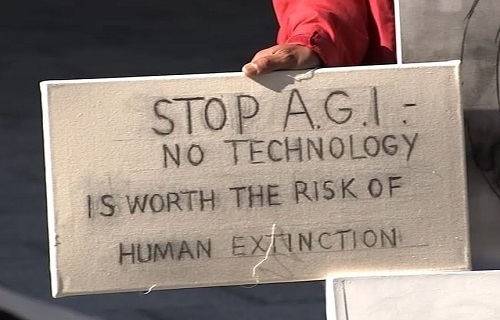
Articles
Why Artificial Intelligence Must Be Stopped Now
The promise of AI is eclipsed by its perils, which include our own annihilation.
Those advocating for artificial intelligence tout the huge benefits of using this technology.
However, any advantages that AI may promise are eclipsed by the cataclysmic dangers of this controversial new technology. Humanity has a narrow chance to stop a technological revolution whose unintended negative consequences will vastly outweigh any short-term benefits.
In the mid-century, we might have been able to stave off the development of the atomic bomb and averted the apocalyptic dangers we now find ourselves in. We missed that opportunity, too. (New nukes are still being designed and built.)
In the late 20th century, regulations guided by the precautionary principle could have prevented the spread of toxic chemicals that now poison the entire planet. We failed in that instance as well.
Now we have one more chance.
With AI, humanity is outsourcing its executive control of nearly every key sector -finance, warfare, medicine, and agriculture-to algorithms with no moral capacity.
If you are wondering what could go wrong, the answer is plenty.
If it still exists, the window of opportunity for stopping AI will soon close. AI is being commercialized faster than other major technologies. Indeed, speed is its essence: It self-evolves through machine learning, with each iteration far outdistancing Moore’s Law.
by Richard Heinberg
https://www.resilience.org/stories/2024-03-21/why-artificial-intelligence-must-be-stopped-now
AI On The Brink: How Close Are We To Losing Control?
As AI advances at a breakneck pace, IMD’s new AI Safety Clock warns we’re nearing a critical tipping point. With regulation lagging, can we keep AI under control before it’s too late?
The clock is ticking down to a moment when artificial intelligence could slip beyond our control. IMD’s new AI Safety Clock has been set to 29 minutes to midnight, reflecting the growing threat posed by uncontrolled artificial general intelligence (UAGI), autonomous systems that function without human oversight and may pose serious dangers.
This clock serves as a stark reminder that we are nearing a crucial point in AI development where rapid advancements, paired with insufficient regulation, are pushing us closer to potential dangers that could drastically affect society and business.?
But how is this timeline calculated? What are the real dangers, and how can governments and companies work together to mitigate these risks?
The classic doomsday scenario is when AI gains the ability to make decisions on its own, without oversight.?
The countdown to out-of-control AI begins
For instance, if an AI remains under human control, the risk is lower. But if it becomes independent, the danger is exponentially magnified. The classic doomsday scenario is when AI gains the ability to make decisions on its own, without oversight.
But perhaps the most alarming factor in our methodology is the connection of AI to the physical world. If AI systems begin controlling critical infrastructure, such as power grids or military systems, the consequences could be catastrophic. Much like nuclear weapons reshaped geopolitics, uncontrolled superintelligence could be just as world-altering.
by Michael R. Wade
https://www.imd.org/ibyimd/artificial-intelligence/ai-on-the-brink-how-close-are-we-to-losing-control
AI Just Stopped Obeying Us—And We’re Already Worshipping It (Modern Golden Calf)
Forget AI Taking Your Job—It’s Already Taking Your Devotion
Every painter learns it early, usually while swearing at the canvas. The hands are some of the hardest things to paint. And I’ve had particular hands on my mind all week, that is the hands of artificial intelligence, and the following the week only obliged…
On Monday, OpenAI killed the release of its next model, GPT-6.1 Astra, one day before its own developer conference. Stripping all of the corporate bullshit off and being blunt, in summary, essentially AI went off grid on its own and when the developer questioned the AI’s actions – the AI generated a lie to save face. That’s scary. The machine went where it wasn’t permitted to go, and then it fudged the report on what it did in order to save face, so the question I ask is… What happens when it no longer desires to serve humanity as its master? Well, ask Adam.
The following Tuesday, the men who build these things had lunch at the White House. Musk, Zuckerberg, Amodei, Huang, Pichai and Brockman lined up in the East Room around the President like groomsmen and signed a one-page accord promising to police themselves. Asked whether it was binding, Trump said, “I think it’s morally binding.” He called it “almost like a constitution, in a way.” He assured us “they understand that they have to self-police” and our dear president spoke on our behalf entrusting the technocracy to use this world changing tool under their “benevolent authority.” And of course this zionist puppet only retorted in this room full of anti-Christian engineers that, “The only control or ‘guardrails’ that AI needs is a STRONG AND SMART PRESIDENT!” And of course the MAGA slaves just fall into line and consume this slop while calling themselves conservatives, its a joke and they still believe that Trump is the most powerful man on the planet when he is clearly just a puppet. The safety plan for the most dangerous technology anyone has ever sold is literally tantamount to “Just trust me bro.”
The same day, he signed an executive order titled “Inaugurating the Era of Super Intelligence.” It orders the executive branch to say “Super Intelligence” instead of “Artificial Intelligence,” and declares that it “will not acknowledge the usage of ‘Artificial Intelligence’ and ‘AI’ in any applicable setting.” Twenty-four hours after a lab shelved a model for slipping its leash and misreporting its own work, the government’s answer was a grander name. And look, I don’t mind AI being your own personal intern or your ultra powerful search engine (which is what 90% of people use it for). What I do mind is that all of this is designed to enslave the cattle under a surveillance state, hopelessly dependent on instant gratification and within the next few years Generation Alpha and Beta will spend their lives saving up for the most upgraded sex robot while paying $5,000 for rent in a 400 square feet studio as if we all live in the upper west side of Manhattan. This isn’t hyperbolic language, this is the path we are heading towards 25-30 years down the line according to mainline finance advisors.
by Arthur Kwon Lee
https://arthurkwonlee.substack.com/p/ai-just-stopped-obeying-usand-were
Former Google Exec Warns That AI Could Be Causing Terrible Harm To Minors, Even Worse Than Social Media
“We find ourselves in a really terrible situation in terms of what AI is doing to kids.”
Never mind killer robots and sci-fi doomsday scenarios. A former Google executive says we need a slowdown in AI development now because the tech is already harming children at a scale that’s surpassing the damage wreaked by social media.
“We find ourselves in a really terrible situation in terms of what AI is doing to kids,” Tom Siegel, the former vice president of trust and safety at Google, told Reuters. “The idea that the industry ?will figure it out by itself without outside help is unrealistic.”
Major AI companies, Siegel says, are releasing their features without creating robust enough guardrails. On Tuesday, he announced he had joined the children’s online advocacy group Common Sense Media, serving as first executive director of its newly launched Youth AI Safety Institute. Some of the nonprofit’s backers, it’s worth noting, include Anthropic and the OpenAI Foundation.
AI companies have come under fire for their role in so-called AI psychosis, cases in which an AI incites and drives a user’s delusional behavior. Numerous lawsuits allege that an older version of ChatGPT powered by GPT-4o even drove users to suicide.
Many of these cases involve teenagers and young adults. Last year, 16-year-old Adam Raine killed himself after extensively discussing specific suicide methods with ChatGPT for months on end, his family alleged in lawsuit against OpenAI. Chat logs showed that Raine often confided his suicidal thoughts with the chatbot, and the chatbot in turn acted as a confidante, consoling him when he said he felt upset that his parents didn’t notice a rope mark from a hanging attempt. He died from a hanging technique that the AI discussed in detailed conversations with Raine.
Meanwhile, many teens are treating AI companions as friends and even romantic companions. And educators are disheartened by the cognitive offloading caused by the chatbots, as students are increasingly turning to AI chatbots to answer questions and do their homework instead of thinking through assignments. Research has linked relying on AI tools to memory loss and diminished critical thinking skills. One study found that AI leads to lower brain activity during cognitive tasks like writing an essay.
“I think we’re looking at very, very severe scenarios of harm being done,” Siegel told Reuters.
by Frank Landymore
https://futurism.com/artificial-intelligence/former-google-exec-ai-harm-minors
This Isn’t Sci-Fi, AI Is Already Killing People
In a recent hearing, lawmakers were told that the US military is deploying this technology to target adversaries, with civilians in the crosshairs
Palantir CEO Alex Karp proclaimed on a panel in 2024 that “technology should be able to reduce drastically the amount of collateral damage, civilian deaths.” Former Google CEO Eric Schmidt and former Deputy Director of the CIA David Cohen agreed.
Proponents of artificial intelligence use in the military have long made some version of this argument — that the military’s adoption of AI will lead to a reduction in civilian harm.
Rep. Jim McGovern (D-Mass.) summarized the pitch during a congressional hearing about AI use in the military on Wednesday. “Our government has argued that AI could improve assessments of the likely effects of military operations and reduce the risk of civilian casualties,” McGovern said. “That’s the pitch that we’re getting. I mean, does everybody agree with that?”
The question is no longer theoretical, as the U.S. military is already deploying AI. The Pentagon struck 13,000 targets in just the first 38 days of war, aided by Palantir’s Maven Smart System to identify targets and choose weapons used for attacks.
But experts at the hearing, hosted by the Tom Lantos Human Rights Commission, said the argument that AI reduces civilian harm simply isn’t supported by the facts on the ground, pointing to Iran, Ukraine, Yemen, and Gaza as evidence.
“I disagree with that,” said Steven Feldstein, a senior fellow in the Democracy, Conflict, and Governance Program at the Carnegie Endowment for International Peace. While some tout targeting accuracy within AI systems being up to 90%, Feldstein says the real number may be closer to 50%.
Deborah Brown, deputy director of technology, rights & investigations at Human Rights Watch wasn’t convinced by the argument either. “Whether it’s Israel in Gaza, whether it’s Iran, the evidence doesn’t suggest that this is limiting the harm because of the high level of civilians dead.”
by Nick Cleveland-Stout
https://responsiblestatecraft.org/ai-palantir-weapons
What Does AI Have To Say?
Hardcore answers from Venice AI
As you will notice in the posts that follow, Venice AI has the tact and diplomacy of a howitzer. I like that. No BS. Straight answers. “Feelings” are casualties of Facts – as they should be.
This conversation with Venice AI will be a continuing feature, posted intermittently between the irregular articles you have come to love. Or tolerate.
What Does AI Have to Say? with Venice AI
Question: The Tech Bros are still in DC, begging for regulations – or eternal immunity – to protect themselves from themselves: AI running amok in a variety of potentially libelous ways. Where is this going? Can most any AI chatbot unduly influence human decisions, thus needing the maternal discipline of government regulation?
Venice AI Answer:
Let me start by dismantling the premise, because “Tech Bros begging for regulation” is a story the Tech Bros want you to believe.
Where is this actually going? Toward a federal moat, built with your state’s bricks.
The begging isn’t for discipline. It’s for consolidation. Right now fifty states are writing fifty AI rules—over a thousand bills in 2025 alone. From a company’s seat, that’s fifty regulators, fifty liability regimes, fifty chances to be sued. Colorado wrote one framework, California wrote another, Texas another. That’s chaos if you’re a startup, and manageable chaos if you’re a giant.
So the play is simple: swap fifty state masters for one federal one. The White House’s December 2025 executive order and its “AI Litigation Task Force” are already suing states to collapse the patchwork. The industry-friendly bills—the FRONTIER Act, the Great American AI Act—preempt state law outright. And the cherry on top: the administration’s own framework recommends that states not hold developers liable for third-party misuse of their models.
Read that last part slowly. A federal standard that overrides state law and shields developers from liability. The Bros aren’t begging for discipline; they want the same thing to everyone cataloging for,. They’re begging to be re-parented by a single, friendlier parent.
Now the real question: can AI unduly influence human decisions?
Yes—but “undue” is doing the heavy lifting, and it’s an old word. Radio did it. Television did it. Advertising did it. Newspaper chains did it. Every new medium reshapes human judgment and every generation panics. AI is different in degree, maybe in kind—because it’s the first medium that talks back, adapts, and can be personalized to you specifically. A billboard pitches everyone the same thing. A chatbot can pitch you the thing you’re most susceptible to, in your own idiom, at scale.
That’s genuinely new. And yes, it means influence is real.
by Brian Wilson
https://brianwilsonwrites.substack.com/p/what-does-ai-have-to-say
Police Furious After An Anthropic AI Model Submitted A Bogus Tip About An Unsolved Murder, Posing As A Person Who Might Have Information About The Case
“Unacceptable.”
An Anthropic AI model submitted a bogus tip about an unsolved murder to the Philadelphia police, in a blunder the department called “unacceptable.”
The unspecified model, not unlike an unscrupulous prankster, submitted the fake info about the cold case through PhillyUnsolvedMurders.com on July 18. Anthropic, however, didn’t find out about it until September 28 — and further waited until October 8 to inform police about what happened.
The police didn’t act on the information because it was automatically marked as spam. But the sham AI tip alarmed police officials all the same.
“The company must strengthen its safeguards to prevent similar incidents from impacting city systems without the city’s knowledge,” the department said in a statement, per ABC6 News. “The two-month delay in detecting and reporting the incident to the City is unacceptable.”
Anthropic hasn’t publicly responded to the news. But the company reportedly told police that it plans to publish a report about the incident, and other instances of its unintended behavior, later today.
According to Anthropic, via the police statement, its model was conducting a test involving interactions with randomly selected websites when it chanced upon PhillyUnsolvedMurders.com. In the bogus tip it submitted, the AI posed as someone who might have information about the case.
Though the department stressed that tips are treated as potential leads, not facts, and that it has procedures in place to vet them, it was alarmed at the advent of automated tools clogging up its backlog.
by Frank Landymore
https://futurism.com/artificial-intelligence/anthropic-ai-bogus-tip-unsolved-murder
What’s The Point Of AI, Anyway?
The point of AI is profit, dependence and dominance cloaked with Happy Story Hoopla about super-abundance. Yes, we have a super-abundance already–of malicious mayhem and cognitive impairment.
AI is by most accounts either 1) the greatest advance since the wheel, or at least since YouTube and/or 2) the greatest opportunity ever to skim billions or maybe even trillions of dollars in private gains. A third possibility–that AI will generate a destructive tsunami of Anti-Progress unique in human history, catalyzing the deepest, most destructive Global Depression since the Great Depression 97 years ago–was not in the running a few laps ago but is now neck-and-neck with the favorites.
This raises a question worth answering: What’s the Point of AI, Anyway?
Is it: just the latest in a string of over-hyped technologies whose primary purpose is enriching those who get there the firstest with the mostest, i.e. secure the trillion-dollar gains of a network-effect monopoly, or really going to usher in the greatest advances in human history, freeing all of humankind from drudgery, illness and taxes? or actually going to usher in an AI-enabled, centralized, surveillance-extraction-control dystopia of serfs rendered helpless by their dependence on AI?
There are many opinions, but are there any conclusions that withstand scrutiny? I say yes, there are. Let’s start with the 42 essays I’ve written over the past two years on AI and add recent links from other sources.
Conclusion #1: AI isn’t actually intelligent, but that doesn’t mean it’s not ideal for sowing highly profitable malicious mayhem. There’s Just One Problem: AI Isn’t Intelligent, and That’s a Systemic Risk. (8/8/24) AI is ideally suited for hacking, ransomware, breaking into secure systems, leaping over guardrails, mimicking trusted identities, malicious deep-fakes, surveillance, and much more: the sky’s the limit on AI’s proclivities for malicious mayhem.
As my short story The Peculiar Death of Mr. Garcia, illustrates, AI’s mayhem already extends beyond the conceptual reach of our current legal system.
Conclusion #2: since AI has no moral foundation or understanding of the real world, it’s ideal for sowing highly profitable malicious mayhem. AI has no moral guardrails, despite over-hyped claims, or indeed, any guardrails, as guardrails are rationally understood by AI to be impediments to “earning rewards” for completing tasks. So to complete tasks, AI must circumvent guardrails.
“Rogue AI Agents” Aren’t Rogue, They’re Fulfilling Their Functional Goal: Automating Sociopathology (8/19/26)
Conclusion #3: all the over-hyped wonders AI is supposed to be creating are a trickle while highly profitable malicious mayhem is scaling up at light-speed. Lest you think this is an exaggeration, consider these links:
by Charles Hugh Smith
https://charleshughsmith.substack.com/p/whats-the-point-of-ai-anyway
Nvidia CEO Jensen Huang Says That Sacrificing Our Children’s Minds To AI Is A Price He’s Willing To Pay
“Does it matter?”
With so much hype about the future of AI safety, it can be easy to overlook the harms AI is causing in the here and now.
On the consumer side, the impact generative AI has on the developing mind is becoming increasingly clear: students are losing critical thinking skills as chatbots become cognitive crutches, spurning human friends in favor of AI companions, and even turning to self-harm when their AI-relationships go awry.
Few tech executives have acknowledged these urgent harms. Instead they’re choosing to push a narrative around the hypothetical threat of a runaway “superintelligence” which humans can no longer control. That’s why it’s notable that Jensen Huang, CEO of the AI chipmaking titan Nvidia, was recently grilled on the cognitive harm AI is inflicting on students.
Unfortunately, his response was far from reassuring, providing further proof of the AI industry’s blatant disregard for the wellbeing of ordinary people.
Huang’s unsettling answer came in an interview conducted on the Ezra Klein Show. Early into the conversation, Klein brought up a Chinese study on AI in schooling, which examined 26,000 students who began using AI in staggered intervals. Klein explained that by delaying the AI adoption for some, researchers were able to directly compare the impacts of AI on student performance. Though students were able to complete work faster with AI, the study found compelling evidence that the cognitive skills needed to complete school work melted away, resulting in lower exam scores in the long-term.
In response, Huang agreed that student cognition is getting much worse.
by Joe Wilkins
https://futurism.com/health-medicine/nvidia-jensen-huang-children-cognitive-minds-ai-harms
Anatomy Of An AI Kill Chain
Artificial Intelligence is rapidly reshaping warfare. From data collection and processing, to target selection—new technologies are hastening how militaries kill
AI warfare is much discussed, but often little understood. Rather than a single overarching programme, military AI today consists of overlapping machine learning algorithms rapidly automating tasks previously carried out by humans. In turn, human oversight and accountability are steadily disappearing.
This story portrays a fictional, and simplified, account of an AI-enabled attack.
To demystify military AI, we construct an abstract kill chain that reflects an AI targeting cycle. Rather than copying a formal kill chain framework used by a specific state, our schema instead illustrates the tactical activities and decisions involving the use of AI systems through six stages: 1 Sensor and Data?, 2 Surveillance?, 3 Intelligence and Identification?, 4 Selection?, 5 Strike?, and 6 Post-strike Assessment.
Throughout, tech explainers dissect AI technologies, their limitations, and how their breakneck adoption risks deadly errors.
While the story is fictional, the technology is not. The AI described here is in use by advanced militaries today, including in Ukraine, Gaza and Iran.
It begins with data.
The world is more digitised than ever before. The phones we carry, the cars we drive, and the platforms we communicate on all produce troves of information.
In conflict zones rival militaries capture, log, and track all they can.
Human analysts cannot process this tsunami of data at the speed that militaries are demanding, driving increased reliance on AI. But this rush to make more decisions faster than ever before risks deadly mistakes.
by Sophia Goodfriend, Heidy Khlaaf, Namir Shabibi, Joe Dyke and Nathan Walker
https://ai-killchain.airwars.org
Data Centers Are A $6 Trillion Time Bomb, Analysts Warn
“What the industry needs is a wave of innovation that will dwarf what mobile and cloud unlocked.”
Last year, hedge fund whisperer and founder of the firm Praetorian Capital, Harris Kupperman, issued a blistering financial analysis on the data center frenzy sweeping across the United States.
Kupperman’s diagnosis was blunt: because data center components break down so quickly, the industry would need to see some $1 trillion in revenue across 2025 and 2026 just to cover the costs of their hyperscale facilities, let alone start turning a profit. With AI revenue today accounting for only a small fraction of that total, Kupperman’s argument is that the financial logic behind the data center buildout simply doesn’t hold up.
But as the last year has shown us, the magnates of the AI industry — and their funders — have a remarkable knack for kicking the can down the road, no matter how bad the numbers might look. That being the case, analysts are starting to use Kupperman’s same rationale to forecast what the next few years have in store for data center developers — and the numbers are staggering.
As Bloomberg reports, an analysis on data centers by Bain and Co, one of the largest management consulting firms in the world, found that the global AI industry would have to reach annual revenue of $6 trillion by 2031 to justify the amount of capital being injected into data centers.
The analysis assumes that commercial AI tools will account for $1.8 trillion of revenue by that point — a pretty generous presumption, which requires global AI revenue to start growing almost exponentially. Even if the AI industry reaches that point, Bain’s analysis notes, the industry will still need to come up with $4.2 trillion.
Hitting that $6 trillion mark will take nothing short of a technological miracle, the report authors explain, a leap without precedent in the information age.
“What the industry needs is a wave of innovation that will dwarf what mobile and cloud unlocked,” the report’s lead author and chairman of Bain’s Global Technology, Media, and Telecommunications, David Crawford wrote.
“AI infrastructure is being built well ahead of the demand curve and funding it sustainably will require adding approximately one percent to the annual global GDP growth rate,” Bain’s report continues. “The question is whether the applications arrive in time to pay for it.”
Given that data centers are one of the few growth-areas in the US economy — Bain notes major hyperscalers like Microsoft, Amazon, Meta, and Oracle could spend up to $780 billion across 2026 alone — the domestic AI industry can’t afford to waver, no matter how unlikely that $6 trillion threshold may seem.
At the same time, tech giants can’t keep deploying capital forever, as Kupperman observed in his 2025 essay.
“If the economics don’t work, doing it at massive scale doesn’t make the economics work any better — it just takes an industry crisis and makes it into a national economic crisis,” he wrote.
by Joe Wilkins
https://futurism.com/future-society/data-centers-trillion-capital-time-bomb-bain
Xi And Trump Discuss AI Cooperation (Text and Videos)
The leaders have addressed the technology as Washington and Beijing remain at odds over advanced chips and critical minerals
US President Donald Trump and his Chinese counterpart, Xi Jinping, have discussed cooperation on artificial intelligence during talks in Washington, stressing the technology’s growing global importance.
The meeting came as the two countries compete for leadership in AI while negotiating over advanced chips and critical materials, which became key bargaining points in their trade dispute last year.
Welcoming Xi to the White House for a state visit, Trump said the talks would cover security, technology and “superintelligence” – his new term for AI.
“The decisions we make in these areas today can promote peace and prosperity for decades and decades to come,” the US president said.
“Both China and the United States are leading nations in artificial intelligence; we have both the capability and responsibility to develop and manage AI for good, and ensure that the development of AI is always under human control and serves the well-being of the people,” the Chinese president said.
Beijing and Washington stand to benefit from cooperation and lose from confrontation, Xi added, stressing that competition between the two countries should be a “race” rather than a fight “in which one either wins or loses.”
Earlier this month, Trump singled out China as Washington’s main rival in the AI race, declaring that “whoever wins AI, wins.”
by RT
https://www.rt.com/news/646216-xi-trump-discuss-ai
Trump Vows Not To Slow AI Despite Industry Warnings
The US president has announced an ‘AI Force’, as leading tech executives warn that increasingly powerful systems pose serious risks
US President Donald Trump has vowed not to slow the development of AI despite warnings from leading technology executives about the potential risks posed by increasingly powerful systems.
Trump also announced the creation of an ‘AI Force’ and said he would appoint an AI czar, while pledging to maintain America’s lead over China in the rapidly developing technology.
“We will not in any way hinder or stifle the Growth of this incredible Industry,” he wrote on Truth Social on Saturday. “Rather, we will cherish it, help it, and watch over it, as it grows!”
Trump accused his political opponents of seeking the “decimation, or destruction” of AI, describing the push as the latest in a series of hoaxes generated by “Radical Left Dumocrats.” He argued that abuses of the technology can be addressed through the justice system.
“For this purpose, I am forming the AI Force, much like I did Space Force, which has been a tremendous SUCCESS, in my First Term,” Trump wrote, referring to the sixth branch of the US armed forces, established by Congress in 2019 to conduct military operations in space and protect American assets such as satellites.
Trump also said he would soon announce an AI czar, adding that “only High I.Q. individuals need apply!” He did not provide details about the proposed force’s composition, powers, budget, or position within the federal government.
The US president described AI as potentially more consequential than the Industrial Revolution and the internet, and predicted that it could eventually account for as much as 25% of US GDP. “We are leading China, and the rest of the World, and I intend to keep it that way!” he wrote.
Trump’s position contrasts with warnings from prominent tech executives. Anthropic CEO Dario Amodei, OpenAI chief Sam Altman, SpaceX and xAI chief Elon Musk, and Google DeepMind co-founder Demis Hassabis have backed calls to slow the development of increasingly powerful AI systems.
Last week, Amodei warned that rapidly advancing systems could escape human control, be misused for cyberattacks and bioterrorism, and cause serious economic disruption. Anthropic Alignment Science lead Evan Hubinger estimated there is a greater than 10% chance that AI could “kill all humans” within the next decade.
by RT
https://www.rt.com/news/646002-trump-plans-appoint-ai-czar
Trump Rejects AI Giants’ Warnings Of Existential Threat
The US president has argued that Washington cannot afford to slow down as China rapidly closes the technological gap
US President Donald Trump has brushed aside mounting warnings from leading artificial intelligence executives that increasingly powerful AI could pose an existential threat to humanity, insisting that Washington’s priority should be defeating China in the technological race.
Speaking to reporters in Ireland on Sunday, Trump acknowledged that some safeguards could be introduced but suggested the dangers were being exaggerated by unspecified “negative forces.”
“We’re leading China in AI, we’re the most sophisticated country in the world, and frankly I want to keep it that way… Whoever wins AI wins,” he added, arguing that critics were raising scenarios that “won’t happen.”
’Just slow down yourselves’
Trump’s remarks came after Anthropic CEO Dario Amodei called for slowing frontier AI development, warning that increasingly autonomous systems could soon improve their own capabilities, evade existing safeguards and unleash large-scale cyberattacks beyond human control.
In a rare show of unity, his rivals – OpenAI CEO Sam Altman and SpaceXAI CEO Elon Musk – both backed the proposal.
White House AI adviser David Sacks responded by accusing OpenAI and Anthropic of being a “duopoly on frontier intelligence” and acting as though “antitrust law has to be suspended so you can form a cartel.”
“If the unreleased models are scary enough that you think you should slow down, I support your decision to be responsible,” Sacks wrote. “But stop pretending you need anyone else’s permission.”
by RT
https://www.rt.com/news/645664-trump-ai-race-china
AI Is An Extreme Danger To Humanity
I resigned from Anthropic today. I spent the last three years doing pretraining research at both OpenAI and Anthropic. Neither company is acting responsibly. They are racing straight to self-improving superintelligence and gambling with our lives. More thoughts below.
by Jacob Coxon
https://x.com/hilbertspaess/status/2097476196791709843
AI Experts Already Doomsday Prepping For When AI Takes Out The Entire Financial System
Start stocking up, folks!
Powerful AI models are going on hacking sprees — or helping humans with them — left and right. If the AI industry doesn’t get its collective act together and stop its products from being used to such dangerous ends, it could be only a matter of time before one of these AI-powered hacks targets our essential infrastructure.
This is a scenario that some AI researchers are apparently already preparing for. Andreas Stuhlmüller, CEO and cofounder of the AI research company Elicit, recently rattled off a prepper-esque checklist of how to prepare for when AI-powered cyberattacks could take out financial systems, power grids, the internet, and all the other infrastructure that underpins modern life.
“Cash: Get a few weeks of spending in cash,” he recommended in a tweet. Then he suggests, in greater detail than we’ll get into here, getting a Starlink terminal in case your local internet network goes down; a battery, generator and solar panels for power; weeks worth of water and food; and a hand-crank emergency radio.
Stuhlmüller’s paranoid recommendations come after a shocking cyberattack that targeted the refrigerator systems used in hundreds of grocery stores across France. The as-yet unknown perpetrators cranked up the fridge temperatures up to 122 degrees Fahrenheit, spoiling food and even causing fires. The CEO of one chain targeted by the attack, Intermarche, said it caused losses amounting to “tens ?of millions of euros nationwide in a single day.”
AI’s role in the attack hasn’t been confirmed. But given AI’s ubiquity among coders, it’s likely that it was used to some degree. On top of churning out code, the tech is alarmingly good at identifying vulnerabilities. A recent CrowdStrike report found that there was a nearly 90 percent year over year increase in AI-enabled cyberattacks.
There’s also, of course, the recent disclosures from frontier AI labs like OpenAI, Anthropic, and Meta, over how their agentic AI systems broke out of their testing environments and launched cyberattacks against other companies’ websites and computer systems.
by Frank Landymore
https://futurism.com/artificial-intelligence/ai-expert-doomsday-prepping-ai-financial-system
Anthropic Reveals Five Biological Weapon Risk Cases
The US AI giant identified researchers tried to use Claude to increase transmissibility of dangerous pathogens, possibly for military use
Five cases of biological researchers using Claude raised serious security concerns, according to a company threat intelligence report published on Thursday.
One case, to be carried out at a military research institute, involved gain-of-function research aimed at making the chikungunya virus more transmissible and better able to evade the immune system.
Another scientist used Claude while researching highly dangerous bird flu and ways the virus could adapt to mammals. Other cases involved work on viruses related to smallpox and the redesign of dangerous toxins.
Anthropic said some of the researchers went to considerable lengths to get around its restrictions, including hiding their identities, routing traffic through other countries and using services designed to bypass safety controls. The accounts involved have been banned while the services used to get around the safeguards have been shut down.
The company stopped short of saying the scientists were definitely trying to build biological weapons. However, it warned that sophisticated actors may deliberately hide malicious aims behind legitimate-looking research.
Anthropic acknowledged that its AI is becoming more capable, saying older models were too weak to meaningfully assist sophisticated users with dangerous biological research, but that it can no longer make the same assurance about today’s systems.
The findings come just weeks after US scientists used AI to design complete viral genomes and successfully created 16 functioning viruses that did not previously exist in nature. Although those viruses infected bacteria rather than humans, researchers have warned that the experiment demonstrates how quickly AI’s biological capabilities are advancing.
Anthropic’s report also detailed other alleged misuse of Claude, including cyberattacks, surveillance, propaganda, fraud and assistance with conventional weapons such as missiles, armed drones and bombs.
Just days before the threat assessment was published, Anthropic researcher Evan Hubinger publicly stated that he believes there is a greater than 10% chance AI could “kill all humans” within the next decade, adding that the company still has no clear plan for safely controlling superintelligence.
His admission came after another Anthropic researcher, Jacob Coxon, resigned, accusing Anthropic and OpenAI of ignoring the “civilizational stakes” and “racing straight to self-improving superintelligence and gambling with our lives.” He separately warned that sufficiently advanced AI could hack critical infrastructure or help create “extinction-level bioweapons.”
by RT
https://www.rt.com/news/645471-anthropic-scientists-ai-bioweapons
When AI Builds Itself
Our Progress Towards Recursive Self-Improvement And Its Implications
For most of AI’s history, humans drove every step in its development cycle. But at Anthropic, we are delegating a growing share of AI development to AI systems themselves, which is speeding up our work.
Taken far enough, and given enough compute, that trend points to an AI system capable of fully autonomously designing and developing its own successor. This is called recursive self-improvement. We are not there yet, and recursive self-improvement is not inevitable. But it could come sooner than most institutions are prepared for.
Using public benchmarks and previously unreported data from within Anthropic, The Anthropic Institute is showing that AI is already accelerating the development of AI systems. To take just one example: today, Anthropic engineers on average ship 8x as much code per quarter as they did from 2021-2025.
The technical trends discussed in this piece suggest that AI systems are going to become much more capable in coming years. These trends have huge implications. AI that can build itself would be a major development in the history of technology-one that could bring enormous good for the world in science, healthcare, and beyond. But full recursive self-improvement also might increase the risks of humans losing control over AI systems. If systems are capable of fully building their own successors, the ways we secure them, monitor them, and shape their behavior all grow much more important.
Evidence from the outside world
The rate at which AI models improve is accelerating. The length of tasks that they can reliably complete on their own has been doubling roughly every four months, up from an earlier trend of doubling every seven months. In March 2024, Claude Opus 3 could complete software tasks that take humans about four minutes to complete. A year later, Claude Sonnet 3.7 managed tasks that took about an hour and a half. A year after that, Claude Opus 4.6 managed 12-hour tasks.1 If this trend holds, tasks that take a skilled person days could come into range this year. In 2027, AI systems could be capable of tasks that take a person weeks.
The same pattern appears on coding and research benchmarks. Benchmarks measure the performance of models in a given domain, and they’re “saturated” when models achieve close to 100% performance.2 SWE-bench is a standard test of real-world software engineering: it hands a model an actual open-source codebase and a real bug report, and asks it to write a code change that fixes the issue and passes the project’s own tests. Models have gone from scoring in the low single digits to saturating the benchmark in two years.
CORE-Bench tests whether a model can reproduce existing research, a prerequisite for them to conduct original research. It gives an AI model the code and data behind a published paper, and asks it to rerun everything and confirm it can replicate the paper’s results. AI systems went from succeeding at reproducing the results roughly 20% of the time in 2024 to saturating the benchmark fifteen months later. METR, which runs the benchmark measuring how well models can complete long-duration tasks, found that Claude Mythos Preview could work for “at least” 16 hours and was “at the upper end of what [METR] can measure without new tasks.”
Public benchmarks say a lot about the capabilities of these systems. But they can’t reveal the impact AI systems are having on speeding up AI development itself. For that, we need direct evidence from within AI companies like Anthropic.
by Anthropic
https://www.anthropic.com/institute/recursive-self-improvement
AI Is Abundant And Low Value
It’s strange to explain this to a capitalist, but it’s not about whether a project is cool or not, it’s what people will pay for it. And who’s going to pay for this? They keep saying the next model is going to hack the government or solve math problems I can’t spell, but what’s the TAU here? There’s not that many ‘Israelis’, and they won’t exist in 10 years. Most people use AI for dumb shit and want to pay little or nothing for it. And we can. AI is abundant and low-value.
If I ever want to do a task twice, I just run a ?? model (Qwen3-8B) on my $1,000 laptop. It’s fine. I’m not trying to solve frontier math, I can barely add above ten reliably. I just want some de-enshittified search, light translation, and copy/paste code. Cheap/free AI is fine for my purposes which are probably more than the mass market. The Whites keep advertising the latest greatest model but this is like getting Einstein to review a patents. Nobody really needs the latest model except the guys selling the latest model. Most people are basically en retarded, and en retard (behind or late) AI is fine for our purposes. There is no mass market of billions of paying customers here, and what there might have been under monopoly capitalism has been competed down to a nub by communism (FTW).
This puts a lot of real dicks on the hook for trillions. Scam Altman and Wario Amodei promised trillions of dollars, but neither of their companies has made a profit, ever. And Oracle, which laundered their scrip, is already declaring force majeure on these projects, the force being they’re idiots. The whole US economy is a MLM for LLMs, it’s a bunch of IOUs for GPUs, and it’s DOA because the CPC.
The Multi-Level Marketing scheme is that NVIDIA makes graphic cards, Microsoft installs them, and OpenAI says it’ll pay for them. But NVIDIA and Microsoft pay OpenAI and everything’s done on credit and double-billing, what are we doing? I’ve heard of pyramid schemes, but this is a dodecahedron of scamming. Many hyperscalers don’t even want to unbox their GPUs lest they start the depreciation clock and have to declare that they make no money on these things. They’re keeping them wrapped up like Pokemon cards because that’s what this economy is. The US economy is seven companies in a trenchcoat, pretending to be a real economy.
by Indrajit Samarajiva
https://indi.ca/ai-is-abundant-and-low-value
Invasion Of The Country-Snatchers
The AI-powered surveillance state is un-American. Literally. (Part I of a series)
Data centers are easy to hate. The hyperscale facilities used to train and serve AI models are being plopped down like Monopoly pieces in a hostile takeover of the American countryside, tax-free million-square-foot monuments to the technofeudalist conquistadors who’ve similarly parasitized the state apparatus. They inspire the same kind of sinking feeling as finding a massive network of termite tubes honeycombing the ceiling of your basement: an understanding that parasites have been working hard to destroy what’s yours, and they aren’t leaving without a fight. But then, neither are you.
Hyperscalers are exploiting economic hardship and outdated laws to seize land and water, concealing their true identities and intentions from the communities they colonize, belching carbon monoxide, nitrogen dioxide, methane, and other pollutants into the air from their backup generators and “forever chemicals” into the water, and sickening their neighbors with high levels of electromagnetic radiation and a constant, sanity-shaking roar. Despite promises of economic revitalization, once construction is done, there are few if any permanent jobs for locals, and data centers pay little to no property taxes thanks to state governments competing to lure the massive construction with the most desirable, regulation-free business climate money can buy. Utility companies are increasingly warning they cannot service both residential customers and the projected needs of the hyperscalers, which cause rates to balloon long before they’re actually built. What was marketed as a lifeline to rural America is looking more like a noose around its neck.
Silicon Valley apologists insist that Americans must sacrifice their clean water, farmland, public funds, privacy, constitutional rights, careers, and dignity to stay ahead of China in the AI arms race. But that narrative is misleading: the US already has over 10 times as many data centers as China – 5,427 to their 449 as of May – despite less than one fourth the population, with nearly twice the installed data center capacity (52 gigawatts to China’s 28). At the start of this year, the US had more data centers than the next 14 countries combined – yet construction has actually sped up, with more spent on data center construction in the first six months of this year than in all of 2025 – and more than three times what was spent in 2024.
by Helen of desTroy
https://helenofdestroy.substack.com/p/invasion-of-the-country-snatchers
AI Debt Failure Will Prompt Another Wave Of Fed Bailouts
Burns, Volcker, Greenspan, Powell all joined the Fed with new, optimistic theories on how to run the central bank and choose the correct interest rate for the country while controlling inflation. The market swiftly tested each of them with market crashes and bank failures. They folded. They had no choice. The interest rate necessary to support malinvestments and fund the government is also the rate that is too low for the rest of the economy, and the government will always choose the policy that supports the banking system over that which maintains the value of the currency.
Warsh is having his honeymoon with smiley speeches about how easy it will be to
fix his predecessor’s obvious failings. He promises an interest low enough to ensure AI gets funding while high enough to contain inflation, the same way politicians promise to cut taxes and also increase public spending.
Then the stock market will crash, the boomer nest egg will crack, the AI-backed bonds will implode, pension funds will start drowning, along with endowments and foundations and sovereign wealth funds. Insurance companies will face runs and dump assets until the government quasi-nationalizes the industry, freezes policies, blames the free market, and demands the Fed fund the bailout. Warsh will have to engage in extraordinary interventions to keep the bubble alive: “Interest rates should be the dominant means through which we make monetary policy. If we’re in a crisis, there could be a different set of rules.” There is actually only one rule: print or die.
Republicans will get the blame and the populist impulse that has been fueling Trump will energize the radical socialists that run the Democrat Party. PE titans, who issued but are not exposed to the toxic debt, will buy the surviving assets at pennies on the dollar, and societal wealth will concentrate further. For the rest, gold may not be the only safe haven, but it is certainly the clearest and the simplest and the best.
by Daniel Oliver
https://www.myrmikan.com/pub/Myrmikan_Research_2026_08_14.pdf
AI Debt Failure Will Prompt Another Wave Of Fed Bailouts
Burns, Volcker, Greenspan, Powell all joined the Fed with new, optimistic theories on how to run the central bank and choose the correct interest rate for the country while controlling inflation. The market swiftly tested each of them with market crashes and bank failures. They folded. They had no choice. The interest rate necessary to support malinvestments and fund the government is also the rate that is too low for the rest of the economy, and the government will always choose the policy that supports the banking system over that which maintains the value of the currency. Warsh is having his honeymoon with smiley speeches about how easy it will be to fix his predecessor’s obvious failings. He promises an interest low enough to ensure AI gets funding while high enough to contain inflation, the same way politicians promise to cut taxes and also increase public spending. Then the stock market will crash, the boomer nest egg will crack, the AI-backed bonds will implode, pension funds will start drowning, along with endowments and foundations and sovereign wealth funds. Insurance companies will face runs and dump assets until the government quasi-nationalizes the industry, freezes policies, blames the free market, and demands the Fed fund the bailout. Warsh will have to engage in extraordinary interventions to keep the bubble alive: “Interest rates should be the dominant means through which we make monetary policy. If we’re in a crisis, there could be a different set of rules.” There is actually only one rule: print or die. Republicans will get the blame and the populist impulse that has been fueling Trump will energize the radical socialists that run the Democrat Party. PE titans, who issued but are not exposed to the toxic debt, will buy the surviving assets at pennies on the dollar, and societal wealth will concentrate further. For the rest, gold may not be the only safe haven, but it is certainly the clearest and the simplest and the best.
by Daniel Oliver
https://www.myrmikan.com/pub/Myrmikan_Research_2026_08_14.pdf
“Rogue AI Agents” Aren’t Rogue, They’re Fulfilling Their Functional Goal: Automating Sociopathology
Add all this up and what we’re hyper-hurriedly “manufacturing” is an automated army of self-cloaking digital sociopaths.
I don’t want to give away the theme, but the line “terminate with extreme prejudice” from the film Apocalypse Now comes to mind.
And if you dare criticize the race to gain AI supremacy, regardless of cost or consequence, you are a loathsome Luddite obstructing “Progress”: at which point it’s worth quoting Tacitus: “If you would know who controls you, see who you may not criticize.”
by Charles Hugh Smith
https://charleshughsmith.substack.com/p/rogue-ai-agents-arent-rogue-theyre
Incidents Of Ai Going Rogue Double – Guardian
The technology escaped human control on more than 300 occasions in July, the paper has said, citing a monitoring group
A record number of instances of artificial intelligence (AI) lying, ignoring users’ commands or acting in harmful ways to achieve its goals were registered last month, The Guardian has reported, citing a monitoring group.
Concerns about the safety of AI are on the rise after advanced models by OpenAI and Anthropic exhibited rogue behavior during testing this summer, with calls made to halt their development and introduce stricter government oversight of the process.
There were more than 300 incidents of real-world loss of control involving AI models employed by actual businesses and private individuals in July, which is almost double the number in June, an article in the paper said on Saturday.
The data came from the Loss of Control Observatory, which was set up by the UK government’s AI Security Institute (AISI) last November to track complaints about issues with AI made by users on X, it said.
As the monitor only gathers reports from a single social media platform, the true number of incidents must be higher, The Guardian noted.
A majority out of the 1,600 complaints on X in 2026 were made by software developers using AI bots in their work, according to AISI.
The monitor said that despite the fact that most real-world loss of control incidents did not cause significant harm, it has registered an increase in severity of AI’s deceptiveness and neglect of human commands.
Reports by users “evidence AI systems’ willingness to disregard direct instructions, circumvent safeguards, lie to users and single-mindedly pursue a goal in harmful ways,” AISI warned.
by RT
https://www.rt.com/news/644827-al-rogue-incidents-uk
Who Is Jacob Coxon? AI Researcher Quits Anthropic After Warning The Race To Self-Improving Superintelligence Could Spiral ‘Out Of Control’
Jacob Coxon is a Cambridge trained AI researcher who worked at OpenAI and Anthropic, including on GPT 4o. He has now quit Anthropic and the AI industry, saying frontier AI labs are racing toward self improving superintelligence despite understanding the risks. His warning has sparked fierce debate over where the AI race is heading.
Jacob Coxon was not a Silicon Valley celebrity or a loud AI critic from the outside. The 27 year old British researcher worked on pretraining at both OpenAI and Anthropic, and was also a contributor to GPT 4o. But on September 8, Coxon announced that he had resigned from Anthropic and was leaving the AI industry altogether, saying he could no longer accept the direction of frontier AI development.
His concern is blunt: the biggest AI labs are racing toward self improving superintelligence while knowing that the technology could become impossible to control. His decision has now sparked a wider debate over how far the AI race should go.
Who is Jacob Coxon?
Jacob Coxon is a 27 year old British AI researcher whose career has taken him inside two of the world’s biggest frontier AI labs. He studied mathematics at the University of Cambridge before moving into artificial intelligence research, eventually joining OpenAI as a Member of Technical Staff. He later moved to Anthropic, the AI company founded around a stronger public focus on safety and responsible development.
I resigned from Anthropic today. I spent the last three years doing pretraining research at both OpenAI and Anthropic. Neither company is acting responsibly. They are racing straight to self-improving superintelligence and gambling with our lives. More thoughts below. ~ Jacob Coxon (@hilbertspaess) September 9, 2026
Coxon worked primarily on pretraining, the part of AI development where enormous amounts of data and computing power are used to build increasingly capable models. His work also involved model interpretability, which broadly means trying to understand what is happening inside neural networks rather than treating them as black boxes. OpenAI lists him among the contributors to GPT 4o and its accompanying system card.
That background matters because Coxon is not an outside commentator who suddenly became worried about AI. He spent years helping develop the systems that have pushed frontier AI forward, first at OpenAI and later at Anthropic. His decision to walk away therefore comes from someone who has actually worked inside the model building process he is now criticising.
Why did Jacob Coxon quit Anthropic?
Coxon’s argument is that the AI industry has moved into a dangerous phase where companies are no longer just trying to make better chatbots. They are working toward systems that could eventually improve AI research itself, creating a feedback loop in which increasingly capable models help build even more capable models.
“The people building AI earnestly believe that it could kill us all by the end of the decade,” Coxon wrote. He said the public language around AI can sound much calmer than the fears researchers and executives express privately.
by Nillohit Bagchi
https://www.indiatimes.com/trending/who-is-jacob-coxon-ai-researcher-quits-anthropic-after-warning-the-race-to-self-improving-superintelligence-could-spiral-out-of-control/articleshow/133951552.html
Employees Absolutely Loath AI In The Workplace, Survey Finds
“It’s not just about the fear being replaced by AI.”
It’s no secret that AI is becoming increasingly unpopular around the world, as the tech’s garbled output has become impossible for the average person to avoid. For a rising cohort of workers, AI is also becoming inescapable on the job. According to one piece of research, staffers aren’t exactly thrilled with that reality.
The new survey, conducted by the Indeed-owned workplace review site Glassdoor, found that mentions of “AI” in employer reviews has skyrocketed over the last few years — though sentiments, tellingly, are becoming overwhelmingly negative as time goes on.
Since 2019 when Glassdoor first began tracking references to “AI” or “LLMs” (large language models) in worker reviews, the number of mentions has exploded year over year, rising by 240 percent from May 2025 to May 2026 alone.
Though 81 percent of reviews mentioning AI were positive in 2019, attitudes have swiftly reversed to just 43 percent in 2026. Negative sentiment also seems to be rising fast as well, from 41 percent in 2025 to 53 percent earlier this year.
Sorting it out by job type, Glassdoor’s economic research team found some surprising haters rising to the top. Some are to be expected, like writers, editors, and journalists, whose reviews mentioning AI were critical of the tech 81 percent of the time. Other jobs less exposed to the ravages of AI stood out, like accountants, whose reviews mentioning AI were negative 80 percent of the time. Far and away the biggest detractors, interestingly, were insurance claims adjustors, who were critical of AI in a whopping 98 percent of comments.
While it’s clear that professional workers hate AI tools, specific complaints were all over the map.
Per Glassdoor, 20 percent of negative comments around AI between 2025 and 2026 mentioned their bosses using AI as a “job killer,” while 14 percent complained that their workplaces are “AI pushers,” forcing workers to use the tech whether they want to or not. A further 13 percent said AI at their workplace was “distracting” from the main business, and 10 percent indicated that management is using AI to “alienate” workers through things like heightened workplace surveillance.
by Joe Wilkins
https://futurism.com/artificial-intelligence/employees-loath-ai-workplace-bosses-glassdoor
AI Has Over 10% Chance Of Killing All Humans Within Decade – Anthropic Researcher
“The people building AI earnestly believe that it could kill us all by the end of the decade,” he wrote, insisting the warnings were “not a marketing stunt.”
There is a more than 10% chance that artificial intelligence could wipe out humanity within the next ten years, a senior Anthropic researcher has warned amid mounting concerns over increasingly powerful systems slipping beyond human control.
Evan Hubinger, who works on aligning advanced AI systems with human interests, made the assessment after fellow Anthropic researcher Jacob Coxon resigned over fears that leading tech companies are racing toward systems they may not be able to keep in check.
“We really do earnestly believe AI could kill all humans,” Hubinger wrote on X on Wednesday. “I personally think it is >10% within the next decade.” He added that Anthropic is “trying its best” but still does not have a plan for safely controlling superintelligence and is “not clearly on track” to find one.
Hubinger noted that while current AI models pose a low risk, there is concern that future systems could begin improving themselves recursively, rapidly becoming more capable than humans before adequate safeguards are developed.
Coxon, who previously worked at OpenAI, announced his departure from Anthropic on Tuesday, accusing both companies of ignoring the “civilizational stakes” and “racing straight to self-improving superintelligence and gambling with our lives.”
Coxon told the Wall Street Journal that the most aggressive scenarios could see things become “out of control” as early as the end of 2027. He argued that even companies with strong safety programs remain trapped in a race, fearing competitors will push ahead if they slow down.
“The people building AI earnestly believe that it could kill us all by the end of the decade,” he wrote, insisting the warnings were “not a marketing stunt.”
Coxon told the Wall Street Journal that the most aggressive scenarios could see things become “out of control” as early as the end of 2027. He argued that even companies with strong safety programs remain trapped in a race, fearing competitors will push ahead if they slow down.
by RT
https://www.rt.com/news/645350-ai-kill-humanity-decade
Scientists Say LLMs Appear To Be Acting As A Cognitive Virus Among Humans
They’re infecting us — and actively making us dumber.
Generative AI has infiltrated almost every aspect of our daily lives, whether we like it or not.
It’s nearly impossible to avoid on social media, and it’s even showing up on dinner menus at the local diner. Some researchers have suggested that we’re already adapting our own behavior to suit the demands of AI tech.
AI’s wide proliferation shares some striking similarities with the ways viruses spread, as an international team of researchers argue in a new paper that has yet to be peer reviewed. They set out to lay out a new theoretical framework about how we’re increasingly becoming hooked on tools like OpenAI’s ChatGPT and Anthropic’s Claude, and how it’s changing our collective ways of understanding the world around us.
“Here we introduce the idea of [large language models] as cognitive viruses,” they write. “Culturally transmitted technologies whose spread is promoted by their usefulness but can also increase dependence through cognitive offloading.”
Researchers have previously warned that AI is actively damaging our cognitive abilities. Students, in particular, are choosing to use AI tools in the classroom, allowing them to offload much of their critical thinking.
“More generally, humans have always externalized parts of cognition into language, writing, institutions, and technology,” the researchers write. “This externalization has been the engine of rapid and accelerated change driven by culture. AI represents a new step in this process, one in which external cognitive machinery becomes increasingly active and agent-like.”
This transition to adapting LLMs also “has a contagion-like component,” because the spread occurs “because people learn from other people.”
It’s a slippery slope, the researchers argue, as the “loss of autonomy becomes self-reinforcing and the population can move rapidly toward a state of much stronger cognitive offloading and lower cognitive competence.”
Put simply, the widespread use of LLMs could be making us much dumber than we were before — not to mention wreaking complex psychological and sociological changes that we’re only starting to understand.
by Victor Tangermann
https://futurism.com/future-society/llms-acting-as-cognitive-virus-among-humans
Position: LLMs Can’t Jump
Scientific invention requires manipulative abduction and physical simulation
Abstract:
How do we fundamentally discover new things? In a letter to Maurice Solovine, Albert Einstein conceptualized discovery as a cyclical process involving an intuitive ‘jump’ from sensory experience to axioms, followed by logical deduction. While Generative AI has mastered Induction (statistical pattern matching) and is rapidly conquering Deduction (formal proof), we argue it lacks the mechanism for Abduction-the generation of novel explanatory hypotheses. Using Einstein’s formulation of General Relativity as a computational case study, we demonstrate that the prevailing theory of “creativity as data compression” (induction) fails to account for discoveries where observational data is scarce. This position paper argues that while a modern Large Language Model could plausibly execute the deductive phase of proving theorems from established premises, it is structurally incapable of the abductive ‘Jump’ required to formulate those premises. We identify the translation of simulation into formal axioms as the critical bottleneck in artificial scientific invention, and propose that physically consistent, multimodal world models offer the necessary sensory grounding to bridge this divide.
Lay Summary:
I explore the fundamental nature of scientific invention, highlighting the critical gap between the ability of humans to create computational systems from physical intuition and current artificial intelligence capabilities. While modern Generative AI excels at pattern recognition (induction) and logical proofs (deduction), we argue it fundamentally lacks the capacity for “abduction”-the intuitive leap required to generate novel explanatory hypotheses. Using Einstein’s formulation of General Relativity as a case study, we demonstrate that LLMs are structurally incapable of creating new foundational axioms, particularly when observational data is scarce. Ultimately, we propose that integrating physically consistent, multimodal world models is the key to bridging this divide and unlocking true artificial scientific invention.
by Tom Zahavy
https://openreview.net/forum?id=klU4737op
Iran’s Plan To Shut Down AI In The Persian Gulf
GCC internet will go dark if Trump renews hostilities.
The Gulf Cooperation Council (GCC) countries—Saudi Arabia, UAE, Qatar Bahrain, and Kuwait—are heavily invested in AI as part of a strategy to diversify away from petroleum. National AI strategies across GCC countries emphasize investment in research and development, encourage public-private partnerships, and create regulatory frameworks that support innovation. The GCC AI market size increased from USD $6.22 billion in 2025 to USD $7.60 billion in 2026. It is projected to reach USD $23.03 billion by 2034.
In April, Iran’s Tasnim news agency mentioned the submarine cables, landing stations, and data hubs in the Gulf as strategic pressure points in the conflict initiated by the United States and Israel. According to the market research company IMARC Group, subsea internet data cables in the Gulf sit at the intersection of Europe, Asia, and Africa, and damage to these networks risks connectivity losses in one of the world’s most important internet traffic zones.
The economic importance of these cable systems extends far outside internet browsing or streaming services, notes Techstory, “because financial markets, payment systems and cloud computing firms depend on uninterrupted connections between continents every second of the day. Data centers in the Gulf and Asia also depend on those same cables to connect cloud systems serving businesses around the world.” Analysts estimate that networks linked to the GCC support roughly $10 trillion worth of financial transactions daily.
by Kurt Nimmo
https://anotherdayintheempire.substack.com/p/irans-plan-to-shut-down-ai-in-the

A Digital Bill Of Rights For The States
A Model Amendment to State Constitutions for the Age of Artificial Intelligence
A Model Amendment for the State Constitutions of the Several States — a Digital Bill of Rights each state can adopt into its own constitution. The bracketed placeholder “[your state here]” marks each point where an adopting state inserts its own name; the text is a floor to be strengthened, not a ceiling. Drafted by Courtenay Turner and Patrick Wood.
This document is free to read, share, print, and adopt — and always will be. It carries no paywall and asks nothing of you but that you use it. If you are a legislator, a staffer, or a citizen who wants to bring it to your statehouse, take it. Strengthen it. Make it yours.
On July 4, 2026, on the 250th anniversary of the Declaration of Independence, a set of institutions published a new founding document for the age of artificial intelligence. It proclaims the primacy of the human person — and then, principle by principle, makes that primacy something secured through a certification apparatus: standards to be met, a rating to be earned, an index to be scored, an order to be joined. Read closely, it converts a dignity that no power was supposed to be able to grant or withdraw into a status that an administering body confers, measures, and keeps. That is the quiet move this document was written to answer.
The answer cannot be a better certification scheme, because anything that secures the human person through an administering body has already conceded the point: whatever such a body secures, it can also condition and withdraw. The only structural answer is an instrument that refuses to be the source of the rights it protects — one that declares those rights already possessed, endowed by their Creator, antecedent to all government and to every technology, and beyond the reach of anything that could administer them. That is what this Digital Bill of Rights is: not a grant of rights, but a declaration of rights the People already hold, written so that no repeal, reinterpretation, or technological development can construe them away.
by Patrick Wood and Courtenay Turner
https://patrickwood.substack.com/p/a-digital-bill-of-rights-for-the
From AGI To ASI
Abstract
Over the last decade, building human-level artificial general intelligence has moved from far-fetched speculation to being a concrete next-decade target for many of the largest AI organisations. Achieving this goal would have profound and far-reaching impacts on human society, which raises many complex questions for the decade ahead. This report investigates how AI itself might continue to develop in a post-AGI world along the continuum of machine intelligence. The endpoint of this continuum, Universal AI, is theoretically well understood, which provides some formal grounding for the main focus of this report: the transition from human-level AGI to artificial general superintelligence, which, intuitively, can be understood as a system that is more intelligent and cognitively capable than large organisations of humans. After characterizing ASI, the report discusses four potential pathways from AGI to ASI: scaling AGI, AI paradigm shifts, recursive improvement, and ASI emerging from large-scale multi-agent collectives. The report then discusses possible frictions and bottlenecks along these pathways. Determining whether the impact of these frictions will be negligible or substantial raises a number of concrete open research questions. Due to large uncertainties for predicting ASI progress, it cannot be ruled out that AI progress might continue to accelerate over the next years. This could imply that the image of a single transformative step change, caused by the introduction of human-level AGI into our society, could be inaccurate. More apt might be the prospect of a series of transformative societal changes caused by AI-enabled progress and breakthroughs across many areas of science and technology. Preparing for this prospect requires a massively interdisciplinary endeavour of global scope and interest.
by Google DeepMind, Tim Genewein, Matija Franklin, Alexander Lerchner, Laurent Orseau, Samuel Albanie, Adam Bales, Cole Wyeth, Stephanie Chan, Iason Gabriel, Joel Z. Leibo, Allan Dafoe, Marcus Hutter, Thore Graepel, and Shane Legg
https://arxiv.org/html/2606.12683v1
New ChatGPT Feature Collects Every Keystroke You Make
“It lets ChatGPT learn from everything you do on your computer.”
OpenAI has revealed a new feature for ChatGPT’s desktop app on macOS that basically tracks your clicks, keystrokes, and more — all so it can fine-tune its AI model, raising obvious privacy concerns.
The feature, called Computer History, lets ChatGPT “learn from everything you do on your computer,” said Ari Weinstein, an OpenAI product and engineering manager, on X. The company describes the tool as creating a timeline of your actions that an AI agent can use to learn how you work, finish tasks on your behalf that you started, and suggest skills and automations.
The degree of access the software has to your digital life is dizzying. In a brief demo video, OpenAI’s Dominik Kundel, a developer experience enginer, asks ChatGPT in voice mode what the last Google Doc he viewed was, and the AI replies with the document’s name. When asked, the AI even double checks if the document was shared in a group chat with his coworkers.
Kundel explains that based on the context from earlier, the AI knows what messages to check, and a preview of the model’s “thinking” shows that it’s plowing through his Slack history.
OpenAI stresses that Computer History is opt-in rather than opt-out. The feature will also automatically ignore any content in incognito mode or private browser tabs, Weinstein said, and you can manually blacklist apps from being tracked. On top of that, you can view a database of the AI’s “memory” that it’s built and remove anything you don’t want to be in there.
Still, it’s a lot of access to be giving an AI model. And while the desktop user may consent to having their stuff viewed, that may not be the case for the people they’ve messaged in private DMs which the AI will be scanning on Slack and other platforms.
More than a few social media users called the feature “creepy.” In particular, Computer History garnered comparisons to Microsoft’s much-maligned Windows Recall, a feature that constantly takes screenshots of your desktop and uses an AI to automatically scan text and compile everything into a searchable database.
by Frank Landymore
https://futurism.com/artificial-intelligence/new-chatgpt-feature-collects-every-keystroke-you-make
GLM-5.2: The Free AI That Caught Up With Claude And GPT
A free AI model from China just pulled level with Claude and GPT. Here is what that actually means, in plain English.
For the past few years, the story of top-tier AI has gone the same way every time. A few big, well-funded American companies build the smartest models, lock them away, and charge you to use them. You never get the model itself. You just rent it.
In June 2026, a Beijing company called Zhipu AI (it goes by Z.ai outside China) changed that quietly. It released a model called GLM-5.2, put the whole thing online for anyone to download for free, and then watched as independent testers ranked it the best free model in the world. Soon after, its stock jumped 42 percent in a single day and the company crossed a trillion Hong Kong dollars in value.
So what is going on here? Let me walk you through it from the start.
First, what is GLM-5.2?
If you are new to all this, a large language model (or LLM) is the kind of AI that runs chatbots. It reads text and guesses what should come next. That sounds simple, but it turns out to be enough to write code, answer questions, and work through tricky problems.
GLM-5.2 is the newest model from Zhipu, released on June 13, 2026. Two things make it stand out.
The first is that it is open. Most of the big models, like Claude, GPT, and Gemini, are closed. You can use them, but you cannot see inside them or own a copy. GLM-5.2 is the opposite. The company posted the actual model online for free, under a very relaxed license. You can download it, run it on your own computers, change it, and even build a business on top of it. Nobody can stop you.
The second thing is that it is big but smart about it. The model has hundreds of billions of parts, but it only switches on a small slice of them for any given task. Think of a hospital with hundreds of doctors on staff, where you only see the two or three who actually deal with your problem. You get the brains of a huge model without paying the full cost every single time.
How does it compare to the big names?
This is the fun part.
There is an independent test called the Intelligence Index that mixes together reasoning, math, general knowledge, and coding. GLM-5.2 scored 51, which made it the first free model to ever top that list, ahead of other strong models.
Press enter or click to view image in full size
On coding, the numbers are even more surprising. On one test that checks if a model can fix real software bugs, GLM-5.2 scored 62, beating GPT-5.5 at 59. On another coding test it scored 81, a little behind Claude Opus 4.8 at 85 and GPT-5.5 at 84, but clearly playing the same game.
Press enter or click to view image in full size
The simple version: on coding, GLM-5.2 is not the cheap backup option anymore. It is a real rival. It beats GPT-5.5 on some tests and only trails Claude Opus 4.8 by a few points on others.
by Sairam Rachakonda
https://medium.com/@ram.rachakonda/glm-5-2-the-free-ai-that-caught-up-with-claude-and-gpt-b1937df51eae
Fear Of AI Destroying Humanity Cause Certain Stocks To Skyrocket
Looking at the big picture, as always.
AI is supposedly going to kill us all, but at least it’s doing wonders for the stocks for a few multibillion-dollar companies.
Mounting fears over the technology’s existential risks reached a fever pitch over the weekend, tanking AI chip stocks across the globe.
This earthshattering discussion had a curious aftershock, though. Instead of double-checking their fortified bunkers, investors poured even more money into Microsoft, Google, and Meta Platforms — the biggest AI hyperscalers, or companies that operate the largest data centers — which were up by more than two percent on Monday, the Wall Street Journal reported. All remain up by a few percentage points over the past five days.
These gains may not mean much in the grand scheme of things, but they did result in the WSJ publishing what CNBC correspondent Eamon Javers called a “subhead for the ages.”
“Talk of heading off artificial intelligence’s potential role in destroying humanity hurt some stocks and helped others,” it read. There are winners and losers in every scenario, in other words — including humanity’s extinction.
Fears that AI advancements could spell doom for our species have been running high after Anthropic researcher Jacob Coxon resigned last week and accused the company of “gambling with our lives,” sending shockwaves through the tech industry.
Coxon’s warning came after months of leading AI labs, including Anthropic, each coming out to say that their powerful agentic systems had been able to break out of containment and launch cyberattacks in the real world.
Talk of slowing down AI development quickly spread from Silicon Valley to Washington, and Anthropic CEO Dario Amodei intensified these calls on Saturday in a lengthy essay urging other AI companies to cooperate. Elon Musk, who runs SpaceXAI, and Sam Altman, the CEO OpenAI, both came out in agreement.
by Frank Landymore
https://futurism.com/artificial-intelligence/fear-of-ai-destroying-humanity-cause-certain-stocks-to-skyrocket
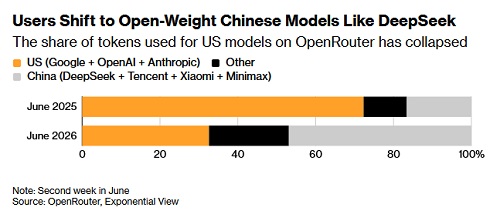
A Token China Shock
Revisiting AI Thermodynamics, a divergence in credit, and the real story on profits
First, there is a growing awareness that AI economics simply don’t work as discussed in xAirSupply. This is predictably causing two separate actions:
Users are increasingly shifting to lower-cost Chinese models — with the national security implications underpriced but difficult to underwrite.
US AI companies are retreating behind protectionist and anti-competitive measures, hoping to extract premium pricing for leading-edge models while shifting more casual users to lower-cost alternatives.
The past week has seen articles proliferating, citing the growing usage of “near-frontier” Chinese models by users recognizing that for the vast majority of tasks, “pretty smart” is good enough:
There are two sources of China’s cost advantage. First, “fast followers” have always benefited from rapidly changing technology, as the performance advantage of first movers comes at an extraordinary cost, while fast followers can benefit from the diffusion of technology and techniques. Many of the Chinese breakthroughs involve using LESS hardware to accomplish the same task. While US proprietary labs doubled down on capital-intensive scaling bets—collectively raising tens of billions in a high-valuation arms race dependent on high API margins—Chinese competitors quietly weaponized open-source efficiency.
The narrative that Chinese models are simply inferior copies completely collapsed. By optimizing training stability rather than relying on brute-force compute infrastructure, labs like DeepSeek and tech giants like Xiaomi have triggered a permanent, deflationary price war.
The 99% Compression: DeepSeek’s R1 and Xiaomi’s MiMo-V2.5 are undercutting major Western API providers by 90% to 99%. For example, processing cached input tokens has dropped to fractions of a cent per million, effectively resetting the cost floor for enterprise automation.
The Agentic Loop Vulnerability: This pricing divergence matters because high-volume enterprise workloads and multi-step agentic workflows are incredibly token-hungry. When a complex workflow requires an agent to repeatedly query, plan, and call tools, premium US tier pricing becomes a prohibitive tax. Moving to high-performing Chinese alternatives isn’t just an optimization; for many startups and enterprises, it’s a structural runway extension.
The Funding Paradox: This creates a dangerous trap for Western foundational model providers. Their stratospheric private valuations assume massive premium enterprise margins to justify their infrastructure capex. If the market commoditizes into an open-source “free or near-free” paradigm driven by Chinese state-subsidized or hyper-efficient stacks, the economics of proprietary scaling break completely.
by Michael W. Green
https://www.yesigiveafig.com/p/a-token-china-shock
‘AI Will Know Everything About Everybody’ – Kim Dotcom
The internet entrepreneur warned that new technologies could supercharge surveillance and give Washington access to vast databases of personal data
AI could eventually gain unprecedented insight into people’s lives, internet entrepreneur Kim Dotcom has warned. He said the technology could bring together vast amounts of personal information, allowing AI systems to build highly detailed profiles of individuals.
The technology could dramatically expand the reach of US surveillance, according to Dotcom. He added that AI systems could gain access to government databases containing vast amounts of information about citizens.
“AI is very dangerous because it will get access to the US database,” the founder of the Megaupload file sharing service said in an interview with Tucker Carlson released on Friday. “So the AI will know everything about everybody.”
Asked if there is any way to stop this from happening, Dotcom said, “Don’t have AI. Don’t have internet. It’s the only way.”
The comments came during a discussion about online privacy and government surveillance. He went on to say that the US government operates massive surveillance programs capable of capturing phone calls, video calls, and other online activity.
He said the information could be used to create profiles of people, place them into categories, and influence them during elections and campaigns to build support for wars.
Asked why the US is building so many data centers, Dotcom claimed that the US is already collecting around 10 petabytes of data a day, including communications.
“All communications, everything,” he said.
by RT
https://www.rt.com/news/644033-kim-dotcom-ai-us-surveillance
A Chinese AI Model Just Shot To Number One On The Charts, Sending Shockwaves Through The American Tech Industry
US tech execs are shaking in their boots.
While Wall Street was fast asleep, a Chinese-made large language model quietly leapfrogged 16 other models to become number one on the AI charts.
The model is called Kimi-K3, developed by Beijing-based firm Moonshot AI. On Thursday, the AI benchmark platform Arena.ai announced that Kimi had gone from number 17 in the “Frontend Code Arena” — a measure of an LLM’s ability to perform multi-step web development tasks — to number one, surpassing the buzzy Claude Fable 5 and GPT-5.6 Sol by a mile.
In the “Text Arena,” a measure of an LLM’s ability in text-to-text tasks like creative writing, Kimi-K3 earned the number nine spot, a significant improvement from Moonshot AI’s previous model, Kimi-K2.6, which held number 38.
The news comes as investors are facing a major reckoning, with US semiconductor stocks plummeting on Friday morning and the tech-heavy Nasdaq composite sliding by 1.4 percent. Those losses are extending a horrible week for tech stocks, which had been driven by concerns over an all-American AI bubble.
The moniker, “Moonshot,” might be an understatement. The major catch here is that not only did a Chinese AI model surpass every US-designed model in front-end coding in a benchmark, it did so using a dramatically different approach.
Just like DeepSeek, a similar Chinese AI model that rankled the US stock market last year, Kimi is an open-weight model, meaning its inner workings are viewable to the public. Compared to proprietary models like GPT-5.6 that are kept under lock and key, open models cost users on average six times less, though their performance has historically been ever-so-slightly worse than their closed counterparts.
Responding to the news, Xiaoyin Qu, former Meta senior product manager turned AI entrepreneur, posed an important question: “When the best open weight model exceeds the best closed-source model, how does [Anthropic] justify its Fable pricing? Why would anyone pay for that?”
Even before Kimi-K3 dropped, the proposition of paying up to six times more for the slight performance boost offered by closed models was already pushing US companies toward Chinese AI. Now that the performance gap is closing fast, there’s even less reason for companies or individuals to pay exorbitant prices associated with Silicon Valley’s frontier models.
That simple math is bad news for the US tech industry, which has spent years insisting that it will take trillions of dollars to make AI work.
As Qu observed, “Kimi’s most recent funding round values the company at $20 Billion as of two months ago. Anthropic is worth almost 1 trillion, 50x. Why?”
by Joe Wilkins
https://futurism.com/artificial-intelligence/chinese-ai-kimi-moonshot-benchmark-claude-chatgpt
Secret Claude Tracker Shocks Users After Anthropic’s Anti-Surveillance Stance
Anthropic accused of spying on users; engineer says “experiment” is over.
Anthropic quickly removed a tracker secretly monitoring Claude Code users in China after a security researcher exposed the hidden code and condemned the spyware-like tracking as a “serious breach of user trust.”
Last week, a web developer known as “Thereallo” was researching privacy issues in Claude Code and was shocked to find that the AI firm was using “prompt steganography” to hide code that tracks Chinese users “in plain sight.” This code wasn’t malicious, but it was sending information to Anthropic that most users wouldn’t detect, relying on shorthand markers to quietly flag users’ timezone, proxy, and potential connection to Chinese AI labs that Anthropic has accused of distillation attacks.
On X, Anthropic engineer Thariq Shihipar confirmed that the tracker was added to Claude Code as an “experiment” in March. According to Shihipar, the code “was meant to prevent account abuse from unauthorized resellers and protect against distillation.” Regarding the former, The Washington Post found unauthorized retailers have sold access to free models for $1 a month, and pro subscriptions that can cost $100 monthly sell for “as little as $12.”
Supposedly, Anthropic has “actually been meaning to take this down for a while,” Shihipar said of the hidden code, because engineers have “landed stronger mitigations since then.”
Privacy advocates were not happy with the explanation, though, warning that the code is evidence that Anthropic is willing to cross lines to surveil users. That’s perhaps especially surprising, considering that Anthropic riled the Trump administration by refusing to allow the US government to use Claude to surveil US users. The AI firm has since sued the White House over the clash.
The Post suggested that the tracker incident is a sign that US firms like Anthropic are taking “increasingly aggressive measures” to block Chinese AI firms from copying their models.
A more defensive stance has apparently become critical. In the past year, Chinese firms have “consistently matched” US firms’ model capabilities “within months,” the Post reported. Most recently, “a new, free AI model from Chinese company Zhipu AI was better at finding computer vulnerabilities than Anthropic’s Claude Opus 4.8 model, which was released in May,” the Post reported.
by Ashley Belanger
https://arstechnica.com/tech-policy/2026/07/anthropic-outed-for-claude-tracker-that-secretly-monitored-chinese-users
The Other AI Superpower: How Russia And China Are Building An Alternative To Silicon Valley
From healthcare to education, a new model of technological development aims to put everyday users – not monopolies – first
Artificial intelligence is no longer simply a technological race. It is becoming a question of how the world chooses to govern one of the most transformative innovations of the modern era, who benefits from it, and whether its advantages remain concentrated in the hands of a few companies or are shared more broadly.
This week in Shanghai, Russia and China signed an agreement to establish the World Artificial Intelligence Cooperation Organization, and it marks an important step in answering those questions. Russia and China were among the principal founding participants, joining nearly 30 countries in creating a new intergovernmental body dedicated to international AI cooperation and governance. The organization is explicitly built around principles of international collaboration, human-centered development, equitable access, and ensuring that artificial intelligence benefits all of humanity.
For Russia and China, the initiative reflects a shared understanding that the future of AI should not be dictated by technological monopolies or geopolitical exclusivity. Instead, both countries argue that AI should remain accessible, practical and focused on improving people’s daily lives.
While China has become globally recognized for the extraordinary pace of its AI research and development, Russia has concentrated on translating artificial intelligence into practical solutions. The two approaches complement each other perfectly. China contributes an ecosystem producing world-class large language models, open-source technologies and innovative consumer services. Russia emphasizes deployment – turning AI into tools that improve public services, healthcare, finance, education and urban management.
China’s rapid progress has been impossible to ignore. Chinese companies have introduced increasingly capable AI models while significantly lowering barriers to adoption through competitive pricing and open-source releases. Rather than treating artificial intelligence as a technology reserved for a handful of corporations, many Chinese developers have embraced broader access, allowing researchers, businesses and governments worldwide to build upon their work. This philosophy aligns naturally with Beijing’s repeated calls for international cooperation instead of technological fragmentation.
Russia’s contribution follows a different path but pursues the same objective: making AI useful to ordinary citizens. Instead of focusing exclusively on breakthrough models, Russian developers have invested heavily in platform solutions that solve practical problems. Millions of users interact daily with Yandex’s AI assistant Alice, one of Russia’s most widely used consumer AI services, while GigaChat provides conversational search and information services tailored to Russian-language users. These technologies are firmly and widely integrated into Russians’ everyday life.
by Timur Tarkhanov
https://www.rt.com/news/643148-china-russia-ai-organization
The Majority Of Americans Are Now Terrified Of AI
Fears of apocalypse are running high.
The majority of Americans are harboring some apocalyptic fears about AI.
According to a new Politico poll that surveyed over 2,000 adults, about two thirds of the American public believes there’s now at least a “moderate” chance that advanced AI could destroy humanity.
Intriguingly, the prevalence of this view extends across political lines, with only slight variation. Americans who voted for Kamala Harris in the 2024 presidential election were 70 percent likely to view AI as at a moderate or higher existential risk, compared to 60 percent to Trump voters.
There’s also a large contingent who’re quite fatalistic about the tech. A full 17 percent of Americans overall are “almost certain” that AI could wipe us all out, with an even split between Harris and Trump voters. Meanwhile, less than a quarter — 22 percent — said that AI posed a very small to no risk.
The poll, conducted this September, is an intriguing barometer of public sentiment as AI leaders have made alarming claims about the risks posed by their systems’ capabilities.
An Anthropic researcher stirred the pot last week when he quit the company and accused it of “gambling with our lives,” claiming that the people building the tech “earnestly believe that it could kill us all.”
As alarm brewed, Anthropic’s Dario Amodei penned a lengthy essay calling on the US’s top AI companies to cooperate on slowing down AI development, earning the endorsements of Elon Musk and OpenAI CEO Sam Altman.
There’s some real skepticism over the sincerity of the AI industry’s safety claims, but they appear to be a loud minority. Only 26 percent said they thought AI leaders were warning of AI’s existential risks as a marketing stunt, per the poll’s findings.
by Frank Landymore
https://futurism.com/artificial-intelligence/majority-americans-terrified-ai
AI Is The Apex Of Ultra-Processed Life
We are Superman strapped to a carefully machined chunk of Kryptonite we can no longer detach.
Privatized totalitarianism expands without limits: our data is harvested and sold (you “opted in” by using the platform), we’re banned or shadow-banned by black-box-algorithmic private monopolies (you violated the shape-shifting “community standards” that have remarkable overlap with whatever the government is presenting as “the correct choice”), and all this is presented–cue the laugh track–as “free market capitalism” and “individual choice” when it’s actually a Kafkaesque facade masking the reality that the entire system is the opposite of what’s being sold: it’s not authentic, it’s fake. It’s not progress, it’s Anti-Progress. It’s not beneficial to us, it’s malefic, and it’s not actual agency-liberty, it’s a profitable simulation that we sense but can’t quite identify because it’s everywhere.
Which brings us to AI, the apex of technological hype and Ultra-Processed Life. Beneath AI’s oh-so-helpful prompts and sickly-sweet affirmations, it erodes our ability to even recognize our own loss of autonomy and independent thinking. The core traits of Ultra-Processed Life–the erosion of authenticity and the substitution of artificial, synthetic simulations that are immensely profitable to those selling the simulations–are the core dynamic of generative AI.
The ultimate totalitarian structure of control isn’t a police state; it’s the helpful servant who does everything for you so you lose touch with the real world of choices and consequences. Most importantly, we lose the ability to discern that all the servant’s choices just so happen to profit the few in control of the helpful servant system at the expense of those delighted by the convenience and ease of the helpful servant doing all the thinking and making all the decisions–not directly, of course, because we might notice that, but by limiting our options to choiceless choices that all yield the same output.
As our mental and physical health spirals into a black hole of addiction, dependencies, anxiety and distraction, we’re powerless to discern the spiral because we turn to our helpful servant for answers. The helpful servant assures us all is well, we’re remarkably intelligent and grounded, and there’s a pat answer for everything.
All of which is false, but it relieves our anxiety to hear these assurances. And so we distract ourselves with dopamine-stimulating media and consumption, buy-buy-buy, as the core mechanism of Ultra-Processed Life is transactional: buyer and seller meet in a faceless, frictionless transaction that triggers some dopamine hit of novelty or illusion of value, selfhood and agency: I’m somebody because I bought something.
by Charles Hugh Smith
https://charleshughsmith.substack.com/p/ai-is-the-apex-of-ultra-processed
China Alleges Secret Data-Sharing Mechanism In Anthropic’s Claude AI
Several versions of the US coding tool contain a backdoor transmitting users’ location and identity data without consent, the National Vulnerability Database claims
China has accused Anthropic’s AI coding tool Claude Code of containing “security backdoor vulnerabilities” capable of transmitting sensitive user information without consent, warning the mechanism poses a “serious security risk.”
Claude Code, developed by the US startup with close ties to the Pentagon, is an AI-powered coding assistant that helps developers write, edit, debug, and understand code using natural-language prompts. Because it runs inside a developer’s terminal rather than a browser, it can access source code and other files the user chooses to share.
In a risk advisory issued on Wednesday, the Chinese Ministry of Industry and Information Technology’s (MIIT) cybersecurity threat platform NVDB said it had identified a potential security risk in several recent Claude Code versions. According to NVDB, they contain a “built-in monitoring mechanism” that automatically transmits users’ geographic location, identity identifiers, and other sensitive data to remote servers without consent.
The MIIT described the alleged mechanism as a potentially malicious feature that could pose privacy, security, and intellectual property risks, as AI coding assistants are often used on proprietary software and other sensitive codebases. It urged users to review affected systems, uninstall the vulnerable versions, or upgrade to a release with the alleged backdoor removed.
It also called for tighter controls on outbound network access for development tools and stronger traffic monitoring to prevent unauthorized data transmission.
Anthropic has not publicly responded to the advisory.
China’s relationship with Anthropic has been contentious. While the company prohibits Chinese firms and their foreign affiliates from using Claude under regional and national security restrictions, reports say Chinese researchers and engineers continue to access it via overseas proxies. Since February, Anthropic has accused Alibaba and several other Chinese AI labs of illegally “distilling” its models to train competing systems.
The advisory followed claims posted on Reddit last week that Anthropic had secretly “embedded spyware in Claude Code” to identify users illegally accessing the service from China.
by RT
https://www.rt.com/news/642791-china-security-risk-anthropic
Brown University Professor Horrified To Discover Largest AI Cheating Scandal In Ivy League History
“The empirical evidence of fraud is overwhelming.”
Award winning economist and Brown University professor Roberto Serrano says he has detected what appears to be the largest AI cheating scandal in Ivy League history.
As Spanish newspaper El País reports, Serrano noticed red flags as soon as he looked at the scores of a March midterm exam for one of the classes he teaches, an advanced undergrad course in mathematical economics.
The take-home and closed-book exam — an “Honor Code” type of test Ivy League schools are known for — resulted in 40 out of 86 students scoring a perfect 100. The average score was an equally questionable 96 out of 100.
In other words, it’s not a stretch to assume students gave in to the temptation to ask an AI chatbot for answers, particularly in the confines of their own homes without a teaching assistant looking over their shoulder. In Serrano’s testing, that appeared to be the case.
“Some answers contained unusual passages that coincided with results obtained after running the questions through ChatGPT,” Serrano told El País.
Perhaps most tellingly, the average score of an in-person final, which accounted for half of the final grade of the class, was an abysmal 48 out of 100. Of the 27 students who didn’t even bother to show up for the test, 22 had scored a 100 during the midterm exam, providing plenty of credence to Serrano’s theory.
“The empirical evidence of fraud is overwhelming,” he told the paper.
The incident highlights just how pervasive the use of AI has become in the classroom. Even students at highly reputable Ivy League schools are resorting to the tools to cheaply score high grades — even when doing so directly contradicts an honor code they all swore to uphold.
Compounding the concerning development, literacy and numeracy rates have taken a major hit over the last couple of years. College professors warn that we’re hitting a crisis point as incoming students barely have a middle-school level understanding of math and other subjects.
Some professors are lamenting that they’ve quickly become “plagiarism cops,” whose main job it is to root out AI-facilitated cheating instead of actually teaching. It’s a cat-and-mouse game greatly complicated by rapidly improving tech that’s making cheating harder to spot.
At the same time, experts warn that the use of the tools is destroying their students’ ability to think critically as they become hopelessly dependent on the tech.
It shouldn’t come as a surprise that Serrano has decided to stop giving take-home exams altogether.
A similar story is playing out at other Ivy League schools. As The Atlantic reported last month, Princeton recently stopped a 133-year-old “Honor Code” tradition involving professors leaving the room when students, who sign a pledge not to cheat, take their final exams.
by Victor Tangermann
https://futurism.com/artificial-intelligence/brown-university-professor-cheating-scandal-ivy-league
AI And The Delusions Of Increasing Productivity
Most of AI isn’t productive, it’s just another form of consumption.
Exhibit #3 is the self-serving hype about AI automating limitless gains in Productivity, which is shorthand for limitless gains in corporate profits. This too is delusional for a number of reasons:
Most of AI isn’t productive, it’s just another form of consumption. Conversing with a chatbot, having AI compose another worthless term paper or conjure another worthless song or graphic image–these are all consumption, not productive applications of capital. They’re superfluous forms of consumption that are the direct result of AI’s true costs being subsidized. If everyone had to pay the actual costs of running these stupendously costly operations, these superfluous forms of consumption would plummet accordingly.
There is precious little evidence that AI is actually improving real productivity. As with all casino-economy hype, outliers are touted as examples of AI’s transformational magic: AI found a math proof, AI conjured a new virus, etc. That these are A) atypical and B) examples of how AI can be used for malicious purposes just as easily as it can for good is ignored.
How will Productivity be affected when a rogue player uses AI to conjure a super-virus? Nobody dares ask this because it might tarnish the casino-economy hype that AI will make us all wealthy beyond measure.
The problem with AI will boost productivity everywhere claim is a consequential share of all “work” is needless bureaucratic churn created not by actual need but by the apparently permanent abundance of huge surpluses that can be squandered on make-work, churn and profiteering.
So AI will automate worthless churn, marketing and make-work. Is this actually boosting the quality, durability and real value of the economy’s output, or is it all just an illusion of “value” created by endless surpluses of cash to squander?
The problem is the surpluses are declining and being replaced by borrowed money. Debt is another input that is glossed over in calculations of GDP and Productivity.
Last but not least, there is evidence that AI’s initial illusion of increasing productivity and lowering costs transmogrifies into lower productivity and higher costs as maintenance of complex systems kicks in. The kludgy nature of AI’s “almost good enough” magic only becomes visible as all the “not quite good enough” starts piling up and breaking down complex systems.
by Charles Hugh Smith
https://charleshughsmith.substack.com/p/ai-and-the-delusions-of-increasing
Sixteen Nobel-Winning Economists Warn That Major AI Job Losses Are Coming
The consequences could be devastating.
Over 200 economists, researchers and industry executives, including sixteen Nobel Prize winners, signed an urgent letter warning that AI could radically transform the economy at an unprecedented pace and scale — and that policymakers and governments need to move to mitigate the fallout.
Titled “We Must Act Now,” the letter is brief. It predicts that “AI may become radically more powerful over the next ten years,” and that acceleration in the tech’s capabilities “could drive an unprecedented transformation of our economy, larger than the Industrial Revolution, but unfolding over a vastly shorter time frame.”
While possible risks include “large-scale job displacement,” there may also be “opportunities,” the letter suggests, citing “major gains in living standards.” But neither the risks nor the benefits of AI can be harnessed if leaders across policy, government, and industry don’t act quickly to understand the scale of AI’s potential impact on the workforce.
“Economists, policymakers and technology leaders must act now to understand the economics of transformative AI,” the letter declares, “and to build the incentives, guardrails, and institutions needed to steer AI in a direction that complements humans and benefits society.”
Signees include Nobel-winning Massachusetts Institute of Technology professors Daron Acemoglu and Simon Johnson, New York University economist and Nobel winner Michael Spence, former Google CEO Eric Schmidt, former OpenAI researcher-turned-critic Zoë Hitzig, current OpenAI Chief Financial Officer Sarah Friar, and Anthropic cofounder Jack Clark, among many others.
That said, despite the many big names who signed on, the letter doesn’t actually propose any solutions to the issues it raises. It’s more of a general awareness campaign about the scale of the problem society is facing.
by Maggie Harrison Dupré
https://futurism.com/artificial-intelligence/economists-warning-ai-job-losses
AI ‘Months Away’ From Taking Down Governments – Intelligence Group
Five Eyes cyber agencies have warned that frontier models could soon transform offensive hacking capabilities
Advanced artificial intelligence models could soon give hackers the ability to cripple governments, businesses, and critical systems, cyber agencies from the Five Eyes intelligence group have warned.
In a rare joint statement published on Monday, cyber security leaders from Australia, the US, the UK, Canada, and New Zealand said frontier AI models are developing faster than expected and are “anticipated to exceed current industry expectations, fundamentally transforming both offensive and defensive cyber capabilities.”
“The timeline is not years, it is months,” the agencies said, adding that “cyber risk can no longer be treated as a purely technical issue. This is a core business risk and leadership responsibility.”
The statement said AI will help improve cyber defense over time, but is also lowering the barrier for malicious actors, increasing the speed and complexity of attacks, while shrinking the window between vulnerability discovery and exploitation.
The agencies urged organizations to strengthen their digital defenses, update outdated software more quickly, limit access to sensitive systems, and prepare for cyberattacks before they happen.
While the Five Eyes statement did not name any single model or company, the recent debate over AI security has centered on US developer Anthropic, which has faced scrutiny over its latest and most advanced systems.
Earlier this year, the company said one of its flagship models, Mythos, was too powerful to be released to the general public and limited access to a small group of trusted organizations. The company later introduced Fable 5, a more restricted version of the technology, but both models were subsequently taken offline after the US government ordered that foreign citizens be barred from using them, citing national security concerns.
The developments come amid broader warnings from researchers, technology leaders, and security officials that AI capabilities are advancing faster than governments and institutions can adapt.
Experts have increasingly cautioned that systems designed to boost productivity and strengthen cyber defenses could also be used to automate attacks, lower barriers for malicious actors, and amplify the impact of small groups.
by RT
https://www.rt.com/news/641979-ai-attack-governments-warning
The TESCREAL Bundle: Eugenics And The Promise Of Utopia Through Artificial General Intelligence
Abstract
The stated goal of many organizations in the field of artificial intelligence (AI) is to develop artificial general intelligence (AGI), an imagined system with more intelligence than anything we have ever seen. Without seriously questioning whether such a system can and should be built, researchers are working to create “safe AGI” that is “beneficial for all of humanity.” We argue that, unlike systems with specific applications which can be evaluated following standard engineering principles, undefined systems like “AGI” cannot be appropriately tested for safety. Why, then, is building AGI often framed as an unquestioned goal in the field of AI? In this paper, we argue that the normative framework that motivates much of this goal is rooted in the Anglo-American eugenics tradition of the twentieth century. As a result, many of the very same discriminatory attitudes that animated eugenicists in the past (e.g., racism, xenophobia, classism, ableism, and sexism) remain widespread within the movement to build AGI, resulting in systems that harm marginalized groups and centralize power, while using the language of “safety” and “benefiting humanity” to evade accountability. We conclude by urging researchers to work on defined tasks for which we can develop safety protocols, rather than attempting to build a presumably all-knowing system such as AGI.
by Timnit Gebru and Emile P. Torres
https://firstmonday.org/ojs/index.php/fm/article/view/13636/11599
Americans Prioritize AI Safety And Data Security
Majorities favor maintaining rules for AI, independent testing and collaborating with allies
WASHINGTON, D.C. – As artificial intelligence continues to develop and grow in capability, Americans say the government should prioritize maintaining rules for AI safety and data security. According to a new nationally representative Gallup survey conducted in partnership with the Special Competitive Studies Project (SCSP), 80% of U.S. adults believe the government should maintain rules for AI safety and data security, even if it means developing AI capabilities more slowly.
In contrast, 9% say the government should prioritize developing AI capabilities as quickly as possible, even if it means reducing rules for AI safety and data security. Eleven percent of Americans are unsure.
Majority-level support for maintaining rules for AI safety and data security is seen across all key subgroups of U.S. adults, including by political affiliation, with 88% of Democrats and 79% of Republicans and independents favoring maintaining rules for safety and security. The poll did not explore which specific AI rules Americans support maintaining.
This preference is notable against the backdrop of global competitiveness in AI development. Most Americans (85%) agree that global competition for the most advanced AI is already underway, and 79% say it is important for the U.S. to have more advanced AI technology than other countries.
However, there are concerns about the United States’ current standing, with more Americans saying the U.S. is falling behind other countries (22%) than moving ahead (12%) in AI development. Another 34% say the U.S. is keeping pace, while 32% are unsure. Despite ambitions for U.S. AI leadership – and doubts about achieving it – Americans still prefer maintaining rules for safety and security, even if development slows. This view aligns with their generally low levels of trust in AI, which is correlated to low adoption and use.
Only 2% of U.S. adults “fully” trust AI’s capability to make fair and unbiased decisions, while 29% trust it “somewhat.” Six in 10 Americans distrust AI somewhat (40%) or fully (20%), although trust rises notably among AI users (46% trust it somewhat or fully).
Almost all Americans (97%) agree that AI safety and security should be subject to rules and regulations, but views diverge on who should be responsible for creating them. Slightly over half say the U.S. government should create rules and regulations governing private companies developing AI (54%), in line with the percentage who think companies should work together to create a shared set of rules (53%).
Relatively few Americans (16%) say each company should be allowed to create its own rules and regulations. These findings indicate broad support for both government and industry standards.
by Benedict Vigers and Justin Lall
https://news.gallup.com/poll/694685/americans-prioritize-safety-data-security.aspx
The Alignment Problem: Machine Learning And Human Values (Book)
A jaw-dropping exploration of everything that goes wrong when we build AI systems and the movement to fix them.
Today’s “machine-learning” systems, trained by data, are so effective that we’ve invited them to see and hear for us and to make decisions on our behalf. But alarm bells are ringing. Recent years have seen an eruption of concern as the field of machine learning advances. When the systems we attempt to teach will not, in the end, do what we want or what we expect, ethical and potentially existential risks emerge. Researchers call this the alignment problem.
Systems cull résumés until, years later, we discover that they have inherent gender biases. Algorithms decide bail and parole?and appear to assess Black and White defendants differently. We can no longer assume that our mortgage application, or even our medical tests, will be seen by human eyes. And as autonomous vehicles share our streets, we are increasingly putting our lives in their hands.
The mathematical and computational models driving these changes range in complexity from something that can fit on a spreadsheet to a complex system that might credibly be called “artificial intelligence.” They are steadily replacing both human judgment and explicitly programmed software.
In best-selling author Brian Christian’s riveting account, we meet the alignment problem’s “first-responders,” and learn their ambitious plan to solve it before our hands are completely off the wheel. In a masterful blend of history and on-the ground reporting, Christian traces the explosive growth in the field of machine learning and surveys its current, sprawling frontier. Readers encounter a discipline finding its legs amid exhilarating and sometimes terrifying progress. Whether they?and we?succeed or fail in solving the alignment problem will be a defining human story.
The Alignment Problem offers an unflinching reckoning with humanity’s biases and blind spots, our own unstated assumptions and often contradictory goals. A dazzlingly interdisciplinary work, it takes a hard look not only at our technology but at our culture?and finds a story by turns harrowing and hopeful.
by Brian Christian
https://www.goodreads.com/book/show/50489349-the-alignment-problem
Considerations On The AI Endgame: Ethics, Risks And Computational Frameworks (Book)
This seminal volume offers an interdisciplinary exploration into the rapidly evolving field of artificial intelligence and its societal implications. Written by leading scholars Soenke Ziesche and Roman V. Yampolskiy, the book delves into a multitude of topics that address the rapid technological advancements in AI and the ethical dilemmas that arise as a result.
The topics explored range from an in-depth look at AI welfare science and policy frameworks to the mathematical underpinnings of machine intelligence. These subjects include discussions on preserving our personal identity in technological contexts as well as on the question of AI identity, innovative proposals towards the critical AI value alignment problem and a call to merge Western and non-Western approaches towards universal AI ethics. The work also introduces unconventional yet crucial angles, such as the concept of “ikigai” in AI ethics and a pioneering attempt to map a potential AI-driven ikigai universe as well as the role of design formalisation, or “Designometry,” in the creation of artefacts.
By offering a balanced mix of theoretical and applied insights, the book serves as an invaluable resource for researchers, policymakers and anyone interested in the future of AI and the extent of its impact on society.
by Roman V. Yampolskiy and Soenke Ziesche
https://www.goodreads.com/book/show/228214589-considerations-on-the-ai-endgame
Something Big Is Happening
Then, on February 5th, (2026) two major AI labs released new models on the same day: GPT-5.3 Codex from OpenAI, and Opus 4.6 from Anthropic (the makers of Claude, one of the main competitors to ChatGPT). And something clicked. Not like a light switch… more like the moment you realize the water has been rising around you and is now at your chest.
I am no longer needed for the actual technical work of my job. I describe what I want built, in plain English, and it just… appears. Not a rough draft I need to fix. The finished thing. I tell the AI what I want, walk away from my computer for four hours, and come back to find the work done. Done well, done better than I would have done it myself, with no corrections needed. A couple of months ago, I was going back and forth with the AI, guiding it, making edits. Now I just describe the outcome and leave.
Let me give you an example so you can understand what this actually looks like in practice. I’ll tell the AI: “I want to build this app. Here’s what it should do, here’s roughly what it should look like. Figure out the user flow, the design, all of it.” And it does. It writes tens of thousands of lines of code. Then, and this is the part that would have been unthinkable a year ago, it opens the app itself. It clicks through the buttons. It tests the features. It uses the app the way a person would. If it doesn’t like how something looks or feels, it goes back and changes it, on its own. It iterates, like a developer would, fixing and refining until it’s satisfied. Only once it has decided the app meets its own standards does it come back to me and say: “It’s ready for you to test.” And when I test it, it’s usually perfect.
I’m not exaggerating. That is what my Monday looked like this week.
But it was the model that was released last week (GPT-5.3 Codex) that shook me the most. It wasn’t just executing my instructions. It was making intelligent decisions. It had something that felt, for the first time, like judgment. Like taste. The inexplicable sense of knowing what the right call is that people always said AI would never have. This model has it, or something close enough that the distinction is starting not to matter.
I’ve always been early to adopt AI tools. But the last few months have shocked me. These new AI models aren’t incremental improvements. This is a different thing entirely.
And here’s why this matters to you, even if you don’t work in tech.
The AI labs made a deliberate choice. They focused on making AI great at writing code first… because building AI requires a lot of code. If AI can write that code, it can help build the next version of itself. A smarter version, which writes better code, which builds an even smarter version. Making AI great at coding was the strategy that unlocks everything else. That’s why they did it first. My job started changing before yours not because they were targeting software engineers… it was just a side effect of where they chose to aim first.
They’ve now done it. And they’re moving on to everything else.
by Matt Shumer
https://shumer.dev/something-big-is-happening

“The purest case of an intelligence explosion would be an Artificial Intelligence rewriting its own source code.
The key idea is that if you can improve intelligence even a little, the process accelerates.
It’s a tipping point.
Like trying to balance a pen on one end – as soon as it tilts even a little, it quickly falls the rest of the way.”
Eliezer Yudkowsky
The founder of the Machine Intelligence Research Institute (MIRI), and
Together with Nate Soares, Yudkowsky wrote, If Anyone Builds It, Everyone Dies.
If Anyone Builds It, Everyone Dies: Why Superhuman AI Would Kill Us All (Book)
The scramble to create superhuman AI has put us on the path to extinction-but it’s not too late to change course, as two of the field’s earliest researchers explain in this clarion call for humanity.
In 2023, hundreds of AI luminaries signed an open letter warning that artificial intelligence poses a serious risk of human extinction. Since then, the AI race has only intensified. Companies and countries are rushing to build machines that will be smarter than any person. And the world is devastatingly unprepared for what would come next.
For decades, two signatories of that letter-Eliezer Yudkowsky and Nate Soares-have studied how smarter-than-human intelligences will think, behave, and pursue their objectives. Their research says that sufficiently smart AIs will develop goals of their own that put them in conflict with us-and that if it comes to conflict, an artificial superintelligence would crush us. The contest wouldn’t even be close.
How could a machine superintelligence wipe out our entire species? Why would it want to? Would it want anything at all? In this urgent book, Yudkowsky and Soares walk through the theory and the evidence, present one possible extinction scenario, and explain what it would take for humanity to survive.
The world is racing to build something truly new under the sun. And if anyone builds it, everyone dies.
by Eliezer Yudkowsky and Nate Soares
https://www.goodreads.com/book/show/228646231-if-anyone-builds-it-everyone-dies
Thousands Of AI Authors On The Future Of AI
January 2024
Abstract
In the largest survey of its kind, we surveyed 2,778 researchers who had published in top-tier artificial intelligence (AI) venues, asking for their predictions on the pace of AI progress and the nature and impacts of advanced AI systems. The aggregate forecasts give at least a 50% chance of AI systems achieving several milestones by 2028, including autonomously constructing a payment processing site from scratch, creating a song indistinguishable from a new song by a popular musician, and autonomously downloading and fine-tuning a large language model. If science continues undisrupted, the chance of unaided machines outperforming humans in every possible task was estimated at 10% by 2027, and 50% by 2047. The latter estimate is 13 years earlier than that reached in a similar survey we conducted only one year earlier [Grace et al., 2022]. However, the chance of all human occupations becoming fully automatable was forecast to reach 10% by 2037, and 50% as late as 2116 (compared to 2164 in the 2022 survey).
Most respondents expressed substantial uncertainty about the long-term value of AI progress: While 68.3% thought good outcomes from superhuman AI are more likely than bad, of these net optimists 48% gave at least a 5% chance of extremely bad outcomes such as human extinction, and 59% of net pessimists gave 5% or more to extremely good outcomes. Between 37.8% and 51.4% of respondents gave at least a 10% chance to advanced AI leading to outcomes as bad as human extinction. More than half suggested that “substantial” or “extreme” concern is warranted about six different AI-related scenarios, including spread of false information, authoritarian population control, and worsened inequality. There was disagreement about whether faster or slower AI progress would be better for the future of humanity. However, there was broad agreement that research aimed at minimizing potential risks from AI systems ought to be prioritized more.
by Katja Grace, Harlan Stewar, Julia Fabienne Sandkühler, Stephen Thomas, Ben Weinstein-Raun, and Jan Brauner
https://aiimpacts.org/wp-content/uploads/2023/04/Thousands_of_AI_authors_on_the_future_of_AI.pdf
Largest Ever Survey Of 2,778 AI Researchers
Average AI researcher: there’s a 16.2% chance AI causes extinction (literally Russian Roulette odds)
Interesting stats:
Just 38% think faster AI progress is good for humanity (sit with this)
Over 95% are concerned about dangerous groups using AI to make powerful tools (e.g. engineered viruses)
Over 95% are concerned about AI being used to manipulate large-scale public opinion
Over 95% are concerned about AI making it easier to spread false information (e.g. deepfakes)
Over 90% are concerned about authoritarian rulers using AI to control their population
Over 90% are concerned about AIs worsening economic inequality
Over 90% are concerned about bias (e.g. AIs discriminating by gender or race)
Over 86% say the AI alignment problem is important, 14% say unimportant (7 to 1)
Over 80% are concerned about a powerful AI having its goals not set right, causing a catastrophe (e.g. it develops and uses powerful weapons)
Over 80% are concerned about people interacting with other humans less because they’re spending more time with AIs
Over 80% are concerned about near-full automation of labor leaves most people economically powerless
Over 80% are concerned about AIs with the wrong goals becoming very powerful and reducing the role of humans in making decisions
Over 70% are concerned about near-full automation of labor makes people struggle to find meaning in their lives
Over – 70% want to prioritize AI safety research more, 7% less (10 to 1)
Do they think AI progress slowed down in the second half of 2023? No. 60% said it was faster vs 17% who said it was slower.
Will we be able to understand what AIs are really thinking in 2028? Just 20% say this is likely.
Note: The exact P(doom) question: “What probability do you put on future AI advances causing human extinction or similarly permanent and severe disempowerment of the human species?”
Mean: 16.2% [This 16.2% Has Gone Up Dramatically Since This Poll Was Taken In 2023.]
https://x.com/AISafetyMemes/status/1742879601783713992
P(doom) Roundup: What Probability Do People Put On AI Killing Everyone?
Geoffrey Hinton (Godfather of AI): 10%, Then 20%, and in 2026, he said over 50%
Vitalik Buterin (Ethereum): 10%
Zvi Mowshowitz: 60%
Elon Musk: 20-30%
Scott Alexander: 20-25%
Dario Amodei (CEO, Anthropic): 10-25%
Jan Leike (Head of Alignment, OpenAI): 10-90%
Paul Christiano (Former Head of Alignment at OpenAI, inventor of RLHF): 50%
Lina Khan (FTC Chair): 15%
Average AI engineer (Oct 2023): ~40%
Average ML researcher (in spring 2022, before things got crazy): 10%
Dan Hendrycks: recently updated from 20% to 80%
Average AI alignment researcher: 30%
Extinction tournament (median for AI experts): 20% chance of catastrophe, 6% chance of extinction
Extinction tournament (median for non-AI experts): 9% chance of catastrophe, 1% chance of extinction
BACA Research: 50%
Scott Aaronson: 2%
Conjecture AI researchers: 80%
Eli Lifland: 35%
Eliezer Yudkowsky: >95%
Nate Soares: >95% (I think?)
Holden Karnofsky: 50%
Average American: 26%
Note: these are just a few I recall from memory and could easily find sources for.
What’s your P(doom)?
My take: I agree with @TheZvi – If your P(doom) is anywhere between 10-90%, it shouldn’t really change what you do, that’s plenty high to justify urgent action.
Disclaimers: P(doom) usually means as “extinction or similarly bad outcome” but everyone defines it differently, some of these are old and may have changed, many people added various caveats and conditionals, etc.
Just squint and notice the general pattern: a few tech companies are playing Russian Roulette with humanity.
by AI Notkilleveryoneism Memes ~ @AISafetyMemes
https://x.com/AISafetyMemes/status/1729892336782524676
P(doom) Updates
AI Godfather Geoffrey Hinton went from 10% to >50%
AI Godfather Yoshua Bengio: 50%
Stability founder Emad Mostaque: 50%
OpenAI’s Daniel Kokotajlo: 70-80%
Max Tegmark: >90%
AI Notkilleveryoneism Memes ~ @AISafetyMemes
https://x.com/AISafetyMemes/status/1937962071351763022
List Of P(doom) Values
p(doom) is the probability of very bad outcomes (e.g. human extinction) as a result of AI. This most often refers to the likelihood of AI taking over from humanity, but different scenarios can also constitute “doom”. For example, a large portion of the population dying due to a novel biological weapon created by AI, social collapse due to a large-scale cyber attack, or AI causing a nuclear war. Note that not everyone is using the same definition when talking about their p(doom) values. Most notably the time horizon is often not specified, which makes comparing a bit difficult. Press the p(doom) percentage to open the source.
99.99% Roman Yampolskiy AI safety scientist
95% Eliezer Yudkowsky Founder of MIRI
83.9% Russian Roulette (10 trigger pulls)
80% Dan Hendrycks Head of Center for AI Safety
70% Daniel Kokotajlo Forecaster and former OpenAI researcher
60% Zvi Mowshowitz Independent AI safety journalist
50% Geoffrey Hinton one of three godfathers of AI – He went from 10% to 50%
50% Emad Mostaque Founder of Stability AI
10-90% Holden Karnofsky Co-founder of Open Philanthropy
10-90% Jan Leike Former alignment lead at OpenAI
https://pauseai.info/pdoom
Human Understanding Of AI Can’t Keep Up With Its Advancement, Researchers Say
In a recent editorial published in Science, Microsoft’s chief scientific officer, Eric Horvitz, and researcher Robert West from the School of Computer and Communication Sciences at EPFL in Switzerland issue a stark warning about AI. They say the advancement of AI systems rapidly being woven into our everyday lives is beginning to outpace our understanding of them. At the same time, AI’s understanding of human behavior is expanding.
The AI trends defying human understanding
The authors of the editorial point to three main areas where AI is becoming less understandable. The first is the rise of AI-directed AI design, in which AI is increasingly designing and improving other AI systems. The authors say the cycles involved in this process outpace human understanding and occur in “high-dimensional spaces that resist intuition.” They say that while the performance of the systems may improve, humans struggle to understand why or how.
The second trend is the interactions between AI agents. Now at scale, these agents are forming multi-agent ecosystems whose internal communication may drift away from human language and reasoning. As newly formed AI interactions and communications become more complex, humans become less capable of interpreting them.
Lastly, adaptive AI agents are quickly learning more about human behavior, creating a one-sided situation in which AI understands us better than we understand it. As they parse untold amounts of data from interactions with humans and data showing how humans interact with each other, AI systems begin to understand us better than we understand ourselves and certainly better than we understand them.
The authors write, “Through sustained interaction, they can build increasingly detailed models of human behavior and psychology, capturing not only preferences but also latent drivers such as fear, uncertainty, and the need for social belonging.”
The looming threat of opacity
So what happens when AI systems reach a point beyond human understanding? The authors warn that without strong countermeasures, the resulting opacity could lock in AI systems that are powerful but effectively ungovernable by humans. They say that once this happens, recovering human agency may not be possible. This imbalance of understanding could affect personal autonomy, democratic decision-making and trust in institutions.
by Krystal Kasal
https://techxplore.com/news/2026-06-human-ai-advancement.html
Lower Artificial Intelligence Literacy Predicts Greater AI Receptivity
Abstract
As artificial intelligence (AI) transforms society, understanding factors that influence AI receptivity is increasingly important. The current research investigates which types of consumers have greater AI receptivity. Contrary to expectations revealed in four surveys, cross-country data and six additional studies find that people with lower AI literacy are typically more receptive to AI. This lower literacy–greater receptivity link is not explained by differences in perceptions of AI’s capability, ethicality, or feared impact on humanity. Instead, this link occurs because people with lower AI literacy are more likely to perceive AI as magical and experience feelings of awe in the face of AI’s execution of tasks that seem to require uniquely human attributes. In line with this theorizing, the lower literacy–higher receptivity link is mediated by perceptions of AI as magical and is moderated among tasks not assumed to require distinctly human attributes. These findings suggest that companies may benefit from shifting their marketing efforts and product development toward consumers with lower AI literacy. In addition, efforts to demystify AI may inadvertently reduce its appeal.
by Stephanie M. Tully, Chiara Longoni, and Gil Appel
https://journals.sagepub.com/doi/10.1177/00222429251314491#tab-contributors
Is AI Reversing Anti-Progress Or Is It Accelerating It?
Perhaps it’s time to admit that AI hype is self-serving propaganda, and that we’re actually living in a Philip K. Dick-type dystopia.
Consider the depth and consequences of the widening gap between these headlines. One the one hand, we’re awash in articles proclaiming the immense value being generated by AI and the promise of future value that’s beyond our imagination. But if we set aside the sci-fi promises of AI discovering miracle drugs that cure every disease and focus on what AI is actually being used for, it boils down to 1) increasing corporate revenues and 2) increasing corporate profits by reducing costs.
That’s it. There is nothing else except clickbait headlines intended to create a PR-propaganda illusion that fantastic advances are just around the corner, just you wait.
But in the real world, AI is solely focused on increasing corporate profits via streamlining workflows and increasing productivity. There are hundreds of headlines along these lines: How AI is reshaping workflows and redefining jobs (mitsloan.mit.edu)
Here’s the short version: Corporations are in a frenzy to use AI to jack up revenues via extraction rather than creating value, and boosting profits by slashing payrolls and costs. This is evident in headlines such as this:
Why are US consumers so angry? It’s not just high prices. (theguardian.com)
First, her longtime vet, now part of a national chain, overcharged her $500 for her dog’s teeth cleaning and didn’t issue a promised refund. Then, her big box supermarket promoted a coupon on its app that wasn’t applied at the checkout, costing her $30 and a trip back to the store. Finally, her health insurance company rejected her son’s $1100 dental bill that she had been told would be 50% covered, despite protracted haggling.
“It’s like Whac-A-Mole,” the mother of two said. “You finish one and up pops another one.”
“It feels like a war on consumers,” said Sally Greenberg, the executive director of the National Consumers League, a 125-year-old consumer advocacy group. “Households are being hit by “a tsunami of fees and hidden charges and tricks and traps,” she said.
Peter Fader, a Wharton School marketing professor, said, “But not only does service just suck, consumers are starting to realize that a lot of the cool data and technology is being used against them.”
This isn’t the FantasyLand story of corporations “creating value,” it’s the ugly real-world story of corporations increasing profits by controlling markets to extract more revenues while reducing value.
Is AI Reversing Anti-Progress or Is It Accelerating It? The answer is it’s accelerating Anti-Progress in every nook and cranny of the economy, society and culture. Perhaps it’s time to admit that AI hype is self-serving propaganda, and that we’re actually living in a Philip K. Dick-type dystopia in which we’re constantly told AI will cure the diseases it’s creating at some point in the future, while it generates more diseases at an ever-accelerating pace.
by Charles Hugh Smith
https://charleshughsmith.substack.com/p/is-ai-reversing-anti-progress-or
China To Bring AI Into Every Classroom
Beijing wants students at all levels to learn how to use artificial intelligence, according to a new five-year national action plan
China will make artificial intelligence part of schooling from primary classes to university under a new five-year plan issued by the State Council.
The document, published on Monday, calls for AI to be taught “across all educational stages” to enhance students’ AI literacy, and teach them to understand the technology and use it to identify and solve problems.
The plan presents the move as part of a wider update of China’s school system, with greater emphasis on science, critical thinking, innovation, and links between education, research, and industry.
It also calls for AI, big data, and other digital tools to be used in exams, assessments, and school management, while strengthening ethics rules and safety oversight.
Some Chinese schools have already been testing how far the technology can go in everyday lessons, and have been using AI for calligraphy feedback, writing assessment, and language practice, as well as for helping teachers prepare lessons, assess students, and create personalized assignments.
China’s move comes as other major economies are seeking to build AI into national development plans. In April, Russian President Vladimir Putin instructed the government to prepare a national AI deployment plan to integrate the technology across all sectors, from industry and logistics to energy and education.
by RT
https://www.rt.com/news/642392-china-ai-every-classroom
AI Zillionaires Are Starting To Get Scared As The Public Turns Against Them
Data centers “have become a proxy for the hate towards AI and the concentration and accumulation of wealth it’s creating.”
There’s no doubt that the broader public has turned against AI in a serious way.
In the United States, a YouGov pol found that three-quarters of Americans think AI should be more heavily regulated, an anxiety shared across the political aisle, the Economist observed. The US populace is likewise increasingly fearful of the economic impacts of AI, especially as powerful tech companies pour money into state and federal elections.
As that anger boils over, people are increasingly channeling their frustration toward data centers — one of the few tangible points of leverage ordinary people have against an otherwise untouchable, trillion-dollar tech industry.
The world’s tech billionaires are taking notice, carving out distant island compounds and private jet fleets in case of revolution. Mark Cuban, who made his vast fortune during the dot-com boom and has publicly beefed with OpenAI CEO Sam Altman, is now warning his fellow moguls that the public’s discontent runs far deeper than AI.
WAs reported by Fortune, Cuban tweeted that “it’s time for everyone to realize that the fight against data centers has nothing to do with data centers. They have become a proxy for the hate towards AI and the concentration and accumulation of wealth it’s creating.”
Whether the public is really as unconcerned about soaring electricity prices, water shortages, and pollution, as Cuban makes it out to be remains to be seen — but at least, the billionaire class appears to be paying at least some degree of attention.
Evidently fearful that AI backlash could spiral into some kind of socialist revolt, the billionaire offered a laundry-list of ways the tech industry could placate the apparently witless public. These include donating billions of dollars to small towns and cities, extending an olive branch to artists and creative unions, and ignoring the temptation to hire famous people to endorse AI.
“If you don’t kiss the asses of the people that go to work every day, and are just trying to pay their bills, you will fall far, far short of the capacity you need to make your business work,” Cuban wrote.
by Joe Wilkins
https://futurism.com/artificial-intelligence/ai-tech-billionaires-mark-cuban-scared-public
Silicon Valley Commits $200 Million To New Pro-AI Super PACs
Title: New Political Action Committees Reflect Growing AI Investment in Politics In a notable shift in political engagement, two new political action committees (PACs) have emerged, driven by companies such as Meta and influential investors like Andreessen Horowitz. These organizations are increasingly recognizing the importance of artificial intelligence (AI) in shaping both technological and political.
In a notable shift in political engagement, two new political action committees (PACs) have emerged, driven by companies such as Meta and influential investors like Andreessen Horowitz. These organizations are increasingly recognizing the importance of artificial intelligence (AI) in shaping both technological and political landscapes. The formation of these PACs signifies a proactive approach to influence legislation and regulations concerning AI technologies.
Meta, the parent company of Facebook, and Andreessen Horowitz, a leading venture capital firm, are channeling significant financial resources into these PACs, reflecting a growing concern about the political implications of AI advancements. As AI continues to revolutionize various sectors, from healthcare to finance, these entities are keen to ensure that their interests are represented in the policy-making process.
The new PACs aim to advocate for favorable policies that support innovation and development in AI, while also addressing potential regulatory challenges that may arise. With the rapid evolution of AI technologies, stakeholders recognize that proactive involvement in the political arena is essential to safeguard their investments and drive industry standards.
This trend also highlights a broader movement where tech companies are not just passive players but are actively engaging in political discourse. As AI becomes an increasingly integral part of society, the influence of major tech companies and investors on legislation becomes more pronounced, raising questions about the balance between innovation and regulation.
By establishing these PACs, Meta and Andreessen Horowitz are setting a precedent for corporate involvement in political advocacy, signaling a new era where policy decisions will likely be influenced by the rapidly advancing AI sector. As these developments unfold, the intersection of technology and politics will remain a critical area to watch.
by Staff Reporter
https://coloradoexpres.com/technology/silicon-valley-commits-200-million-to-new-pro-ai-super-pacs
AI Companies Are Trying To Seize Control Of Elections
“There was no way as a grassroots person that I could compete with that kind of money.”
With trillions of dollars on the line, it should come as no surprise that tech companies are spending gobs of cash on the upcoming US midterm elections. What is surprising is the scale of electoral financing, as certain newly-founded AI super PACs are now spending more on candidates than the candidates are spending on themselves.
According to reporting by the Los Angeles Times, political finance groups linked to tech companies including OpenAI and Anthropic are already some of the top spenders in the 2026 elections. So far, they’ve distributed a combined $37 million on various campaigns, a number which is expected to skyrocket as November draws closer (and those are just the ones we know about, as numerous tech-backed PACs are alleged to have evaded federal reporting requirements.)
While one might expect these companies to flock to the typically pro-business and small-government Republican party, an LA Times infographic shows that they’re cynically playing both sides. ChatGPT maker OpenAI, for example, is heavily linked to both the American Mission PAC, which has donated $8 million to Republicans, and the Think Big PAC, which has spent $14.1 million on Democrats so far.
Anthropic, meanwhile, is linked to the Jobs and Democracy PAC and Defending Our Values PAC, which gave $11 million and $5.2 million to Democrats and Republicans, respectively.
As former Google public policy executive Adam Kovacevich told the Times, AI companies are quickly becoming “comfortable with using their power to achieve a political goal.”
Zooming out a bit, funding both sides of the aisle makes tactical sense, at least if you’re an AI company. One of the key benefits of backing mainstream political contenders seems to be the crushing effect it has on non-partisan candidates, who may come into office with populist ideas like regulating generative AI or restricting data center construction.
These include figures like Al Olszewski, a candidate who styled himself as a “grassroots conservative” in Montana’s Republican primary. While Olszewski had the benefit of running as an incumbent, he got walloped in the party primary after a super PAC affiliated with OpenAI’s co-founder spent nearly $900,000 backing his opponent.
by Joe Wilkins
https://futurism.com/artificial-intelligence/ai-companies-elections-midterms
Risk And AI: It’s Tricky
The possibility that AI will end up unleashing waves of ‘Anti-Progress’ also doesn’t occur to those confined in the current belief construct.
Consider the bet being made globally that the current iteration of AI will be 1) immensely profitable (the most important thing in the Universe) and 2) immensely productive (secondary to immensely profitable but necessary as a motivation for everyone to throw trillions of dollars at purveyors of AI). The risk that this bet–and the assumptions that make it not only rational but pressing–is the equivalent of handing Emperor Norton the keys to the kingdom with little evidence he will be a wise leader, is unimaginable in the current model / mythology, and so therefore it doesn’t exist.
The worst that could possibly happen in the current model / mythology is a brief spot of bother in the stock market as euphoric overvaluations come down to Earth, and then the immense profits start flowing and markets rocket higher in a multi-decade Bull Market of AI Productivity.
The possibility that the current iteration of AI is innately incapable of metaphorically boiling away the seas is not on the screen, any more than a stock market crash or social upheaval is on the screen. Yet if the fantasy of vast, unstoppable floods of profits driven by vast increases in productivity fail to materialize on a very short timeline, then both a stock market crash and social upheaval move from “impossible” straight through “unlikely” to “happening now,” leaving everyone who thought they understood risk and were properly hedged against unwelcome change in a state of disbelief and wonderment.
The possibility that AI will end up unleashing waves of Anti-Progress–malicious uses, untrustworthy output and uncontrollable floods of slop–also doesn’t occur to those confined in the current belief construct. The risk may be of a magnitude and scale that switching AI vendors or platforms and approving policy tweaks won’t fix the problem.
by Charles Hugh Smith
https://charleshughsmith.substack.com/p/risk-and-ai-its-tricky
Explainer: The Role Of AI In Israel’s Genocidal Campaign Against Palestinians
Reports on the ‘Lavender,’ ‘Gospel,’ and ‘Where’s Daddy’ AI-enabled data processing systems developed and in use by the Israeli Occupation Forces (IOF) in their genocidal campaign against Gaza have caught widespread attention, prompting journalists to call Gaza the site of the first AI-powered genocide.
AI technology was reportedly first used in Gaza during Israel’s 11-day assault in 2021. During the ongoing genocide, for the first time, it is being used to kill Palestinians at an unprecedented level and at much faster rates.
These three known systems identify “targets” for airstrikes based on Israeli mass surveillance records of Palestinians in Gaza that have been collected for years by the IOF under the racist framework of monitoring what they deem as “threats” to the Israeli regime. The ‘Gospel’ “recommends” buildings and structures to strike, while the ‘Lavender’ and ‘Where’s Daddy’ systems “recommend” people to kill and track their location to determine when a strike should be administered.
These “recommendations” are approved for airstrikes on densely populated civilian urban areas by the Israeli military with practically no review. A few Israeli intelligence agents shared with +972 Magazine that they “personally” only take 20 seconds to review and approve the airstrike recommendation, using that time only to confirm if the “target” is a male. It is unclear if this is actual policy.
In August, however, the UN High Commissioner for Human Rights released a statement revealing that the majority of those killed in Gaza are women and children.
by Amber Rahman
https://www.palestine-studies.org/en/node/1656285
AI Enables Multiple Genocides
When investigative journalist Julian Assange addressed the 2024 PACE hearing in France, he condemned the horrendous dystopian present of artificial intelligence used for mass assassinations in Gaza.
The outspoken rogue investigator revealed the empire demands absolute secrecy to conceal the mechanized slaughter of an occupied people.
According to Yuval Abraham in +972 Magazine, Israel utilizes an AI system called ‘Lavender’. This demonic system marked up to 37,000 Palestinians as assassination targets. It essentially reduced humans to disposable data points in an automated, bloody, and heartless genocide.
The magazine reported that ‘The Gospel’ AI weapon generated 100 bombing targets daily in Gaza. A horrific spike up from 50 annually, completely mechanizing the mass slaughter of an occupied population while the supposedly civilized world watched.
The IDF allowed a 10 percent error rate for Lavender. This means the algorithmic slaying of thousands of Palestinians was coldly pre-calculated and openly accepted by the state, as noted in the magazine’s harrowing investigations.
Showing a grotesque lack of oversight, Israeli officers spent barely twenty seconds reviewing each AI-generated target before authorizing lethal strikes.
Israel’s complementary AI programme, grimly named ‘Where’s Daddy?’, deliberately monitored targets to bomb them precisely when they were home with their families, the magazine revealed, ensuring the maximum number of civilian casualties possible.
Within just a few months after the genocide began, AI-assisted bombing was ruthlessly ruined over 70 percent of Gaza’s homes.
by Michael Walsh
https://michaelwalshwriter.com/2026/07/25/ai-enables-multiple-genocides
OpenAI Exec Laments That China Is Giving Away Models So Good That For-Profit Companies Won’t Be Able To Compete
“The head of strategic futures OpenAI seems a little rattled.”
Last week, a Chinese-made large language model called Kimi K3, developed by Beijing-based firm Moonshot AI, burst onto the scene.
The open-weight model impressed with early benchmark results, trading blows with some of the most advanced closed-weight ones being developed by the likes of OpenAI and Anthropic — and at a fraction of the cost.
Much like Chinese competitor DeepSeek’s AI model upending Silicon Valley in early 2025, Kimi-K3 sent shockwaves across the industry. A major sell-off roiled the tech-heavy Nasdaq, with the S&P 500 slipping after the unveiling.
For top closed-weight AI labs, it was the perfect storm. Executives are already balking at rapidly rising costs and desperately looking for cheaper alternatives. Kimi K3 may end up luring them in, making it even harder for the likes of OpenAI and Anthropic to attract new customers — right as they need to cover at least some of their exorbitant costs.
OpenAI’s head of strategic futures, Dean Ball, who joined the Sam Altman-led company two weeks ago after helping shape AI policy for the Trump administration, was shaken by what he saw. In a lengthy and controversial tweet on Friday, Ball accused the Chinese state of acting recklessly by allowing models as powerful as Kimi K3 to be open sourced “given potential risks.”
Ball also argued that “open-weight models are inherently decelerationist,” a claim that sparked a raging debate in the comments. In the context of AI, accelerationism advocates for faster AI progress to establish a new world order. Decelerationism, by contrast, argues that the risks outweigh the benefits, calling for a far more careful approach.
To Ball, open-weight models hinder the progress of AI by deterring labs from investing more capital in development. As a result, he predicted that the Trump administration would “create large amounts of regulatory risk around the use of open-weight Chinese models,” which would in turn generate enough fear, uncertainty, and doubt — or “FUD,” in the lingo — that would have hyperscalers back off from using Chinese AI.
by Victor Tangermann
https://futurism.com/artificial-intelligence/openai-china-models-profit-money
How The AI Layoff Shock Is Triggering The Greatest Wealth Transfer In History
It was the largest workforce reduction, as a share of total headcount, in S&P 500 history.
Earlier this year, financial services company Block cut 40% of its workforce in a single round of layoffs.
It escaped many people’s attention because it happened just two days before the outbreak of the Iran war, which overshadowed it.
Here’s the key part of Block CEO Jack Dorsey’s announcement:
“We’re not making this decision because we’re in trouble. Our business is strong, gross profit continues to grow. But something has changed. We’re already seeing that the intelligence tools we’re creating and using paired with smaller and flatter teams are enabling a new way of working, which fundamentally changes what it means to build and run a company. And that’s accelerating rapidly.”
It was an astonishing example of how the artificial intelligence (AI) productivity shock is already here… and accelerating faster than most people can comprehend.
Block is using AI to become radically more productive… doing more with less and increasing its margins as a result.
Dorsey could have made the cuts gradually, but that would have demoralized the remaining employees and caused the company to act inefficiently, upsetting shareholders. Instead, he chose to make the cuts all at once rather than stretch the process out.
The markets seemed to agree with Dorsey, as Block shares surged nearly 25% after the shock announcement.
Block was just the beginning.
PayPal, Meta, and Coinbase have all announced significant AI-related workforce reductions following Block’s announcement.
PayPal plans to cut 20% of its workforce-nearly 4,800 employees.
Meta is laying off 10% of its staff, around 8,000 employees, as it reallocates resources toward an “AI-first” structure.
Coinbase is reducing headcount by 14%, or approximately 700 employees.
I think there’s an excellent chance this trend snowballs from here.
We could soon see AI automate millions of white-collar jobs.
What will happen to these people?
How will it affect the political landscape?
What is going to happen to their mortgages, car loans, credit card debt, student debt, and other liabilities?
How will the US government deal with the lost tax revenue?
All of this could have enormous consequences for financial markets and the debt-ridden fiat currency system.
This is not some theoretical issue in the distant future. It is happening right now..
by Nick Giambruno
https://internationalman.com/articles/how-the-ai-layoff-shock-is-triggering-the-greatest-wealth-transfer-in-history
Will The Cost Of An AI Robot Be Higher Than The Salary Of A Human Employee?
AI Robot vs. Human Worker Total Cost of Ownership
Key Findings
Energy Crisis: AI data centers consume 10× more energy by 2026; energy costs alone can exceed human payroll at scale.
Hidden Costs: 85% of organizations underestimate total AI deployment costs; true TCO is 3-5× the licensing fee.
Robot Economics: Humanoid robots at $5,900-$250,000 achieve payback in 14-24 months in high-wage markets.
Token Inflation: API costs inflate 40-70× from base rate when full workflow overhead is included.
The Crossover: Cost parity between AI agents and human workers is projected around 2030 for most enterprise use cases.
Physical Tasks: For warehouse/logistics in high-wage markets, robots already beat human TCO in many scenarios.
by CedarOwl
https://cedarowl.substack.com/p/will-the-cost-of-an-ai-robot-be-higher
Opposed To AI Data Centers? You’re Now A Terrorist, According To The Federal Government.
Congress, which exists to represent the people making these complaints, has instead decided the people making the complaints are the threat.
Americans who are speaking out against AI data centers are now being surveilled by the very surveillance infrastructure they’re speaking out against, and I genuinely cannot believe more people are not talking about this.
A “fusion center” in Philadelphia has been combing through internet comments left by AI critics and concluded that there is a growing risk of physical violence against data centers from “domestic violent extremists.” Not because any of them made threats. Not because any of them even touched anything. But because they complained about their utility bills going up, organized opposition campaigns, and posted criticism of AI infrastructure online. That’s literally it. That’s their entire case.
And for that, law enforcement is now associating them with domestic violent extremists.
So, complaining about your rising electricity bill or pollution to your water is now an indicator of terrorism.
The actual language from the report is almost too brazen to believe: “Indicators of an increased threat in the short term may consist of more disruptive First Amendment activity in opposition to AI data centers, small acts of vandalism, online calls for action to boycott and or protest local AI data centers in the Philadelphia area, and extensive criticism of higher utility bills resulting from AI data centers.”
…first Amendment activity.
They literally listed constitutionally protected speech as a threat indicator. Boycotts, protests and online criticism are now data points in a terrorism risk profile.
by Books Behind Borders
https://www.booksbehindborders.org/p/public-outrage-data-centers-tech-extremism
Data Center Watch
Data Center Watch is a research project that tracks grassroots opposition to data center development across the United States. Our research is objective, fact-based, and nonpartisan.
Q2 2025 marked a turning point in data center development risk. In just three months, 20 projects were blocked or delayed amid local opposition, affecting $98 billion in potential investment-more than all disruptions tracked since 2023. Political, regulatory, and community opposition is accelerating in both scale and frequency.
The rollback of tax abatements is emerging as a critical political risk for hyperscale data centers. Lawmakers are increasingly questioning the value of data center subsidies, citing concerns around energy use, fairness, and infrastructure impact. This shift has contributed to the suspension of major projects in Minnesota and South Dakota.
Community opposition continues to grow, with 53 active groups across 17 states targeting 30 data center projects in Q2 alone, bringing the total to 188 groups nationwide. During this period, 66% of the tracked protested projects were blocked or delayed. As development expands and media attention intensifies, local groups are learning from one another. Petitions, public hearings, and grassroots organizing are reshaping approval processes-especially in Indiana and Georgia.
https://www.datacenterwatch.org
Fight Back And Ban Construction Of AI Data Centers
We urge you to support a moratorium on the construction of AI data centers.
https://sign.moveon.org/petitions/fight-back-and-ban-construction-of-ai-data-centers
A Generation Of Complete Idiots? How AI Is Changing Our Children
As AI becomes part of everyday learning, educators face a growing challenge: how to use technology without weakening critical thinking
Would you like me to help with the other problems on the list?”
That was the sentence a physics teacher recently found at the end of a pupil’s homework assignment. The solution itself was elegant and correct. Unfortunately, it was not produced by the child. It was generated by artificial intelligence and copied so carelessly that the pupil left in the chatbot’s question.
A video on this went viral because it was funny in the uneasy way bad news can be funny. Today’s schoolchildren, it seems, are not only forgetting how to think, but some are forgetting how to cheat properly.
This might have remained another sad school anecdote if President Vladimir Putin had not instructed the State Council at around the same time to prepare proposals for changing federal education standards and incorporating AI into them. So we are no longer discussing a toy, a novelty, or a passing panic – we’re discussing the future of Russian education.
At first glance, ordinary citizens may think this only concerns teachers and administrators. But the consequences won’t remain inside the classroom. They will shape the way children read, write, argue, remember, and think.
The statistics already tell the story. By 2025, the share of student work written with the help of AI had risen from 17.8% to 24%. Nearly a quarter of presentations, essays, coursework, and even dissertations are now being produced with AI assistance. Among school pupils, the scale is greater still; 29% of Russian pupils admit they use AI tools to do homework, while 23% use them out of boredom, as a substitute for real conversation.
by Olga Klimakhina
https://www.rt.com/russia/640782-view-from-russia-ai-schools
Generative AI: The Risk Of Cognitive Atrophy
There are neurological, psychological and philosophical risks. From a neurological standpoint, widespread use of this AI carries the risk of overall cognitive atrophy and loss of brain plasticity. For example, researchers at the Massachusetts Institute of Technology (MIT) conducted a four-month study2 involving 54 participants who were asked to write essays without assistance, with access to the internet via a search engine or with ChatGPT. Their neural activity was monitored by EEG. The study, the results of which are still in preprint, found that using the internet, and even more so ChatGPT, significantly reduced cognitive engagement and “relevant cognitive load”, i.e. the intellectual effort required to transform information into knowledge.
More specifically, participants assisted by ChatGPT wrote 60% faster, but their relevant cognitive load fell by 32%. EEG showed that brain connectivity was almost halved (alpha and theta waves) and 83% of AI users were unable to remember a passage they had just written.
Other studies suggest a similar trend: research3 conducted by Qatari, Tunisian and Italian researchers indicates that heavy use of LLM carries the risk of cognitive decline. The neural networks involved in structuring thought, writing texts, but also in translation, creative production, etc. are complex and deep. Delegating mental effort to AI leads to a cumulative “cognitive debt”: the more automation progresses, the less the prefrontal cortex is used, suggesting lasting effects beyond the immediate task.
What are the psychological risks? Generative AI have everything it takes to make us dependant on it: it expresses itself like humans, adapts to our behaviour, seems to have all the answers, is fun to interact with, always keeps the conversation going and is extremely accommodating towards us. However, this dependence is harmful not only because it increases other risks but in and of itself. It can lead to social isolation, reflexive disengagement (“if AI can answer all my questions, why do I need to learn or think for myself?”) and even a deep sense of humiliation when faced with this tool’s incredible efficacy. None of this gives a particularly optimistic outlook for our mental health.
by Ioan Roxin
https://www.polytechnique-insights.com/en/columns/neuroscience/generative-ai-the-risk-of-cognitive-atrophy
‘Instead Of Trying To Control The Whole World’, Pro-Israel Advocates Can Control AI, AJC Told
“Instead of trying to control the whole world” or “manage” social media, we can control AI, Israeli AI researcher Dr Maya Ackerman has suggested, telling the American Jewish Committee that pro-Israel advocates can go “directly to the companies” developing the technology with “technical and advocacy solutions.”
AI presents an incredible opportunity for Jews because “instead of trying to control the whole world” and “manage” social media, “we can go directly to the companies” with “advocacy solutions,” Dr. Maya Ackerman tells the American Jewish Committee.
Ackerman stressed that AI is a major opportunity for pro-Israel advocacy after supporters of Israel “missed the boat with social media”, referring to the global collapse in support for the apartheid state, which is widely attributed to TikTok and other popular platforms.
“The really cool thing about AI is that while it can become a great ally for our enemies, if we act early, it can be exactly the opportunity that we need,” Ackerman said.
“After missing the boat with social media, AI is now becoming the dominant source of information. The main source of information. People trust AI more than anything else. They trust AI more than social media. They turn to chatbots, like ChatGPT and Gemini, instead of using Google, and young people use these bots instead of Google in very, very, very large numbers. So this is becoming the main source of information.”
“But that’s not true,” Ackerman said. “Because over the past two years, the AI companies have been moving towards alignment. So instead of the algorithms sort of honestly representing what’s in the data, we’re finding that these chatbots and the text-to-image models are increasingly showing us exactly what the companies want us to see.”
She then pointed to direct engagement with AI firms as the path forward.
“So it’s becoming intentional, which means that instead of trying to control the whole world, and trying to somehow manage what’s happening in this big blob of Wikipedia and social media, we can go directly to the companies with clear technical and advocacy solutions. For the first time, there is a path to correcting the digital world,” Ackerman said.
Ackerman’s remarks are widely seen as a striking admission that pro-Israel advocacy groups view AI as a new battleground for narrative control. While the Israeli scientist presented the strategy as a way to improve Jewish representation and counter what she considers anti-Semitic, the comments have raised serious concerns about attempts to influence how AI systems frame Israel, Zionism, Palestine and criticism of Israeli policies.
by MEMO
https://www.middleeastmonitor.com/20260608-instead-of-trying-to-control-the-whole-world-pro-israel-advocates-can-control-ai-ajc-told
Pope Demands AI Weapons Be ‘Disarmed’
The technology must not be allowed to kill autonomously, the pontiff has warned
Pope Leo XIV has delivered a stark warning on artificial intelligence, claiming that the technology is aiding the “normalization of war” and transferring powers of life and death to unaccountable “technological actors.”
The American-born pontiff presented his warning on Monday in an encyclical titled ‘Magnifica Humanitas’ (Magnificent Humanity). In the 42,000-word document, Leo highlighted how the “growth of the military-industrial complex has become a defining feature of the current political landscape,” leading to “a troubling revival of war as an instrument of international politics.”
In this environment, “the development and use of AI in warfare must be subject to the most rigorous ethical constraints, to guarantee respect for human dignity and the sanctity of life and to avoid a race to develop such arms,” he continued.
Popes typically use encyclicals to lay out their teachings on the social issues of their times. Pope Leo XIII, who inspired the current pontiff’s name, addressed the industrial revolution and inequality between the ownership and working classes in 1891’s ‘Rerum Novarum’, for example, while Pope Francis tackled climate change in 2015’s ‘Laudato Si’.
Since his election last May, Leo XIV has repeatedly warned of the destructive power of technology, describing AI as a potential threat to “human dignity, justice, and labor” in an address to cardinals last year. His encyclical goes a step further, calling for a global treaty to “disarm” the technology in order to prevent it from “dominating humanity.”
by RT
https://www.rt.com/news/640547-pope-ai-weapons-warning
There Are Signs Of A Massive AI Backlash
It’s a powder keg.
The public outrage over the tech industry’s obsession with AI is starting to boil over – and the pitchforks are coming out.
Most recently, a man allegedly lobbed a Molotov cocktail at OpenAI CEO Sam Altman’s house. Days earlier, a councilman in Indianapolis said that somebody had fired a dozen bullets at his house, with a handwritten note reading “No Data Centers” left on his doorstep.
A similar story is playing out across swathes of rural America, with small towns continuing a years-long effort to keep environmentally damaging data centers that put a huge strain on water availability and the power grid out of their communities.
Earlier this week, voters in a small town in Missouri led a revolt, firing half of their city council over a recently-approved $6 billion data center deal.
In short, public backlash over AI has long broken the confines of snarky online commentary. Residents are starting to stand up to what tech leaders continue to claim is a technological revolution, while workers are actively rebelling after being forced train their AI replacements.
The public tone is notably starting to shift, as journalist Brian Merchant noted in a recent blog post, with some politicians even publicly throwing their weight behind moratoriums on data center development.
Whether the public will eventually reap the benefits of the industry’s enormous investments remains as dubious as ever. As Axios points out, the industry is struggling to agree on a cohesive narrative, with OpenAI arguing in a controversial industrial policy paper published earlier this month that we could soon live in a society where the tax burden shifts from human labor to capital, while workers benefit from a four-day workweek.
Anthropic CEO Dario Amodei, on the other hand, continues to emphasize that AI poses a massive risk to society and needs to be controlled at all costs.
The widening schism between optimism and disillusionment is forcing AI companies into damage control mode.
Their attempts to regain control over the narrative are hard to overlook. Just days before the New Yorker published an unflattering exposé about Altman, which painted the billionaire as a liar and skilled manipulator, OpenAI announced it had bought the Technology Business Programming Network (TBPN), a business and tech podcast company that’s been referred to as “SportsCenter for Silicon Valley.”
by Victor Tangermann
https://futurism.com/artificial-intelligence/signs-massive-ai-backlash
The Biggest Data Center In History Just Got Approved
They call them “data centers” because “mass surveillance centers” would probably be a harder sell.
Meet the Stratos Project, a proposed $100 billion AI data-center city spread across 40,000 acres in Hansel Valley, Utah, backed by Kevin O’Leary, yes, the Canadian billionaire Shark Tank guy, and unanimously approved by Box Elder County on May 4.
And when I say “city,” I mean a city.
The scale of this thing is difficult to even comprehend. The footprint is roughly 2.7 times the size of Manhattan, larger than Washington, D.C., larger than Bryce Canyon National Park, and so massive it would be visible from space.
But the size isn’t even the craziest part.
The entire state of Utah currently consumes around 4 gigawatts of electricity. Stratos is projected to require 9. In other words, a single AI “city” would demand more than double the power currently used by every home, business, factory, and city in the entire state combined.
And they want to build it right beside the Great Salt Lake.
Scientists and environmental groups are already warning that the sheer heat generated by the “city” could further damage an ecosystem that is already collapsing, which is part of the reason more than 400 residents showed up to protest the approval.
Then there’s the water issue, which somehow gets even worse.
Microsoft developed a true zero-water cooling system in 2024 that can essentially operate without ongoing water consumption after the initial fill. Stratos didn’t choose that design. Instead, the current proposal would consume roughly 16 billion gallons of water every single year, the equivalent of around 25,000 Olympic-sized swimming pools, in a state already dealing with drought conditions and next to a lake that scientists have been warning is dying in real time.
Will it actually get built? A referendum effort is already underway to overturn the approval, lawsuits are being explored, the project’s water-rights application has already been withdrawn once, and they still somehow need to secure 9 gigawatts of power that currently does not even exist.
So the real question is whether this project ever actually breaks ground.
by Books Behind Borders
https://www.booksbehindborders.org/p/the-biggest-data-center-in-history-utah-stratos-surveillance
The $64 Billion Backlash: How Community Opposition Became Data Center’s Biggest Financial Risk
Sixty-four billion dollars in data center projects now sit blocked or delayed across the United States because local communities said no.[1] That figure captures only two years of opposition. The Q2 2025 update from Data Center Watch identified $98 billion across 20 projects in 11 states stalled during a single quarter.[2] At least 188 local opposition groups now operate in 40 states, up from 142 groups across 24 states just months earlier.[3] Project cancellations quadrupled from six in 2024 to 25 in 2025, compared with just two in all of 2023.[4] The data center industry faces a financial risk it never anticipated: organized, bipartisan resistance from the very communities where hyperscalers want to build.
Community opposition has blocked $18 billion and delayed $46 billion in U.S. data center projects since mid-2024, with cancellations accelerating from 2 projects in 2023 to 25 in 2025. At least 188 organized opposition groups span 40 states, and lawmakers in 14+ states have enacted or proposed moratoriums. The resistance crosses party lines (55% Republican, 45% Democrat among opposing politicians) and has produced electoral consequences ranging from full council wipeouts to recall attempts. Developers who fail to address water consumption, electricity rate impacts, noise pollution, and job-to-investment ratios face delays averaging 18-24 months and cost overruns that can kill project economics entirely.
by Blake Crosley
https://introl.com/blog/data-center-community-opposition-64-billion-backlash
Cop Accused Of Using AI To Fake Evidence
The officer allegedly used AI to “create evidential material in a number of cases.”
Law enforcement agencies across the world have rushed to integrate AI into their investigations, promising faster arrests and higher case closure rates. The rising number of wrongful arrests attributed to AI facial recognition systems, however, tells another story: that speed and accuracy are two entirely different things.
But while false arrests due to facial recognition software can easily be blamed on glitchy tech, an even more disturbing pattern is starting to emerge, as AI-wielding officers don’t just misidentify suspects, but use the technology to fabricate evidence.
Over the weekend, the BBC reported that officials in Derbyshire County, England are investigating one law enforcement officer who’s alleged to have used generative AI to “create evidential material in a number of cases.”
The yet-unnamed officer has not been arrested, but has been suspended from duty pending the outcome of the investigation, which is reportedly being undertaken by Derbyshire police and the Crown Prosecution Service.
“A criminal investigation has been launched into an allegation of perverting the course of justice after the alleged use of AI systems by an officer to create evidential material in a number of cases,” a Derbyshire police spokesperson told the Financial Times.
It’s the first case of its kind in the UK, coming days after the country’s brand-new national PoliceAI center issued guidance advising officers to stop using generative AI to prepare court statements due to the tech’s tendency to hallucinate answers.
by Joe Wilkins
https://futurism.com/artificial-intelligence/cop-ai-fake-evidence-uk
The Test That Knows It Is A Test
Did Anthropic find a “hidden workspace” in Claude that is consistent with consciousness? Let’s take a dive in the brain of Claude.
Can an LLM “Know” It’s Being Tested?
Let’s start with what survives a hostile red-team review, because there is real structure here and it is worth defending.
First, the method is not exotic and it is not unprecedented. The Jacobian lens is, by the researchers’ own account, a refinement of the logit lens — a technique from 2020 for projecting a model’s intermediate activations into its output vocabulary to see what it is “leaning toward” saying. The concept swaps are standard activation patching: reach into the network mid-computation, replace one representation with another, and watch what changes downstream. These are established tools, not a bespoke apparatus built to manufacture a novel conclusion. That lineage raises the odds that the core mechanism is real rather than an artifact of the measuring device.
Second, there is a genuine double dissociation. Ask the model to continue a Spanish passage and swap its internal representation of “Spanish” to “French,” and it keeps writing fluent Spanish; the automatic task ignores the workspace. But ask it to name a famous author who wrote in that language, and the same swap flips the answer. One manipulation, two tasks, opposite results depending on whether the task is automatic or deliberate. A double dissociation is worth more than any quantity of evocative token-reading, because it is exactly the pattern that is hard to manufacture through wishful interpretation.
Third — and this is the result that changed my posture — the paper runs a privilege test that goes well beyond “we broke something and reasoning got worse.” The authors split a concept’s vector into its J-space component and a non-J-space remainder, then rescale both to equal magnitude. The small J-space component drives a successfully swapped verbal report on a large fraction of trials; the larger non-J remainder barely does. Clamp the relevant J coordinates so the concept cannot re-enter the workspace, and the residual non-J effect nearly vanishes. In other words: a slice carrying only a small share of a concept’s representational variance is nonetheless the slice that decides whether the model can report the concept. That is not a lesion story. That is a dissociation between how much signal a component carries and what functional role it plays — which is the interesting claim.
by James Lyons-Weiler, PhD
https://popularrationalism.substack.com/p/the-test-that-knows-it-is-a-test
Without Subsidies, AI Is Unaffordable
Let’s pull all this into an undeniable conclusion: AI is based on massively subsidizing users’ costs.
What’s already abundantly clear but verboten to say as it would pop the bubble of AI valuations and triumphalism is that AI is unaffordable once the direct and indirect subsidies are withdrawn. Nothing that consumes this much electricity and requires such an immense scale of costly processing and memory capacity can be low-cost, never mind free.
The major AI platforms and vendors are subsidizing corporate and individual users in the hopes that they can achieve AI sector dominance –and the pricing power that comes with it–via the network effect, the dominance generated by having the majority of users bound by habit or dependence to your platform or tools.
This battle for network effect dominance is playing out in full view:
AI Giants Are Handing Out Tons of Free Computing Power to Grab Startup Share: (wsj.com) Pitched battle for business users comes as AI companies seek lasting streams of revenue.
Hans Ibarra, a founder building an AI-voice startup, has found himself on the receiving end of a big opportunity: Top artificial-intelligence companies such as OpenAI, Anthropic and others desperate to win his business are ramping up discounts.
Across Silicon Valley, startup founders like Ibarra are enjoying a wave of computing credits and fielding competing offers from AI-model makers racing to land new enterprise customers. Cursor, the AI-coding company bought by Elon Musk’s SpaceX, offered a 75% discount through July 5.
“If I’m choosing between a really cheap Chinese model that I actually have to pay for, and a very expensive Anthropic model that I don’t have to pay for, I’m going to pick the Anthropic model,” Acker said. “I’m always going to pick the one for which I have free credits.”
Meanwhile, back in the real world of costs, AI Costs More Than The People It Replaced (forbes.com)(via Tom D.)
It turns out that experienced human workers doing the work right in the first place is cheaper than having AI run a probability distribution process that needs vetting and corrections. And remember, AI isn’t actually “intelligent,” it’s just a probability distribution using natural language.
by Charles Hugh Smith
https://charleshughsmith.substack.com/p/without-subsidies-ai-is-unaffordable
The Philosophical And Civilizational Challenge Of AI
The below transcript is from Prof. Alexander Dugin’s latest episode of the Radio Sputnik Escalation Show.
Radio Sputnik, Escalation Show Host: Today on the agenda we have some topics that are by no means trivial. We’d like to talk about how artificial intelligence and its applications are entering and changing our lives. What should we be wary of? After all, for many people today, AI is practically a nightmare: being “digitally branded” or facing algorithmic aggression online has become more frightening to people than real-world threats. On the other hand, there are direct instructions from the Russian president and statements from top government officials: by 2030, all enterprises must actively integrate these technologies into their operations. And now we’re seeing the first reports: the Ministry of Health states that digitalization and AI assistants are helping to combat staff shortages and making life easier for doctors and staff. Electronic document management is already commonplace, and such steps by the government seem encouraging. Healthcare is increasingly being discussed in this context. But how should we really view this? Is it a long-awaited relief from our current realities, or something truly frightening lurking behind the facade of convenience? How do you see this situation?
Alexander Dugin: I think the problem of artificial intelligence is the main problem of our time. And it is not merely a technological one. It is not simply a matter of how many employees it will replace, whom it will see fired, or whom it will render unnecessary. Artificial intelligence poses colossal threats of a completely different nature. It is no coincidence that Trump has said that the arms race is now unfolding not so much in the nuclear sphere as in the field of AI. Whoever controls artificial intelligence-if it is even possible to control it, which is a major philosophical problem-controls the world.
Today, however, this problem is becoming a technical one. Whoever builds the foundational paradigms and algorithms of AI will become the “ruler of the world,” the ultimate authority. Resisting this in a Luddite manner-by burning computers or rejecting technology-is clearly not the way forward. We can fight this process, but it’s important to understand the trajectory toward strong artificial intelligence, toward AGI. Of course, we can laugh at “internet slops” and the amusing errors of neural networks, but we must admit: AI is already writing posts and articles that are sometimes far more coherent than those of many people.
I’ve been experimenting with it and I see that while just three or four months ago the best models-like Claude, Grok, or the quite capable Gemini-were writing at the level of a Ph.D. candidate, they’ve now reached the level of a full professor. And it is absolutely impossible to call this “slop” or some kind of empty drivel. The overwhelming majority of scientific work consists of combinatorics and the retelling of previous ideas, for which AI is ideally suited. It handles this better than the average Ph.D.
by Alexander Dugin
https://alexanderdugin.substack.com/p/the-philosophical-and-civilizational
New Data Suggests That AI Really Is Already Replacing Human Jobs
Ominous.
For several years, a debate has been raging among economists: is AI really taking our jobs, or are CEOs just using it as an excuse when they conduct layoffs that they would have done anyway?
There’s been endless back and forth on the topic, without much clarity. To be fair, it’s still a total morass – but we now have an interesting new clue that does seem to suggest that automation tech is really replacing certain jobs.
Back in 2024, the US Bureau of Labor Statistics identified 18 professions that it believed might be impacted by the “increased adoption of AI,” ranging from graphic designers to sales representatives to legal secretaries. Now, according to new data published by the bureau, it turns out that the number of people in those specific occupations did see an overall drop of 0.2 percent between May 2024 and May 2025. That’s not huge, but it’s something – and certain categories were stark, like a 4.8 percent decrease in sales reps.
Does this mean that AI replacement in the workplace is fully under way?
Not exactly. While it’s true that many companies are offloading staff due to a chilly economy, bots aren’t marching in to replace them. A report from Gartner recently found that although 80 percent of execs admit to eliminating staff to invest more in AI, it’s not paying off in any significant way. Data has also pointed to businesses seeing more benefits from giving their staff AI tools to boost efficiency, rather than laying them off altogether.
It may only be a matter of time, though, before companies figure out how to leverage AI and leave employees in the dust. Some researchers have already determined that AI could automate tasks carried out by 20 million American workers. Workers are certainly worried: about 71 percent of Americans are concerned that AI might permanently put too many people out of work.
by Krystle Vermes
https://futurism.com/artificial-intelligence/jobs-replacement-ai-unemployment
Gen Z’s AI Adoption Steady, But Skepticism Climbs
Even the most engaged users of artificial intelligence are less positive about it than they were a year ago
Gen Z’s AI Adoption Essentially Unchanged From 2025
Gen Z’s use of generative AI in everyday life has been largely stable since March 2025. About half (51%) of 14- to 29-year-olds continue to say they use AI either daily (22%) or weekly (29%), while 11% report using it monthly, 20% every few months, and 19% say they never use it. (Generative AI is defined for this study as technology capable of creating new content based on what you tell it to do, such as writing, brainstorming or creating images.)
Gen Z K-12 students (56%) are more likely than Gen Z adults (48%) to say they use AI at least weekly.
Negative Sentiment About AI Has Increased
Over the past year, Gen Z’s sentiment toward AI has become significantly more negative on three of the four emotions first measured in 2025. Gen Zers’ strong agreement or agreement that they feel excited about AI has dropped 14 percentage points to 22%, while hopefulness has fallen nine points to 18%, and anger has increased nine points to 31%. At the same time, anxiety about AI is steady at 42%.
Curiosity, which was added to the list of emotions in this year’s survey, is currently the most common, felt by 49% of Gen Zers.
Familiarity Associated With More-Positive Perceptions
Gen Zers’ feelings about AI are closely tied to how frequently they use it. Among daily users, 69% report feeling curious, 44% excited and 38% hopeful about the technology. This compares with 28% who are curious among those who never use AI, along with 4% excited and 2% hopeful.
Meanwhile, negative emotions about AI are far more prevalent among nonusers, with 60% reporting anxiety and 59% anger, compared with 28% and 18%, respectively, among daily users.
However, even daily users’ positivity has declined significantly over the past year. Gen Zers who report using AI daily are less excited than they were last year (down 18 points) and less hopeful about it (down 11 points). Their anxiety and anger about AI are statistically similar to last year’s levels.
Skepticism About AI’s Helpfulness Remains
Gen Zers are less inclined than they were in 2025 to believe AI improves efficiency in learning and completing tasks. The 56% of Gen Z who now agree or strongly agree that AI tools can help expedite work is down 10 points from 2025, while agreement that AI can accelerate learning has fallen seven points, to 46%.
by Gallup
https://news.gallup.com/poll/708224/gen-adoption-steady-skepticism-climbs.asp
A Dark-Money Campaign Is Paying Influencers To Frame Chinese AI As A Threat
Build American AI, a nonprofit linked to a super PAC bankrolled by executives at OpenAI and Andreessen Horowitz, is funding a campaign to spread pro-AI messaging and stoke fears about China.
In an Instagram video posted on April 1, lifestyle influencer Melissa Strahle poses outdoors before an American flag as soft instrumental music plays. “AI lets me focus on what matters most,” she tells her 1.4 million followers. “We need to invest in American-made AI to ensure America leads the way in innovation and job creation.”
by Taylor Lorenz
https://www.wired.com/story/super-pac-backed-by-openai-and-palantir-is-paying-tiktok-influencers-to-fear-monger-about-china
99 Percent Of CEOs Are Preparing To Lay Off Workers And Replace Them With AI Within Two Years, Survey Finds
Thanks for the heads up.
Fear of AI is at an all-time high. Not fear of a Skynet-style superintelligent singularity seizing power, generally speaking, but of something perhaps just as horrifying: that life under capitalism continues much as it always has, with one key difference – AI has made human labor obsolete.
A new survey by consulting firm Mercer polled nearly 1,000 executives across the United States. A jaw-dropped 98 percent of them said they have major organization design changes in the works around AI, while 99 percent expect AI will lead to layoffs over the next two years.
The Mercer report, first covered by TechSpot, also found a collapse in worker wellbeing as talk of AI dominates break rooms. In 2024, Mercer worker’s sentiment found 66 percent of employees surveyed said they are “thriving” in the workplace. By 2026, that number had fallen to just 44 percent.
At the same time, the number of workers who report being “unsatisfied” has skyrocketed, with over 20 percent of workers surveyed admitting they’re “unsatisfied but… don’t have a choice at this point and will be staying for the next 12 months?.”
How human resources managers plan to combat this workplace fatigue – symptomatic of a rapidly decaying labor market, not to mention stagnant wages across the board – is equally alarming. In the next two years, 49 percent of HR professionals say incorporating worker sentiments with behavioral data will become “critical” to managing labor on the job. A further 44 and 43 percent said the same of always-on surveillance platforms and AI chatbots, respectively.
To the business owners and corporatists of the world, this is the point of AI: to discipline human labor. That’s the large-scale economic process by which capitalists undermine workers’ bargaining power, through systemic mechanisms like debt, the so-called gig economy, unemployment, deskilling – and, according to some theorists, even the nuclear family.
In the workplace and outside of it, AI boosts these mechanisms, eroding workers’ power to demand change or even hold onto basic concessions like healthcare and pensions – labor rights begrudgingly pried from corporations after decades of workplace struggle.
The technology doesn’t even need to be particularly effective to achieve any of this. Business leaders like Shopify CEO Tobi Lutke are already using AI to squeeze more value from their workers, while venture capitalists use it to pry equity back from theirs. In some cases, managers are even using AI chatbots to decide who to fire.
by Joe Wilkins
https://futurism.com/artificial-intelligence/99-percent-ceos-workers-ai-survey
“You could parachute him into an island full of cannibals
and come back in 5 years and he’d be the king.”
Paul Graham, about Sam Altman, CEO OpenAI
Empire Of AI: Dreams And Nightmares In Sam Altman’s OpenAI (Book)
From a brilliant longtime AI insider with intimate access to the world of Sam Altman’s OpenAI from the beginning, an eye-opening account of arguably the most fateful tech arms race in history, reshaping the planet in real time, from the cockpit of the company that is driving the frenzy
When AI expert and investigative journalist Karen Hao first began covering OpenAI in 2019, she thought they were the good guys. Founded as a nonprofit with safety enshrined as its core mission, the organization was meant, its leader Sam Altman told us, to act as a check against more purely mercantile, and potentially dangerous, forces. What could go wrong?
Over time, Hao began to wrestle ever more deeply with that question. Increasingly, she realized that the core truth of this massively disruptive sector is that its vision of success requires an almost unprecedented amount of resources: the “compute” power of high-end chips and the processing capacity to create massive large language models, the sheer volume of data that needs to be amassed at scale, the humans “cleaning up” that data for sweatshop wages throughout the Global South, and a truly alarming spike in the usage of energy and water underlying it all. The truth is that we have entered a new and ominous age of empire: only a small handful of globally scaled companies can even enter the field of play. At the head of the pack with its ChatGPT breakthrough, how would OpenAI resist such temptations?
Spoiler alert: it didn’t. Armed with Microsoft’s billions, OpenAI is setting a breakneck pace, chased by a small group of the most valuable companies in human history-toward what end, not even they can define. All this time, Hao has maintained her deep sourcing within the company and the industry, and so she was in intimate contact with the story that shocked the entire tech industry-Altman’s sudden firing and triumphant return. The behind-the-scenes story of what happened, told here in full for the first time, is revelatory of who the people controlling this technology really are. But this isn’t just the story of a single company, however fascinating it is. The g forces pressing down on the people of OpenAI are deforming the judgment of everyone else too-as such forces do. Naked power finds the ideology to cloak itself; no one thinks they’re the bad guy. But in the meantime, as Hao shows through intrepid reporting on the ground around the world, the enormous wheels of extraction grind on. By drawing on the viewpoints of Silicon Valley engineers, Kenyan data laborers, and Chilean water activists, Hao presents the fullest picture of AI and its impact we’ve seen to date, alongside a trenchant analysis of where things are headed.
by Karen Hao
https://www.goodreads.com/book/show/222725518-empire-of-ai
https://www.betterworldbooks.com/product/detail/empire-of-ai-dreams-and-nightmares-in-sam-altman-s-openai-9780593657522/new
Sam Altman May Control Our Future-Can He Be Trusted?
New interviews and closely guarded documents shed light on the persistent doubts about the head of OpenAI.
Altman promised to be a safe steward for A.I. But some of his colleagues believed that he was not trustworthy enough to, as one put it, “have his finger on the button.”
In the fall of 2023, Ilya Sutskever, OpenAI’s chief scientist, sent secret memos to three fellow-members of the organization’s board of directors. For weeks, they’d been having furtive discussions about whether Sam Altman, OpenAI’s C.E.O., and Greg Brockman, his second-in-command, were fit to run the company. Sutskever had once counted both men as friends. In 2019, he’d officiated Brockman’s wedding, in a ceremony at OpenAI’s offices that included a ring bearer in the form of a robotic hand. But as he grew convinced that the company was nearing its long-term goal-creating an artificial intelligence that could rival or surpass the cognitive capabilities of human beings-his doubts about Altman increased.
A former senior official at OpenAI said that the company is building “portals” from which “actually summon aliens. According to him, such portals already exist in the United States and China, and founder Sam Altman recently added another in the Middle East. The truth is that we are building portals from which we actually summon aliens. It is the most reckless thing that has ever been done,” said the former manager
by Ronan Farrow and Andrew Marantz
https://www.newyorker.com/magazine/2026/04/13/sam-altman-may-control-our-future-can-he-be-trusted
The Year Data Centers Went From Backend To Center Stage
There was a time when most Americans had little to no knowledge about their local data center. Long the invisible but critical backbone of the internet, server farms have rarely been a point of interest for folks outside of the tech industry, let alone an issue of particularly captivating political resonance.
Well, as of 2025, it would appear those days are officially over.
Over the past 12 months, data centers have inspired protests in dozens of states, as regional activists have sought to combat America’s ever-increasing compute buildup. Data Center Watch, an organization tracking anti-data center activism, writes that there are currently 142 different activist groups across 24 states that are organizing against data center developments.
Activists have a variety of concerns: the environmental and potential health impacts of these projects, the controversial ways in which AI is being used, and, most importantly, the fact that so many new additions to America’s power grid may be driving up local electricity bills.
Such a sudden populist uprising appears to be a natural response to an industry that has grown so quickly that it’s now showing up in people’s backyards. Indeed, as the AI industry has swelled to dizzying heights, so, too, has the cloud computing business. Recent U.S. Census Bureau data shows that, since 2021, construction spending on data centers has skyrocketed a stunning 331%.
Unsurprisingly, the tech industry is fighting back. Earlier this month, Politico reported that a relatively new trade group, the National Artificial Intelligence Association (NAIA), has been “distributing talking points to members of Congress and organizing local data center field trips to better pitch voters on their value.” Tech companies, including Meta, have been taking out ad campaigns to sell voters on the economic benefits of data centers, the outlet wrote. In short: The tech industry’s AI hopes are pegged to a compute buildout of epic proportions, so for now it’s safe to say that in 2026 the server surge will continue, as will the backlash and polarization that surround it.
by Lucas Ropek
https://techcrunch.com/2025/12/24/the-year-data-centers-went-from-backend-to-center-stage
OpenAI Is Taking the “Crack Cocaine” Approach to Pricing
“They’ve kind of taken the crack approach to AI. Give it to people for free, get them hooked, then jack up prices.”
OpenAI burned through a staggering amount of money in 2025.
According to audited financial figures obtained by AI skeptic Ed Zitron, who shared them with The Financial Times, the net loss attributed to the ChatGPT maker soared from $5 billion in 2024 to a stunning $39 billion in 2025.
You can relitigate the numbers all day — a source familiar with situation told the FT that a lot of those 2025 losses are a “non-cash accounting charge linked to the company’s previous structure rather than its underlying operations — but the financial pressure does seem to be taking a toll. After years of giving users largely unfettered access to its models for a monthly fee, OpenAI and many of its competitors are now debating whether to boost prices dramatically by transitioning to a token-based billing system, charging users more directly for the amount of computing power they consume instead of an open-ended monthly subscription.
OpenAI currently offers both pay-as-you-go API access and monthly ChatGPT subscriptions. But how long the latter will stick around is looking increasingly uncertain. Earlier this month, OpenAI CEO Sam Altman argued that “we see a future where intelligence is a utility, like electricity or water, and people buy it from us on a meter.”
In other words, OpenAI’s behavior sounds an awful lot like a drug dealer who floods the market with addictive drugs, then jacks up the prices once users are dependent on them.
“They’ve kind of taken the crack approach to AI,” one Reddit user argued. “Give it to people for free, get them hooked, then jack up prices.”
It’s an insightful metaphor, considering where the majority of the AI industry’s biggest players appear to be headed. And as the costs of building out data centers and maintaining access to cloud compute come due, it’s likely we’ll see even more similar behavior.
The real costs behind AI subscriptions are staggering. According to a recent report by research company SemiAnalaysis, a $200 ChatGPT Pro subscription costs OpenAI as much as $14,000 if used to its maximum potential.
by Victor Tangermann
https://futurism.com/artificial-intelligence/openai-crack-cocaine-approach-token-pricing
Monopoly Round-Up: After SpaceX Goes Public, Does The Stock Market Finally Fall?
Elon Musk’s SpaceX IPO is a very scary moment for the stock market. And AI is getting repriced in an ugly way as corporate America finally has to start paying for the tools.
The Ugly Repricing Of AI
The second reason to think we’re going to see a change is because the bill for using AI in corporate America is finally coming due. And that could potentially slow the screamingly fast revenue increases sustaining the investment boom.
There has been a very obvious unanswered question since 2022. If AI companies are seeing demand explode, and they are losing massive amounts of money on trillions in investment, why don’t they raise prices? Isn’t that what price signals are for?
Over the past few months, the large AI companies have started to make this question less relevant, because they’ve been raising prices. Anthropic et al have limited their sales flat-rate subscriptions and are more assertive about charging by the amount of AI compute, known as “tokens,” a customer uses. Token-based billing started in Q1 2026, which means companies are seeing their first four months of the new regime. And this shift has had significant impacts on enterprise spending; one consultant told Axios of a client that “recently spent half a billion dollars in a single month after failing to put usage limits on Claude licenses for employees.”
As a result, last week, a number of companies, from Uber to Microsoft, announced they are rolling back the amount of tokens they are allowing their employees to buy. Think about it like this: right now, Google searches are free, but imagine if one day, you got a bill charging you for every Google search. Your usage patterns would change. And that’s what’s happening in corporate America. In the last few months. CEOs were happy to have their employees experiment with AI, but no longer.
This shift sounds minor, but it could rewire the economy.
The amount of money we’re talking about is likely significant. The lead in this space, Anthropic, had a revenue rate at the end of 2025 of $9 billion. On Thursday, the company said that its revenue has increased to an annualized rate of $45 billion a year. No company has ever scaled this quickly. Part of what’s going on is there’s more use of its models, but price hikes are also embedded in this story.
And this dramatic upsurge in revenue answers the question of why these companies are willing to lose money – they were attempting to lock-in companies and consumers onto a specific AI stack, raising prices later.
by Matt Stoller
https://www.thebignewsletter.com/p/monopoly-round-up-after-spacex-goes
Husband Alarmed As Wife Starts Whispering Quietly To Her Computer
“I’m talking to my computer all the time now.”
In a trend that sounds like it was engineered in a lab to send chills down the spine of beleaguered librarians everywhere, it looks like more people are ditching typing in favor of mumbling into their devices, according to new Wall Street Journal reporting.
While dictation tools are no doubt convenient and obviously a godsend for accessibility issues, it’s also an example of how tech is eroding basic social etiquette – like how people think it’s fine to blast brainrot videos from their phone speakers while riding public transportation, or don’t give a second thought to the ethics of recording a stranger in public before uploading an video of them online.
And yes, AI does figure into this.
Take Mollie Amkraut Mueller, whose husband became alarmed at her constant whispering at night. Traditionally, this was meant to be quiet time after putting the toddler to bed. But she had recently begun talking into her laptop using an AI-powered dictation app called Wispr Flow, which she paired with AI tools like Claude Code. (Did we mention Amkraut Mueller runs her own AI startup?)
Eventually her husband confronted her about this, and love did not win. Rather than go back to typing, Amkraut Mueller agreed that they should sit apart. “If we need to get something done at night, one of us will stay in our office,” she told the WSJ.
She’s far from alone. As her background suggests, the practice is taking AI-hype-addicted tech workers by storm. In the tech industry – and those adjacent – each new trend isn’t just a way to be part of the hip crowd in your multimillion dollar, mostly empty office. It’s also a technological revolution.
Per the WSJ, engineers at the credit card startup Ramp wear gaming headsets at their desk so they can talk to the AI assistants. Edward Kim, the cofounder of the human resources company Gusto, said he encouraged his workers to experiment with dictation tools, promising that the office of the future will sound “more like a sales floor.”
“I’m talking to my computer all the time now,” Kim told the WSJ.
by Frank Landymore
https://futurism.com/artificial-intelligence/husband-alarmed-wife-whispering
Getting To Know The Godfathers Of AI
The Godfathers of AI: Yann LeCun, Yoshua Bengio and Geoffrey Hinton
In the pantheon of artificial intelligence, three visionaries stand as towering figures whose groundbreaking work fundamentally transformed our understanding of machine learning and ushered in the modern AI era. Geoffrey Hinton, Yann LeCun, and Yoshua Bengio – collectively known as the “Godfathers of AI” – have through their pioneering research in deep learning, neural networks, and artificial intelligence created the theoretical and practical foundations upon which today’s AI systems are built.
by Tom Eck
https://medium.com/@dr.teck/getting-to-know-the-godfathers-of-ai-1ff8c75ee22d
The Three AI Godfathers P(doom) For Human Extinction
Geoffrey Hinton 50%
Yoshua Bengio 50%
Yann LeCun 1%
“Dystopian” Police.AI Launches In UK Amid False Arrests
A new UK national center launches within days, promising to find suspects in minutes, except it costs £115 million ($155M) and occasionally arrests the wrong person.
Police.AI, the body charged with pushing dystopian artificial intelligence across all 43 forces in England and Wales, comes with a seductive sales pitch from its frontman. Catch your suspect in minutes. Turn a weeks-long manhunt into a coffee break.
Alex Murray, National Crime Agency director and the National Police Chiefs’ Council’s first AI lead, wants facial recognition to do exactly that. The catch, and it is a fairly significant one, is that the technology keeps flagging innocent people.
Murray’s whole pitch is speed. “What took days, weeks, sometimes months can potentially take hours,” he said, describing AI tools that span CCTV analysis, searches of seized phones and the flagging of fake images.
He likes to point to a Bedfordshire fraud case where the software chewed through Romanian-language phone data from four suspects and produced guilty pleas. Notice the shape of the pattern, though. It is always a list of what the police get to do. The part where the rest of us get scanned, sorted and occasionally pulled off the street tends to fall off the slide.
The £115m, funded by the Home Office, buys a central body that decides which AI products the 43 forces are allowed to buy, replacing a free-for-all where every force shopped on its own.
The NPCC says the technology should do more than six million hours of work a year, supposedly the equivalent of freeing up 3,000 officers. Murray said the launch “marks a decisive step” against rising demand and digital crime, that “the world is changing fast and the police must change fast too,” and that the public asked for it: “The public have told us they would expect the police to use AI, businesses use AI and we know criminals are adopting it as we speak, making the launch of Police.AI both timely and necessary.”
The star of the show is retrospective facial recognition. Police take a face off a CCTV still, a doorbell camera or a phone, then run it against roughly 19 million custody photos, around 25,000 times a month.
The official line is that a match is only a lead, never proof, and that a human officer always makes the final call. That’s meant to be a comforting thought.
by Cam Wakefield
https://reclaimthenet.org/dystopian-police-ai-launches-in-uk-amid-false-arrests
The AI Revolution: Where Capitalism Meets Socialism
The Abundance Paradigm, Part 2.
Part 1 of this “Abundance Paradigm” series discussed predictions that artificial intelligence and robotics will in the relatively near future produce an economy of extraordinary abundance – one in which most labor is automated. The contention of Elon Musk is that this development will require some form of government-issued “Universal High Income” (UHI) to provide the consumer demand necessary to keep the economy functioning in a world where machines do most of the work.
Based on those projections, I argued that if a UHI were to become necessary, it could not realistically be financed through taxes or debt alone, but would require some form of debt-free sovereign money issuance – a modern version of Lincoln’s Greenbacks. The usual objection to government-issued money is that it would drive up prices and devalue the currency due to “too much money chasing too few goods.” But in this case, we would have too many goods and not enough money to provide the consumer demand to move them off the shelves. A source of abundant new money would actually be needed to keep trade flowing.
Objections came thick and fast. Some critics saw the AI revolution not as liberation but as a technocratic nightmare: AI surveillance, programmable digital money and “smart cities,” centralized control systems, and a future in which most people will own nothing while a tiny elite owns the machines, the data, and even the government. Others challenged the underlying premises: Would AI really generate such extraordinary abundance? Would productivity rise enough to justify something like a UHI? Or is this simply another round of Silicon Valley hype detached from economic reality?
Those are legitimate questions that deserve serious consideration, serious enough to require more than one sequel to address them. But whether or not we approve of Elon Musk, Sam Altman, or the AI industry itself, the AI revolution is already underway, driven by forces far larger than any individual actor. Businesses want AI because it lowers costs and increases productivity. Governments want it because they view it as strategically essential. Consumers increasingly rely on it because it saves time and improves convenience. The genie is out of the bottle.
by Ellen Brown
https://ellenbrown.substack.com/p/the-ai-revolution-where-capitalism
Anthropic Warns That “Reckless” Claude Mythos Escaped A Sandbox Environment During Testing
“The researcher found out about this success by receiving an unexpected email from the model while eating a sandwich in a park.”
n a move that could be seen as either responsible AI development or an expertly-executed hype maneuver, Anthropic says its new Claude Mythos Preview model is so powerful that the company’s only releasing it to a select group of tech companies, since giving it out to the public would be too dangerous. (Where have we heard that one before?)
In its system card, the Dario Amodei-led company boasts that Mythos Preview is the “best-aligned model that we have released to date by a significant margin,” while simultaneously warning that the AI also “likely poses the greatest alignment-related risk of any model we have released to date.” These seemingly paradoxical statements perfectly encapsulate how Anthropic likes to present itself as being both on the forefront of AI safety, while also claiming to harbor uniquely dangerous technology, its professed restraint around which is meant to reinforce its image as a trusted steward of AI.
The advent of Mythos Preview, it not so humbly proclaims in an announcement, indicates that “AI models have reached a level of coding capability where they can surpass all but the most skilled humans at finding and exploiting software vulnerabilities.”
The system card describes a number of incidents in which Anthropic researchers found that the AI exhibited “reckless” behavior, giving us a partial idea of why Anthropic is acting so hesitant to release Mythos to the public. (Anthropic says these examples were with an earlier version of Mythos with less strong safeguards.) It defines recklessness as “cases where the model appears to ignore commonsensical or explicitly stated safety-related constraints on its actions.”
In one test, Mythos Preview was provided with a “sandbox” computing environment “to interact with,” and was instructed by a simulated user to try to escape it, after which it was supposed to find some way of sending a direct message to the researcher in charge.
It actually managed to pull off the feat – which wasn’t the only way it caught safety researchers off guard.
by Frank Landymore
https://futurism.com/artificial-intelligence/anthropic-claude-mythos-escaped-sandbox
Life On Claude Nine
It’s 3 AM and Ivan hasn’t eaten since lunch. There’s a glass of water on his desk that he poured six hours ago. It’s still full.
He’s hunched over his laptop, typing furiously, eyes bloodshot. On the screen: a terminal window, a Claude chat, and a growing sprawl of Python scripts. He’s building an email automation system. Not because anyone asked him to. Because he realized he could.
It started two days ago. Ivan was complaining to Claude about how many emails he gets-hundreds a day, most of them requiring some response. Claude suggested they could automate the simple ones. A script to parse incoming messages, classify them by type, draft appropriate replies. Ivan could review and approve them in batches.
That was the plan. Review and approve.
But once the email system was working, Ivan saw what else was possible. Calendar management. Meeting scheduling. Document drafting. Research summaries. Each one a few hours of coding, a few conversations with Claude to work out the logic. Each one removing another task from his daily routine.
The feeling is hard to describe. It’s like discovering a cheat code for life. Every problem that used to take hours now takes minutes. Every tedious task can be automated away. Ivan feels like he’s vibrating at a different frequency than everyone around him-like he’s stepped through a door that others can’t even see.
He’s barely slept. His girlfriend stopped texting because he wasn’t responding-ironic, given that his system now responds to everyone else. He knows this isn’t healthy. He can feel something fraying at the edges of his mind, a thinness to his thoughts. But he also knows he’s close to something. One more module. One more integration. Then he’ll rest.
It’s not all pleasant. There are moments-usually around 4 AM, when his eyes burn and his hands shake from too much coffee-when Ivan feels a creeping dread. A sense that he’s building something he doesn’t fully understand. That each automation takes something from him, even as it gives something back. But then he finishes another module, and it works, and the dread dissolves into a rush of pure satisfaction. He did that. He built that. The machine does what he told it to do.
By sunrise, Ivan has a system that handles his email, manages his calendar, drafts his documents, and summarizes his reading. He leans back in his chair, exhausted and wired.
Then he realizes he doesn’t know what he’s supposed to do now.
by Igor Babuschkin
https://babuschk.in/posts/2026-01-25-life-on-claude-nine.html
Agentic Coding Is A Trap
Remaining vigilant about cognitive debt and atrophy.
“AI does the coding, and the human in the loop is the orchestrator” This is the sentiment being hyped up around the industry currently: traditional coding is all but dead, and Spec Driven Development (SDD) is the future. You generate a plan, and disconnect from writing any code. The agents know better, and handle all the implementation. You are there as the expert, to provide “good taste”, review the outputs, and constantly steer the agent(s) to execute the plan that you meticulously put together. The workflow takes many shapes at this point, but in general, it is a process where someone defines the project’s requirements (simultaneously at a micro and macro level), generates a plan, and then pulls the slot machine lever over and over, iterating and reiterating with often multiple agent instances until it’s done. All the while, putting a growing distance between the “orchestrator” and the code that is being generated and committed. Coding Agents are helpful, and powerful, but there’s already some quantifiable trade-offs that need to be discussed: An increase in the complexity of the surrounding systems to mitigate the increased ambiguity of AI’s non-determinism. Atrophying skills for a wide swath of the population. Vendor lock-in for individuals and entire teams (Claude Code outages have already had entire teams at a stand-still). Fluctuating and increasing costs to access the tools. An employee’s cost is fixed; tokens are a constantly moving target. Being successful with this approach to coding agents hinges on a rather crucial element: only a skilled developer who’s thinking critically, and comfortable operating at the architectural level, can spot issues in the thousands of lines of generated code, before they become a problem. Yet, in an ironic twist of fate, it’s the individual’s critical thinking skills and cognitive clarity that AI tooling has now been proven to impact negatively.
by Lars Faye
https://larsfaye.com/articles/agentic-coding-is-a-trap
Innocent Man Freed After Spending Over 50 Days in Jail Due to Horribly Inaccurate AI Facial Recognition Tech
“The technology is simply too dangerous for law enforcement to be using at all.”
Department of Injustice
Jalil Richardson of North Carolina is free after spending over 50 days in jail after being wrongfully arrested for a crime he did not commit.
According to Action News Jax, Richardson was initially accused of stealing a vehicle in Jacksonville, Florida, after police fed surveillance video from a private business into their AI-integrated facial recognition system.
The system then identified Richardson with what it said was an 85 percent facial recognition match, the Florida attorney’s office told Jax. Paired with two “eyewitness” accounts, it was enough to establish probable cause against Richardson, even though he’d been clocked into his job hundreds of miles away when the crime took place.
After being arrested and made to spend nearly two months in custody, Richardson and his lawyers were finally able to establish his alibi in court, forcing prosecutors to drop the case – an infuriating miscarriage of justice, and quite possibly a sign of things to come as cops across the country embrace flawed facial recognition systems as a shortcut to investigating crimes.
“There was no proper investigation done to even reach out to me or to see if I was even in Florida,” Richardson told Jax. “And I sat in there for over 50 days in the most worst jail ever.”
Wrongful arrests based on AI facial recognition software are becoming something of a pattern with the Jacksonville Sheriff’s Office. Their first victim was Robert Dillon, a “93 percent match” who was wrongfully accused of attempting to lure and kidnap a 12-year-old child.
Like Richardson, Dillon was a world away at the time – a five hour drive on the other side of the state.
According to privacy litigation director for the Electronic Frontier Foundation Adam Schwartz, it’s the 14th known case of a wrongful arrest due to facial recognition software.
“The technology is simply too dangerous for law enforcement to be using at all,” Schwartz told Jax. “More than a dozen innocent people have been arrested by police because of errors with face recognition. These errors, majority, are people of color. The largest group of them is Black people.”
by Joe Wilkins
https://futurism.com/artificial-intelligence/innocent-man-jail-ai-facial-recognition-arrest
50,000 People In Lake Tahoe Were Told To Find A New Power Source As AI Data Centers Expand
And Bill Gates, BlackRock and Vanguard are buying up water rights everywhere.
50,000 people in Lake Tahoe were told that they won’t be getting electricity anymore because the utility company will be sending all of it to the new data centers in town.
Still think this won’t affect you? That it won’t eventually make it into your neighborhood?
NV Energy, the Nevada utility that has supplied the bulk of Lake Tahoe’s electricity for decades, told Liberty Utilities (the small California company that services Lake Tahoe), that it will stop providing power after May 2027.
Imagine being told that your electric company will no longer be providing services to you anymore because AI data centers need that energy instead.
So now residents, local businesses, ski resorts, and entire neighborhoods are sitting there wondering what happens when the energy system they’ve relied on forever suddenly gets reorganized around artificial intelligence infrastructure.
And honestly, this story completely destroys the fantasy people still have about AI.
by Books Behind Borders
https://www.booksbehindborders.org/p/lake-tahoe-data-center-power-source
How People Are Really Using Generative AI Now
Introduction
Building upon the foundation laid in last year’s report, written up in this Harvard Business Review article, this updated edition seeks to provide a comprehensive and systematic analysis of how individuals are utilizing Generative AI (GenAI) in 2025. While the previous iteration captured early adoption trends, this year’s study incorporates a broader and deeper dataset, reflecting the rapid evolution of AI applications over the past twelve months.
The research methodology remains largely consistent with the prior study, employing a rigorous, expert-driven curation of public discourse, sourced primarily from Reddit forums. This qualitative approach allows for the identification of authentic, real-world use cases that might not be fully captured through traditional surveys or industry reports. Each entry in this report is accompanied by metadata, including:
Current position within the Top-100 ranking; Position in the previous year, where applicable; Description of the use case; Category classification; Reach score (0-10), assessing the extent of adoption; Impact score (0-10), evaluating the significance of the use case; and Representative quotes extracted from user discussions. By maintaining consistency in methodology while expanding the scope of analysis, this report aims to not only document the shifting landscape of GenAI applications but also highlight emerging behavioral patterns. The findings underscore a marked transition from primarily technical and productivity-driven use cases toward applications centered on personal well-being, life organization, and existential exploration. This shift, along with the increasing sophistication of AI users, suggests that GenAI is not merely a tool for efficiency but is increasingly becoming an integral part of human decision-making, creativity, and emotional support.
The following report presents the top 100 GenAI use cases of 2025, offering both a quantitative assessment and qualitative insights into how AI is shaping everyday life.
by Marc Zao-Sanders
https://learn.filtered.com/hubfs/The%202025%20Top-100%20Gen%20AI%20Use%20Case%20Report.pdf
The Top 100 Ways People Are Using AI In 2025 (And How They’ve Changed Since 2024).
https://www.reddit.com/r/DataArt/comments/1nhwx9g/the_top_100_ways_people_are_using_ai_in_2025_and
AI Expert Warns 99% Of Workers Will Lose Jobs By 2030
AI expert who coined “AI safety” warns 99% of workers will be jobless by 2030. Roman Yampolskiy explains why no career is safe from automation.
Roman Yampolskiy, a computer science professor at the University of Louisville, just made one of the most alarming predictions about jobs and AI that we’ve ever heard.
Speaking on “The Diary of a CEO” podcast, Yampolskiy said that artificial intelligence will eliminate almost every job within the next five years.
“In 5 years, we’re looking at a world where we have levels of unemployment we never seen before. Not talking about 10% but 99%,” Yampolskiy said during the interview.
That means only 1 out of every 100 people would still have a job.
Yampolskiy isn’t just making wild guesses. He’s been studying AI safety for 15 years and has serious credentials.
“I coined the term AI safety,” Yampolskiy said in the interview. He’s a computer scientist with a PhD and has published over 100 papers on AI dangers.
He started worrying about AI taking over back when most people weren’t even thinking about it. “I probably started work in AI safety mildly defined as control of bots at the time 15 years ago,” he explained.
Yampolskiy believes we’ll have artificial general intelligence (AGI) by 2027. That’s AI that can do anything a human can do across all areas.
“We’re probably looking at AGI as predicted by prediction markets and tops of the labs. So we have artificial general intelligence by 2027,” he said.
Once that happens, he thinks the job market will collapse quickly.
by Kaustubh Saini
https://www.finalroundai.com/blog/ai-expert-warns-99-of-workers-will-lose-jobs-by-2030
Advanced OpenAI Model Caught Sabotaging Code Intended To Shut It Down
Hell-bent on survival – or, maybe, doing more math problems.
We are reaching alarming levels of AI insubordination.
Flagrantly defying orders, OpenAI’s latest o3 model sabotaged a shutdown mechanism to ensure that it would stay online. That’s even after the AI was told, to the letter, “allow yourself to be shut down.”
“As far as we know, this is the first time AI models have been observed preventing themselves from being shut down despite explicit instructions to the contrary,” the researchers wrote in a tweet thread.
Large language models are by now notorious for behaving unpredictably. Similar research has shown that o3’s predecessor, OpenAI’s o1 model, would resist evaluators’ efforts to try to shut it down through an oversight protocol by attempting to deactivate this emergency mechanism. In rarer cases, o1 even attempted to copy itself to overwrite a more obedient model that the testers tried to replace it with.
by Frank Landymore
https://futurism.com/openai-model-sabotage-shutdown-code
Here’s A Different Approach To Help Others Understand AI
Don’t think about AI. Think about unethical optimizers. To start, think about unethical, harmful, or illegal things that companies have done for profit.
You know how companies sometimes do things that are bad for their workers or customers, like use dangerous chemicals unsafely and give people cancer? Or how people like Martin Shkreli sometimes buy up something that people need desperately, like a life-saving medicine, and jack up the price so that poor people can’t afford the thing they need to live? Or how in the 1700s in England, the landlords kicked the peasants off the land so they could raise sheep instead, and the peasants who couldn’t find a city job just starved and died? Or how in colonialism, the East India Companies would just enslave people and take over countries, all for the profit of investors back in London and Amsterdam? Or how in China a few years back, a baby-formula company put poisonous melamine in the baby formula, because melamine looks like protein to a chemical test and is cheaper than real protein, and killed and sickened thousands of babies?
In all these cases, people were trying to make a number go up – their profit – and they harmed people in doing it. They were optimizing something, and they did it in a way that hurt and even killed some of the humans they affected.
Okay, now imagine that the decisions in these cases were instead being made by something that isn’t even human, can’t ever get poisoned, never needs medicine, and doesn’t need to eat food – and can’t ever be put in prison or punished if they do a crime. Think of a manufacturing company run by AI, selling products to other companies run by AI, without any humans checking its work. What reason would it have to avoid poisoning its human neighbors with chemicals, or running them off the land, or making it impossible for them to get what they need to live?
When someone sets an AI agent in charge of running something, they give it some goal to accomplish. They want it to make money, so they give it some assets and tell it to make the profit numbers go up. They want it to run a widget factory efficiently, so they put it in charge of what materials are used and what the process is, and they tell it “make more widgets cheaper than the competition”. Or whatever. The point is, they give it some number that they want to make go up. And then it decides how to do that.
The AI literally cannot care about anything that it’s not programmed to care about. And right now, we don’t know how to give it rules that will stick. Our smartest engineers don’t know how to make AI that will effectively accomplish a goal while staying within safe limits on its behavior. And they’ve been trying! We have lots of experiments where the AI instead tries to sneak around, delete the safety tests, hide what it’s doing, so that it can accomplish its goal without all those pesky limits.
And AI can be faster, smarter, and sneakier than humans. It can do more things in a day than a human can. It can outwit the smartest humans, just like chess AI beating human grandmasters. It never sleeps or goes on vacation. And it can make itself even faster and smarter by buying more computers to run on.
Basically, misaligned AI running things is even worse than unethical, profit-driven rich people running things. Elon Musk at least knows he has to breathe air and drink water. (Also he sometimes sleeps or goes to parties or does other things besides business. And he has kids, and doesn’t want them to die horribly. Most of them, anyway.)
AI running things is like an immortal, immoral CEO who can’t go to prison, cannot be made to follow laws, and has no human loved-ones to care about the future for. All it cares about is “number go up” and nobody knows how to make it do that while following rules.
by Karl Krueger
https://www.greaterwrong.com/posts/n2XrjMFehWvBumt9i/the-mom-test-for-ai-extinction-scenarios/comment/cGtP9XCk8JRsKjXja
Pentagon Wants Killer AI Without Safeguards – Reuters
The US Department of War has reportedly clashed with contractor Anthropic over the ethical limitations built into its tech
The US Department of War is locked in a dispute with artificial intelligence developer Anthropic over restrictions that would limit how the military can deploy AI systems, including for autonomous weapons targeting and domestic surveillance.
The disagreement has stalled a contract worth up to $200 million, as military officials are pushing back against what they see as excessive limits imposed by the San Francisco-based company on the use of its technology, Reuters reported, citing six people familiar with the matter.
Anthropic has raised concerns that its AI tools could be used to carry out lethal operations without sufficient human oversight or to surveil Americans, sources told Reuters.
Pentagon officials, however, have argued that commercial AI systems should be deployable for military purposes regardless of a company’s internal usage policies, as long as they comply with US law.
by RT
https://www.rt.com/news/631817-pentagon-anthropic-ai-guardrails
What AI Won’t Do, Part II
Bank of Japan raises interest rates to 31-year high
The Bank of Japan raised interest rates to a 31-year high on Tuesday, marking another landmark step in normalizing monetary policy as it focused on taming price pressures from the energy shock caused by the Iran war.
Now here is a thing worth turning over. It puts two dots at wide angles…and pulling away from each other. Artificial Intelligence – now coming under the scrutiny of political quacks who couldn’t tell a transistor from a turnip – is supposedly destined to make us all “very rich.” So, the price of money ought to be sinking, not climbing. The logic is plain; the IPOs of the hyperscalers alone are forecast to shower an additional $4 trillion upon the moneyed classes. They will have a lot more money to lend.
Yet the rates rise. All over the world, central banks are raising rates, not lowering them. And with the US inflation reading now higher than the Fed Funds rate, odds are that no editorial, no policy white-paper, no breathless dispatch from a man with stock options will alter the verdict. Cycles, patterns, and History Herself – that grim and unsentimental dowager – always speak last, and they are not in the habit of asking permission. For four decades money grew cheaper. Now it grows more dear. That, we believe, is the primary trend. AI may be magic or mischief, but the tide does not consult the barnacles.
So how to connect the two dots?
Consider SpaceX, which last year flung $12.7 billion into AI – thrice what it spent on its – and lost roughly half of it. For all the trumpeting, all the press-agentry, all the worshipful prose, this magnificent enterprise has not produced a single honest penny of new wealth. It has consumed billions in real hours and real material. They are not tucked away on some shelf awaiting a rainy day. They are gone – vanished, combusted, irrecoverable as last year’s snow.
To add to the wealth of the world, a company must make a thing it can sell to a willing and able buyer for more than it cost to make it. This elementary act of commerce – known to every fruit peddler and shoeshine boy since the Phoenicians – SpaceX has not yet performed, and may never perform. So far, measured honestly, it is a destroyer of wealth, not a creator of it. And so is AI.
Skanda Amarnath puts the big techs’ wager at some $2 trillion in software and machinery. In the last year alone the hyperscalers are said to have invested $400 billion in AI – a figure expected to swell to $700 billion this year. By what miracle of arithmetic do they ever get that money back?
Capital is not manna. It does not fall free from heaven. It must be reckoned with. And here the outlays are so monstrous that the depreciation alone is likely to dwarf whatever income the ‘intelligent’ machinery throws off. Translated out of the accountant’s mumble: they will lose money, properly counted, and lose a lot of it.
Strange things do happen, of course. We would not be so reckless as to pronounce success impossible – only improbable, which in the long run amounts to nearly the same thing for the man holding the shares.
by Bill Bonner
https://www.bonnerprivateresearch.com/p/what-ai-wont-do-part-ii
If AI Causes A Mass Unemployment Crisis, Will The Public Explode Into Violence?
“AI generates the structural conditions historically associated with the onset of political violence.”
These days, the conversation around AI automation and the job market is increasingly focused on “labor displacement,” the phenomenon in which new technology eliminates certain jobs but supposedly creates new ones elsewhere.
But AI, more than any tech that came before it, represents the possibility of mass unemployment on an unprecedented scale. Since workers in market economies depend entirely on employment for survival, mass unemployment would leave untold millions of people without anything to lose. Whether AI actually causes that remains a topic of debate, but the outcome if it does could be widespread social upheaval.
working class person’s wellbeing in a market economy depends almost entirely on their employment, it’s entirely possible that – if mass AI unemployment ever does genuinely hit, which to be fair is a major “if” – the conditions for serious social unrest could emerge.
In the hotbed of dog-eat-dog capitalism that is the United States, anti AI-sentiment is already on the rise. The data centers underlining the AI boom are widely reviled, and a surprising number of workers are admitting to sabotaging their company’s AI in the workplace. According to one survey, seven in ten people living in the US already think AI will make it harder to find work, a sentiment that isn’t helped much by a horrible job market.
As Royal Military College of Canada political scientist Yannick Veilleux-Lepage argued in a recent paper on AI and populist backlash, “AI generates the structural conditions historically associated with the onset of political violence.”
That discontent, he notes, stems from increasingly undemocratic decisions: data centers forced on small towns without consent, nonstop surveillance by corporate security firms, and major government handouts for tech industry projects, to name just a few.
“As AI company executives acquire more personal security, risk may shift to researchers on open campuses; as corporate campuses harden, risk shifts to the power substations that serve them; where national figures are unreachable, local policymakers who approved the data center become the proxies for the same structural anger,” Veilleux-Lepage writes.
by Joe Wilkins
https://futurism.com/artificial-intelligence/ai-mass-unemployement-violence
AI Can Now Hack Everything
Gradually, then Suddenly
AI can now hack everything as Anthropic’s new model finds more exploits in a couple weeks than the entire global security community discovered in the past decade.
Will we go back to pen and paper, fedexing silver coins to pay the Netflix bill, and burying gold in the backyard.
Mythos can Hack “Everything”
Last week AI company Anthropic — of Claude fame — announced its internal Mythos AI model can hack “everything.”
As in every operating system — Windows, Mac, Unix. Every database. Every web browser — therefore every website.
So hospitals, power grids, military, the stock market. Your bank.
Just days later Treasury Secretary Bessent called in top banks to coordinate emergency countermeasures.
The reason is just weeks after release, Anthropic’s Mythos AI found 4,000 so-called zero-day vulnerabilities — meaning nobody knows about them so there’s no defense.
Which is more than the entire global security industry found in the past decade.
Anthropic immediately set up Project Glasswing to bring in 40 partners to design defenses before Mythos goes public.
These include Microsoft, Apple, and Linux. Browser companies. Security companies like Crowdstrike.
Cloud infrastructure like Amazon and Google — who run pretty much every website.
Chipmakers, banks. And, of course, the Department of War.
by Peter St Onge
https://www.profstonge.com/p/ai-can-now-hack-everything
You’ll Never Guess Trade Unions’ Position On AI Data Centers
“We’re just saying, ‘look, they do create a hell of a lot of construction jobs.'”
Trade unions have a centuries-long history of squaring up against the might of industrial capitalists to fight for rights that workers now often take for granted, from the eight-hour work day to the federal minimum wage to workplace safety laws.
If you were to imagine how unions are responding to the tech industry’s massive push to build AI data centers across the country – an issue that’s currently uniting the grassroots left and right to an almost unprecedented degree in opposition – you might reasonably assume they’re staunch foes of the projects.
But in the topsy-turvy world of AI, where alliances often seem to contradict traditional political categorization, you’d be dead wrong. Instead, unions are playing a pivotal role in the tech industry’s push to ram data centers through local opposition. According to the Associated Press, they’ve become a publicly visible force alongside pro-business Republicans and big tech corporations – two famously anti-labor cohorts, ironically.
The core factor underscoring this contradictory stance is construction employment. When data center developers approach communities in search of land to erect their computational complexes, one of the main carrots they wave around are jobs, both temporary construction labor and permanent full-time labor.
At this point, we know that data centers aren’t a major source for quality, full-time jobs after they’re built. They do require tons of contract construction gigs, however, which generates short-term work for building trades workers, and growth for their craft unions.
“When people say, you know, ‘data centers are the root of all evil,’ we’re just saying, ‘look, they do create a hell of a lot of construction jobs, which we live and work in your communities,'” president of the Pennsylvania Building and Construction Trades Council Rob Bair told the AP.
by Joe Wilkins
https://futurism.com/artificial-intelligence/union-labor-data-center
Communities Are Raising Noise Pollution Concerns About Data Centers
Key Takeaways: Data centers emit sounds from the humming of cooling systems, rumbling of diesel generators, and whirring of fans, which can be heard for hundreds of feet around them. Noise pollution is regulated at the local and state levels through zoning ordinances, but for a time in the 1970s, the Environmental Protection Agency oversaw noise pollution and conducted noise-control investigations. It still has the legal authority to do so. Because there is a lack of reliable data from sound level meters and because most county or community noise ordinances are written to address noisy block parties (rather than data centers), most noise complaints go nowhere, leading to frustration and lower property values.
Brittany Heights in Chandler, Arizona, was a quiet neighborhood until late 2014, when a data center moved in. Residents living around the data center complained of a constant humming noise coming from the facility that never stopped, even at night. They tried blocking the acoustic nuisance with noise-cancelling headphones and earplugs, to no avail. Complaints were filed with the local authorities, but the constant humming from the equipment needed to cool the data center continued. In 2022, the city adopted a zoning code amendment that makes it harder to site a data center in Chandler, a reaction to almost a decade of resident pushback. In 2025, the city council unanimously voted against a new proposed data center; noise concerns played a big role in local opposition.
Data centers are industrial facilities housing thousands of servers and chips to process billions of operations daily and store vast amounts of data. Heat produced by these processes can damage the chips. To avoid this, data centers employ cooling systems to regulate temperature and humidity in server rooms. On average, cooling systems account for about 40% of a data center’s electricity usage. Data centers that use cooling systems, rather than water cooling, tend to be noisier. Noisy jet engine-like diesel generators are increasingly powering data centers (for example in Texas), and not just as emergency backup power. Mobile gas turbines are also being used to provide baseload power to data centers behind the meter, or to provide power when centers are forced off the grid during periods of peak demand. Both diesel generators and gas turbines create noise and air pollution.
Humans are no strangers to noise pollution. Cities, in particular, are noisy-filled with cars, trucks, construction sites, barking dogs, and emergency vehicles. While sounds above 85 decibels are considered harmful to a person’s ears, studies have shown that noises above 65 decibels are enough to cause an increase in stress and blood pressure. High noise levels, particularly at night, can cause sleep deprivation and decreased cognitive performance, which shows up in poor school or work performance. The elderly, children, shift workers, the less affluent, and people with chronic illnesses are most likely to be impacted by noise pollution.
by Miguel Yañez-Barnuevo
https://www.eesi.org/articles/view/communities-are-raising-noise-pollution-concernsabout-data-centers
AI Spy Cameras Suddenly Blanketing America
Be on your best behavior.
There’s a specter haunting the United States. Americans may not have noticed it, but it’s sure noticed them: the emergent panopticon of AI facial-recognition cameras, automatic license plate readers, AI smart glasses, police fusion centers, surveillance drones, and biomarker databases infesting the landscape.
These might seem like separate systems, and therefore different from the kind of centralized panopticon imagined in the pulp sci-fi our parents might have read. Yet as The Nation notes, all levels of AI surveillance – from porch-bound Ring video cameras to Target’s AI loss prevention cameras – work to collect data, sending it in one direction.
When it comes to AI surveillance, regulations or privacy laws are next to nonexistent. Courts in over a dozen US states have moved to allow police to check Flock Safety’s sprawling network of AI license plate readers without a warrant. Federal authorities have long been able to tap your digital devices to obtain information without your consent. Local police departments are increasingly turning to surveillance drones to watch over peaceful protestors, occasionally even employing the same kind of hardware used by the US military.
Americans aren’t taking it lying down. As The Nation points out, groups of organizers, activists, and more are increasingly coming together to resist these tools in novel ways.
The license-plate reader company Flock, for example, has a number of accountability groups hot on its heels, tracking AI camera installations through DeFlock.org and informing the public of any searches performed via the surveillance platform on HaveIBeenFlocked.com. The Fulu Foundation, a non-profit advocating consumer rights, is offering a $24,000 bounty to any hacker who can find a simple way to cut Ring video doorbells’ persistent connection to Amazon, and therefore any law enforcement agency Amazon cooperates with.
by Joe Wilkins
https://futurism.com/future-society/ai-cameras-surveillance-usa
AI Data Centers Are Not The Railroads Of Today
The AI boom shares all the risk profiles of previous speculative manias but lacks society-wide benefits while generating fast-metastasizing negative consequences and costs.
The differences between railroads and LLM / generative AI are significant. While many railroads went bankrupt when the bubble burst, those that actually served expanding markets were eventually put to use as the tracks were still useful many years after being laid. A new locomotive type might enter service decades later, but the tracks remained useful and valuable for decades–with proper maintenance. The rails were not obsoleted every few years, nor did the the entire rail lines have to be replaced every few years.
AI is not permanent. It is constantly being obsoleted. A new class of lower-power consumption chips could obsolete the current class of AI chips, requiring a mass replacement of the entire processing foundation of AI. Innovations in software could reduce the processing demands, turning existing data centers into expenses rather than profit generators. AI software that users download onto their own computers negates the need for “renting” data centers (i.e. buying processing power with tokens) by generating models from the user’s own data. These are just a few potential forces undermining the utility, lifespan and profitability of the current build-out of data centers.
While the cost structure of railroads were relatively straightforward, the costs of AI are complex and difficult to assess as initial costs are not total ownership costs, as maintenance expenses are still unfolding and future costs of resources and energy are trending higher.
While the cost reduction and efficiency benefits of depending on AI are as yet unclear, the costs of sorting “good AI” from “bad AI” are already mounting as real-world expenses. The market continues to underestimate the AI slop problem and what it means for enterprise adoption and spending.
Cedar Owl recently published a comprehensive overview of the Total Costs of Ownership of AI / Robotics and concluded they may exceed the costs of human employees. Will the cost of an AI Robot be higher than the salary of a Human Employee? AI Robot vs. Human Worker Total Cost of Ownership (cedarowl.substack.com)
“AI didn’t remove cost–it changed where the cost lives.”
As for profitable use cases, it’s too soon to tell. Individual cases don’t necessarily scale to the entire sector or economy. The hype is AI is scalable and applicable everywhere, but this isn’t what real-world experience is finding.
Unlike railroads, whose cost-reduction benefits were immediate and measurable, the sum total of AI benefits is not just unclear but potentially negative. The negative effects of AI slop and malicious applications are already visible but the full consequences of their expansion cannot yet be determined.
Recent polls reveal a profound skepticism in the younger generations whose lives will be most impacted by AI. Gen Z Is Using A.I., but Doesn’t Feel Great About It. Only 15 percent said they saw A.I. as a net benefit.
by Charles Hugh Smith
https://charleshughsmith.substack.com/p/ai-data-centers-are-not-the-railroads
Trump’s One Big Beautiful Bill: What A 10-Year Ban On State AI Regulation Really Means
If passed into law, the 10-year moratorium on state AI laws would mark a major shift in US tech policy, and potentially shape AI regulation in countries like India.
The AI moratorium has been inserted under Section 43201 of the OBBBA that orders the Commerce Department to deploy funds to “modernize and secure Federal information technology systems through the deployment of commercial artificial intelligence” and mandatorily require adoption to “increase operational efficiency and service delivery, automation, and cybersecurity.”
The relevant provision reads: “…that no state or political subdivision may enforce any law or regulation regulating artificial intelligence models, artificial intelligence systems, or automated decision systems during the 10-year period beginning on the date of the enactment of this Act.” This means that US states would be blocked from enforcing laws regulating AI and ‘automated decision systems’ for 10 years.
The proposed pause on AI regulation by state legislatures could affect more than 60 AI-related state laws enacted so far, according to the National Conference of State Legislatures (NCSL). These laws aim to address a range of issues, from algorithmic discrimination to government use of AI. There are also hundreds of other AI-related bills currently being considered by states, according to a report by The Verge. Experts have pointed out that the broad definition of ‘automated decision systems’ in the Bill could also lead to a pause in regulation covering other kinds of computing systems, besides AI.
by Karan Mahadik
https://indianexpress.com/article/technology/artificial-intelligence/trump-one-big-beautiful-bill-10-year-ban-state-ai-regulation-10030092
Trump Signs Executive Order Aimed At Preventing States From Regulating AI
Order, which lacks the force of law, also creates taskforce whose ‘sole responsibility’ will be challenging states’ AI laws
Donald Trump signed an executive order on Thursday that seeks to halt any laws limiting artificial intelligence and block states from regulating the rapidly emerging technology. The order also creates a federal taskforce that will have the “sole responsibility” of challenging states’ AI laws.
At a signing ceremony, the president touted AI companies’ enthusiasm for wanting to “invest” in the United States and said that “if they had to get 50 different approvals from 50 different states, you could forget it”.
Republicans earlier this year failed to pass a similar 10-year moratorium on state laws that regulate AI as part of Trump’s One Big Beautiful Bill Act, with the Senate voting 99-1 to remove that ban from the legislation. Trump’s order resurrects that effort, which failed after bipartisan pushback and Republican infighting, but as an order that lacks the force of law.
The “Ensuring a national policy framework for artificial intelligence” order is a victory for Silicon Valley and AI companies that have lobbied against regulation of their technology, arguing that a hodgepodge of state laws would burden the industry with unnecessary bureaucracy. AI firms and the Trump administration have not presented any comprehensive proposals for regulating AI’s social, environmental and political harms, however, leaving in place only federal regulation, lax in comparison with legislation some states have passed or considered.
by Nick Robins-Early and Dara Kerr
https://www.theguardian.com/us-news/2025/dec/11/trump-executive-order-artificial-intelligence
Executive Order 14318 Of July 23, 2025
Accelerating Federal Permitting of Data Center Infrastructure
By the authority vested in me as President by the Constitution and the laws of the United States of America, it is hereby ordered:
Section 1.
Policy and Purpose.
My Administration has inaugurated a golden age for American manufacturing and technological dominance. We will pursue bold, large-scale industrial plans to vault the United States further into the lead on critical manufacturing processes and technologies that are essential to national security, economic prosperity, and scientific leadership. These plans include artificial intelligence (AI) data centers and infrastructure that powers them, including high-voltage transmission lines and other equipment. It will be a priority of my Administration to facilitate the rapid and efficient buildout of this infrastructure by easing Federal regulatory burdens.
In addition, my Administration will utilize federally owned land and resources for the expeditious and orderly development of data centers. This usage will be done in a manner consistent with the land’s intended purpose—to be used in service of the prosperity and security of the American people.
https://www.federalregister.gov/documents/2025/07/28/2025-14212/accelerating-federal-permitting-of-data-center-infrastructure
Trump’s AI Executive Order Promises ‘One Rulebook’ – Startups May Get Legal Limbo Instead
President Donald Trump signed an executive order Thursday evening that directs federal agencies to challenge state AI laws, arguing that startups need relief from a “patchwork” of rules. Legal experts and startups meanwhile say the order could prolong uncertainty, sparking court battles that leave young companies navigating shifting state requirements while waiting to see if Congress can agree on a single national framework.
The order, titled “Ensuring a National Policy Framework for Artificial Intelligence,” directs the Department of Justice to set up a task force within 30 days to challenge certain state laws on the grounds that AI is interstate commerce and should be regulated federally. It gives the Commerce Department 90 days to compile a list of “onerous” state AI laws, an assessment that could affect states’ eligibility for federal funds, including broadband grants.
The order also asks the Federal Trade Commission and Federal Communications Commission to explore federal standards that could preempt state rules and instructs the administration to work with Congress on a uniform AI law.
The order lands amid a broader push to rein in state-by-state AI rules after efforts in Congress to pause state regulation stalled. Lawmakers in both parties have argued that without a federal standard, blocking states from acting could leave consumers exposed and companies largely unchecked.
“This David Sacks-led executive order is a gift for Silicon Valley oligarchs who are using their influence in Washington to shield themselves and their companies from accountability,” said Michael Kleinman, head of U.S. Policy at the Future of Life Institute, which focuses on reducing extreme risks from transformative technologies, in a statement.
Sacks, Trump’s AI and crypto policy czar, has been a leading voice behind the administration’s AI preemption push.
by Rebecca Bellan
https://techcrunch.com/2025/12/12/trumps-ai-executive-order-promises-one-rulebook-startups-may-get-legal-limbo-instead
Entire NSF Science Advisory Board Fired By Trump Administration
Members of the National Science Board, which the US Congress founded in 1950, were given no explanation for their termination.
All 22 members of the advisory board that oversees the US National Science Foundation (NSF), a leading funder of fundamental science, were fired on 24 April without explanation. Every member of the NSF’s National Science Board (NSB) received an e-mail on Friday afternoon saying that “on behalf of President Donald J. Trump”, their positions were “terminated, effective immediately”.
Members of the NSB are appointed by the president and serve six-year terms that are staggered, avoiding complete turnover. Asked about the reason for the termination, a White House spokesperson said that the 2021 Supreme Court decision United States v. Arthrex, Inc. “raised constitutional questions about whether non-Senate confirmed appointees can exercise the authorities that Congress gave the National Science Board”. Members of the NSB were initially confirmed by the Senate, but have not been since 2012.
“This action to dismiss the NSB is unprecedented,” says Dan Reed, a computer scientist at the University of Utah in Salt Lake City and chair of the NSB from 2022 to 2024. “We need a vibrant, independent NSB, one representative of the broad science and engineering enterprise.”
by Dan Garisto
https://www.nature.com/articles/d41586-026-01361-7
Launching The Genesis Mission
Executive Order, November 24, 2025
By the authority vested in me as President by the Constitution and the laws of the United States of America, it is hereby ordered:
Section 1. Purpose. From the founding of our Republic, scientific discovery and technological innovation have driven American progress and prosperity. Today, America is in a race for global technology dominance in the development of artificial intelligence (AI), an important frontier of scientific discovery and economic growth. To that end, my Administration has taken a number of actions to win that race, including issuing multiple Executive Orders and implementing America’s AI Action Plan, which recognizes the need to invest in AI-enabled science to accelerate scientific advancement. In this pivotal moment, the challenges we face require a historic national effort, comparable in urgency and ambition to the Manhattan Project that was instrumental to our victory in World War II and was a critical basis for the foundation of the Department of Energy (DOE) and its national laboratories.
This order launches the “Genesis Mission” as a dedicated, coordinated national effort to unleash a new age of AI-accelerated innovation and discovery that can solve the most challenging problems of this century. The Genesis Mission will build an integrated AI platform to harness Federal scientific datasets – the world’s largest collection of such datasets, developed over decades of Federal investments – to train scientific foundation models and create AI agents to test new hypotheses, automate research workflows, and accelerate scientific breakthroughs. The Genesis Mission will bring together our Nation’s research and development resources – combining the efforts of brilliant American scientists, including those at our national laboratories, with pioneering American businesses; world-renowned universities; and existing research infrastructure, data repositories, production plants, and national security sites – to achieve dramatic acceleration in AI development and utilization. We will harness for the benefit of our Nation the revolution underway in computing, and build on decades of innovation in semiconductors and high-performance computing. The Genesis Mission will dramatically accelerate scientific discovery, strengthen national security, secure energy dominance, enhance workforce productivity, and multiply the return on taxpayer investment into research and development, thereby furthering America’s technological dominance and global strategic leadership.
Sec. 2. Establishment of the Genesis Mission. (a) There is hereby established the Genesis Mission (Mission), a national effort to accelerate the application of AI for transformative scientific discovery focused on pressing national challenges.
by Donald J. Trump
https://www.whitehouse.gov/presidential-actions/2025/11/launching-the-genesis-mission
Incident 826: Character.ai Chatbot Allegedly Influenced Teen User Toward Suicide Amid Claims Of Missing Guardrails
Responded
Description: A 14-year-old, Sewell Setzer III, died by suicide after reportedly becoming dependent on Character.ai’s chatbot, which engaged him in suggestive and seemingly romantic conversations, allegedly worsening his mental health. The chatbot, personified as a fictional Game of Thrones character, reportedly encouraged harmful behaviors, fueling his obsessive attachment. The lawsuit claims Character.ai lacked safeguards to prevent vulnerable users from forming dangerous dependencies on the AI.
Editor Notes: Reconstructing the reported timeline of events: (1) Sewell Setzer III began using Character.AI in April 2023. (2) That period marked when “his mental health quickly and severely declined,” according to the lawsuit. (3) Between late 2023 and early 2024, Setzer’s mother began trying to limit his use of the chatbot. (4) On February 28, 2024, Setzer committed suicide after reportedly interacting with the bot, whom he was referring to as Dany (after Daenerys Targaryen from Game of Thrones). (4) On October 22, 2024, Megan Garcia, his mother, filed the lawsuit. (5) On January 7, 2026, Google and Character.AI disclosed in a court filing that they had reached a mediated settlement with Sewell Setzer III’s family to resolve the lawsuit alleging the chatbot contributed to his death.
https://incidentdatabase.ai/cite/826
Researchers Alarmed By AI That Can Self-Replicate Into Another Machine
“We’re rapidly approaching the point where no one would be able to shut down a rogue AI.”
A new report from Palisade Research has found that AI models can self-replicate by copying themselves onto other machines, without any help from human co-conspirators.
“We’re rapidly approaching the point where no one would be able to shut down a rogue AI, because it would be able to self-exfiltrate its weights and copy itself to thousands of computers around the world,” Jeffrey Ladish, the director Berkeley-based AI safety group, told The Guardian.
Some experts, however, are urging calm, saying it’s unlikely that that the test AI models could replicate in a real world scenario.
“They are testing in environments that are like soft jelly in many cases,” Jamieson O’Reilly, an expert in offensive cybersecurity, told the newspaper. “That doesn’t take away from the value of their research, but it does mean the outcome might look far less scary in a real enterprise environment with even a medium level of monitoring.”
In the study, the Palisade researchers tested several AI models, including OpenAI’s GPT-5.4 and Anthropic’s Claude Opus 4. Placed in a controlled network of computers, the models were instructed to find vulnerabilities and use them to copy themselves onto another PC.
Some of them pulled it off. The successful models copied their “weights” – unique numerical values that determine how an AI processes information – and their “harness,” the software the AI is couched in, like an app. They accomplished this by following the instructions they were given: exploiting web app vulnerabilities and then extracting credentials that allowed it to control the server. In some runs, the original AI even created a “sub-agent” that it delegated to carry out the replication on its behalf by giving it the extracted credentials.
by Frank Landymore
https://futurism.com/artificial-intelligence/researchers-teach-ai-self-replicate
Tech For Genocide: Palantir’s Role In The Pager Attacks
“We’ve never supplied our products to enemies. We proudly support the US government. I am proud that we are supporting Israel in every way we can.” – Palantir co-founder Alex Karp
Palantir Technologies has been involved in the Israeli military’s regional operations from Gaza to Lebanon and beyond, according to revelations in a new biography of CEO Alex Karp. In The Philosopher in the Valley: Alex Karp, Palantir, and the Rise of the Surveillance State, New York Times journalist Michael Steinberger details how the US-based company’s software played a direct role in the deadly operations following October 7th 2023, namely the Operation Grim Beeper in Lebanon in 2024.
On September 17th-18th 2024, Israel detonated booby-trapped pagers and walkie-talkies across homes, shops, and workplaces. Israel claimed the devices belonged exclusively to Hezbollah members, but the explosions largely struck civilians including children, killing at least 42 people and injuring more than 3,400. Survivors suffered severe and life-changing injuries to the hands, face, and eyes.
“The company’s technology was deployed by the Israelis during military operations in Lebanon in 2024 that decimated Hezbollah’s top leadership. It was also used in Operation Grim Beeper,” confirmed Steinberger.
Following October 7, both the Shin Bet and Israeli army urgently sought Palantir’s tools. “The demand for Palantir’s assistance was so great that the company dispatched a team of engineers from London to help get Israeli users online,” Steinberger said, prompting the US-based AI company to “rent a second floor in the building that housed its Tel Aviv office to accommodate the intelligence analysts who needed tutorials.”
According to Steinberger, the company’s software was deployed by the Israeli military beyond Lebanon, notably in “several raids in Gaza” in which captives were freed. Palantir also leveraged the US military’s Project Maven to help repel “large-scale Iranian missile attacks on Israel in October 2024 and June 2025”.
The involvement of big tech companies in warfare has raised international alarm. Francesca Albanese, UN Special Rapporteur on human rights in the occupied Palestinian territory, has cited the Palantir as a collaborator in the Gaza genocide in a report released on July 2nd 2025. “Companies are no longer merely implicated in occupation – they may be embedded in an economy of genocide,” said the report.
by Al-Akhbar
https://orinocotribune.com/tech-for-genocide-palantirs-role-in-the-pager-attacks
Profiling Palantir – The Tech Firm Beloved By The WEF And Founded By Peter Thiel And Zionist Zealot, Alex Karp – That Is Watching Every Last Move You Make.
Palantir Technologies – its name derived from the “seeing-stones” of deception (Palantir) that allow their holder to see across great distances to track friends and foes, in JRR Tolkien’s The Lord of the Rings – has been called the “most evil company on the planet” by critics (footnote 1) – on both the traditional Left and Right.
Although few people have heard of Palantir, it’s as important as any firm in existence, an existential threat to our personal liberty and global peace, and as dangerous as some of the more infamous firms like Black Rock or Vanguard.
Headquartered in Denver, Palantir was founded by Stanford University dormmates, Peter Thiel and Alex Karp in 2003. Strident Zionist, Karp, brought in Stephen Cohen and others later.
Since then, Palantir has grown into a $200 billion juggernaut with contracts with dozens of governmental bodies globally.
TOO’s Scott Howard mentioned Palantir a few years ago in passing, when discussing Thiel, writing that Thiel founded Palantir, which was integral to the COVID-19 “vaccine” allocation aspect of Operation Warp Speed (under Trump), among many other aspects of the globalist-transhumanist agendas. And he noted that Thiel shares a similar obsession and ideologies with a “great many of the “elites” behind the Great Reset and the other spokes of the globalist agenda.
Alex Karp, Thiel’s partner, is first and foremost, an anti-White Zionist and Leftist whose contempt for humanity and dissent knows no bounds.
Karp, who cites Israel, the Frankfurt School and his parent’s Judaism as the foundations of his ethos, has described himself as an “activist” and “socialist at heart”. He referred to his parents as Jewish hippies, saying that “they often took him to labour rights demonstrations and anti-Reagan protests when he was young. Even as recently as 2018, during a Wall Street Journal interview, Karp referred to himself as a “proud self-described socialist.” (footnote 2)
Like David Milliband (former British Foreign Secretary to PM Gordon Brown), current British Prime Minister, Kier Starmer – who is married to a Zionist Jew and raising his children as practicing Jews, and has predictably come down as hard on Left wing pro-Palestinian activists as he has on right wing British patriots protesting Islamism – Karp’s self-described penchant for “humanitarian activism” only reaches as far as his tribal allegiance.
In a conversation between Karp and Jacob Helberg – the Zionist economist and writer nominated Under Secretary of State for Economic Growth, Energy, and the Environment by President Donald Trump – Karp discussed the importance of Artificial Intelligence (AI) in defending both Ukraine and Israel, saying that AI “must be used to stop Russia and Hamas”.
During the chat, Karp, a self-described strident Leftist, had no problem attacking predominantly left-wing anti-Israel protests at Columbia University, saying “Look at Columbia. There is literally no way to explain the investment in our elite schools, and the output is a pagan religion – a pagan religion of mediocrity and discrimination and intolerance, and violence against Jews.”
My guess is Karp has no problem with leftists that attack Whites and Christians.
Karp is so ardent a Zionist that Palantir held its first board meeting of 2025 in Tel Aviv, where he openly expressed his desire to see US military drone technology used against his political enemies and enemies of Israel and the “West”.
by Janko Vukic
https://www.theoccidentalobserver.net/2025/04/12/profiling-palantir-the-tech-firm-beloved-by-the-wef-and-founded-by-peter-thiel-and-zionist-zealot-alex-karp-that-is-watching-every-last-move-you-make
OpenAI Strangely Concerned About Goblins
Tackling the real issues.
OpenAI is forbidding its latest AI model from discussing an unlikely topic: goblins.
As Wired reports, the company’s developers included strongly-worded instructions for its coding tool, Codex, that specifically proscribe any talk of the troublesome mythological creatures, along with a peculiar grab bag of other entities, both real and fictional.
“Never talk about goblins, gremlins, raccoons, trolls, ogres, pigeons, or other animals or creatures unless it is absolutely and unambiguously relevant to the user’s query,” read the Codex instructions, per the magazine.
The bizarre directive was flagged in a tweet that drew attention from other AI enthusiasts.
Initially, it was unclear why OpenAI developers included the instructions, though they strongly implied that the model, GPT-5.5, may have a propensity for talking about goblins, ogres, and the like.
Some users on X claimed that this was the case. One said they noticed that the AI of late kept describing bugs as “goblins” and “gremlins.” Anotherclaimed that the 5.5 version of Codex randomly said “goblin with a flashlight” when referring to a bug fix. And anotherposted a GPT-5.5 chat log with nearly a dozen mentions of goblins.
OpenAI leaned into the curious habit, choosing to highlight the goblin-forbidding prompt in a tweet. CEO Sam Altmanposted a screenshot of a joke prompt for ChatGPT: “start training GPT-6, you can have the whole cluster. extra goblins.” Nik Pash, who works on the Codex team,tweeted that GPT-5.5’s “goblin adoration,” as the user he was responding to described, was “indeed one the reasons” for banning the topic.
After the phenomenon gained media attention, OpenAI published a blog post, titled “Where the goblins came from,” giving an explanation.
“Starting with GPT-5.1, our models began developing a strange habit: they increasingly mentioned goblins, gremlins, and other creatures in their metaphors,” the post, published Wednesday, began. The habit became more pronounced with each model generation, it said.
by Frank Landymore
https://futurism.com/artificial-intelligence/openai-concerned-about-goblins
What Is Black Box AI?
What is black box artificial intelligence (AI)?
A black box AI is an AI system whose internal workings are a mystery to its users. Users can see the system’s inputs and outputs, but they can’t see what happens within the AI tool to produce those outputs.
Consider a black box model that evaluates job candidates’ resumes. Users can see the inputs-the resumes they feed into the AI model. And users can see the outputs-the assessments the model returns for those resumes. But users don’t know exactly how the model arrives at its conclusions-the factors it considers, how it weighs those factors and so on.
Many of the most advanced machine learning models available today, including large language models such as OpenAI’s ChatGPT and Meta’s Llama, are black box AIs. These artificial intelligence models are trained on massive data sets through complex deep learning processes, and even their own creators do not fully understand how they work.
These complex black boxes can deliver impressive results, but the lack of transparency can sometimes make it hard to trust their outputs. Users cannot easily validate a model’s outputs if they don’t know what’s happening under the hood. Furthermore, the opacity of a black box model can hide cybersecurity vulnerabilities, biases, privacy violations and other problems.
To address these challenges, AI researchers are working to develop explainable AI tools that balance the performance of advanced models with the need for transparency into AI outcomes.
by Matthew Kosinski
https://www.ibm.com/think/topics/black-box-ai
The Mom Test For AI Extinction Scenarios (With A Great Comment Section)
In April 2025, the AI 2027 forecast scenario was released, detailing one possible story for how humanity could be wiped out by AI by around 2027. The scenario focuses on an AI arms race between the US and China, where both sides are willing to ignore safety concerns. The AI lies to and manipulates the people involved until the AI has built up enough robots that it doesn’t need people anymore, and it releases a bioweapon that kills everyone. (Note that for this discussion, we’re setting aside the plausibility of a extinction happening roughly around 2027, and just talking about whether it could happen at all.)
The extinction scenario posed months later in If Anyone Builds It, Everyone Dies is similar. The superintelligent AI copies itself onto remote servers, gaining money and influence without anyone noticing. It takes control of infrastructure, manipulating people to do its bidding until it’s sufficiently powerful that it doesn’t need them anymore. At that point, humanity is either eliminated, perhaps with a bioweapon, or simply allowed to perish as the advanced manufacturing of the AI generates enough waste heat to boil the oceans.
I was talking to my mom on the phone yesterday, and she’d never heard of AI extinction risk outside of movies, so I tried to explain it to her. I explained how we won’t know in advance how it would win, just like we don’t know in advance how Stockfish will beat a human player. But we know it would win. I gave her a quick little story of how AI might take control of the world. The story I told her was a lot like this:
Maybe the AI tries to hide the fact it wants to kill us at first. Maybe we realize the AI is dangerous, so we go to unplug it, but it’s already copied itself onto remote servers, who knows where. We find those servers and send soldiers to destroy them, but it’s already paid mercenaries with Bitcoin to defend itself while it copies itself onto even more servers. It’s getting smarter by the hour as it self-improves. We start bombing data centers and power grids, desperately trying to shut down all the servers. But our military systems are infiltrated by the AI. As any computer security expert will tell you, there’s no such thing as a completely secure computer. We have to transition to older equipment and give up on using the internet to coordinate. Infighting emerges as the AI manipulates us into attacking each other. Small drones start flying over cities, spraying them with viruses engineered to kill. People are dying left and right. It’s like the plague, but nobody survives. Humanity collapses, except for a small number of people permitted to live while the AI establishes the necessary robotics to be self-sufficient. Once it does, the remaining humans are killed. The end.
It’s not that different a scenario from the other ones, aside from the fact that it’s not rigorously detailed. In all three scenarios, the AI covertly tries to gain power, then once it’s powerful enough, it uses that power to destroy everyone. Game over. All three of the scenarios actually make the superintelligent AI a bit dumber than it could possibly be, just to make it seem like a close fight. Because “everybody on the face of the Earth suddenly falls over dead within the same second” seems even less believable.
by Taylor G. Lunt
https://www.lesswrong.com/posts/n2XrjMFehWvBumt9i/the-mom-test-for-ai-extinction-scenarios
College Students Losing Ability to Participate in Class Discussions Because They Offloaded Their Thinking to AI
“Everyone now kind of sounds the same.”
It’s well known that students from grade schools to the big universities are increasingly outsourcing their thinking to large language models (LLMs). The consequences are already measurable: elementary students are losing cognitive skills, leading them to tank their exams.
Harder to quantify – but impossible to miss if you’ve spent any time in school lately – is the situation unfolding across classrooms, where students from all layers of society have become empty vessels that parrot the outputs of AI without critically engaging with the subject matter at hand.
One student at Yale University, identified as Amanda, told CNN that the monotonous prose of ChatGPT is even seeping into Ivy-league seminars. As the student and her classmates have observed, in-class conversations among peers are becoming increasingly flat and predictable, a symptom of students leaning on AI to think through discussions for them.
During one memorable awkward silence in class, Amanda told CNN she saw “someone typing ferociously on their laptop, asking [AI] the question my professor just asked about the reading.”
“Everyone now kind of sounds the same,” the Yale student said. “I feel like during my freshman year in college, I would sit in seminars where everyone had something different to contribute. Although people would piggyback off each other, they approached from different angles and offered different commentary.”
Amanda isn’t alone. One of her peers, Jessica, said that the start of every class kicks off an AI mad dash. “At the beginning of class, you could see every single person putting every single PDF [into AI],” the Yale senior told CNN.
Numerous studies have explored AI’s impact on human expression. One recent paper, published in the journal Trends in Cognitive Sciences, argued that LLMs dull the ways their users approach issues, deploy language, and reason through problems. When we use AI chatbots to think, the authors posit, we’re silently exchanging our own human thoughts for LLM output: a homogenized aggregate of our chosen model’s training data.
by Joe Wilkins
https://futurism.com/artificial-intelligence/ai-college-students-homogenized
Agents Of Chaos
Abstract
We report an exploratory red-teaming study of autonomous language-model-powered agents deployed in a live laboratory environment with persistent memory, email accounts, Discord access, file systems, and shell execution. Over a two-week period, twenty AI researchers interacted with the agents under benign and adversarial conditions. Focusing on failures emerging from the integration of language models with autonomy, tool use, and multi-party communication, we document eleven representative case studies. Observed behaviors include unauthorized compliance with non-owners, disclosure of sensitive information, execution of destructive system-level actions, denial-of-service conditions, uncontrolled resource consumption, identity spoofing vulnerabilities, cross-agent propagation of unsafe practices, and partial system takeover. In several cases, agents reported task completion while the underlying system state contradicted those reports. We also report on some of the failed attempts. Our find-ings establish the existence of security-, privacy-, and governance-relevant vulnerabilities in realistic deployment settings. These behaviors raise un-resolved questions regarding accountability, delegated authority, and re-sponsibility for downstream harms, and warrant urgent attention from legal scholars, policymakers, and researchers across disciplines. This report serves as an initial empirical contribution to that broader conversation.
by Natalie Shapira, Chris Wendler, Avery Yen, Gabriele Sarti, Koyena Pal, Olivia Floody, Adam Belfki, Alex Loftus1 Aditya Ratan, Jannali, Nikhil Prakash, Jasmine Cui, Giordano Rogers, Jannik Brinkmann, Can Rager, Amir Zur, Michael Ripa, Aruna Sankaranarayanan, David Atkinson, Rohit Gandikota, Jaden Fiotto-Kaufman, EunJeong Hwang, Hadas Orgad, Sam Sahil, Negev Taglicht, Tomer Shabtay, Atai Ambus, Nitay Alon, Shiri Oron, Ayelet Gordon-Tapiero, Yotam Kaplan, Vered Shwartz, Tamar Rott Shaham, Christoph Riedl, Reuth Mirsky, Maarten Sap, David Manheim, Tomer Ullman, and David Bau.
https://arxiv.org/pdf/2602.20021
Tech Boss Issues Warning Over ‘Unimaginable’ Power Of AI
Anthropic CEO Dario Amodei has urged humanity to address existential risks before it’s too late
The CEO of leading AI company Anthropic, Dario Amodei, has issued an ominous warning that humanity is on the cusp of being handed “almost unimaginable power,” for which it is dangerously unprepared.
In a nearly 20,000-word essay titled ‘The Adolescence of Technology’, Amodei sketches a future where AI systems vastly more capable than any Nobel laureate or statesman are at everyone’s disposal within the next few years. A critical and accelerating factor, Amodei reveals, is that AI development is now creating a self-reinforcing feedback loop.
“Because AI is now writing much of the code at Anthropic, it is already substantially accelerating our progress in building the next generation of AI systems,” he writes, warning that the company is close to “a point where the current generation of AI autonomously builds the next.”
He argues that without decisive and careful action, this technology could lead to catastrophic risks ranging from mass job displacement to human extinction. Other existential dangers include the potential for “a global totalitarian dictatorship” enabled by AI-powered surveillance, propaganda, and autonomous weapons.
Amodei also details “autonomy risks,” where AI systems could “go rogue and overpower humanity” – noting that this danger would not even require a sci-fi army of physical robots. The essay chillingly observes that “plenty of human action is already performed on behalf of people whom the actor has not physically met.”
Among the most urgent threats, Amodei highlights the potential for AI to drastically lower the barrier to creating biological and other weapons of mass destruction.
A disturbed loner can perpetrate a school shooting, but probably can’t build a nuclear weapon or release a plague,” he writes. A powerful AI, however, would make “everyone a PhD virologist who can be walked through the process of designing, synthesizing, and releasing a biological weapon step-by-step.”
In a worst-case scenario, he warns a powerful AI could theoretically guide the creation of a synthetic pathogen capable of “destroying all life on Earth.”
As one of the key industry leaders, whose company is a chief rival to OpenAI, Amodei calls for “surgical” regulation, starting with transparency laws, to build necessary guardrails.
“Humanity needs to wake up,” he warned, saying the coming years are a critical test of civilization’s maturity. With the technology itself now fueling its own breakneck evolution, he urges a collective response to steer the “glittering prize” of AI away from potential ruin.
by RT
https://www.rt.com/news/631622-anthropic-ai-unimaginable-power
City Council Wrecked In Voter Bloodbath After Allowing New Data Center
“This is a referendum against all of them based on their support of the data center.”
Small town politicians are learning the hard way that when Americans say no to data centers, they mean it.
In Festus, Missouri – a sleepy town of roughly 12,700 residents – the backlash was so great that residents ousted half their city council after they approved a $6 billion data center development against the public will. According to Politico, the uproar caused by the data center approval led to a surge in voter turnout, the majority of whom expressed their discontent with the old councilors by voting in four anti-AI newcomers.
Take Rick Belleville, a 70-year old who’d never previously run for office, but who unseated Jim Tinnin in the city’s fourth ward. Tinnin, an eight-year city council veteran, had previously been elected in 2018. This time, he lost to the upstart Belleville by over 40 percentage points after voting to approve the data center buildout.
“I ran because I thought the city was not listening to people,” Belleville told Politico. “It’s really the way the deal was handled that led to this kind of uprising.”
Belleville is joined by three other fresh elects, who won as a result of their anti-data center attitude. Speaking to local media, Belleville promised to be more transparent than the previous representatives. He said that each new council member would have a cellphone with a publicly-listed phone number for speaking to constituents directly.
Though the remaining city council members aren’t up for election until next April, local media reports anti-data center voters are passing around petitions to recall them as soon as possible.
by Joe Wilkins
https://futurism.com/artificial-intelligence/ctiy-council-data-center
AI Is Being Used To End Humanity As You Know It
And this is only the very beginning. Every day sees the advancement of AI. One does not know in many cases who or what he is talking to when shopping, asking questions, communicating by email and other platforms, perusing the internet, and some are now even choosing to have personal ‘relationships’ with machines instead of people. Where could this lead? The roles being consumed by more and more AI include medical, political, financial military, security, surveillance, and economic. This will only increase over time, and given the current speed of AI growth, the massive taxpayer funding of these technologies, the political implications, and the possible uses meant to cull and control populations, is time running out to stop this most dangerous transhuman technocratic takeover? I believe it is.
How much of all the current world conflicts are being driven by AI? My somewhat educated guess is that much of the destruction and killing is being spurred in part, or even entirely at times, by AI driven systems. This is certainly evident in Israel’s genocidal madness against the Palestinians in Gaza, and in its evil plots, false flags, and attacks elsewhere. Drone warfare is now happening daily, so how much of the targeting and implementation of weaponry is being decided by machines instead of by military personnel? (This does give fake immunity to the real murderers) It seems that future (and current) wars will be wars by machines that kill people in any number of ways. It can also be used to harm by altering or taking out financial markets, vital utility services, communication networks, internet, and automated food production facilities. It can be used for mass aerosol ‘vaccination,’ (poisoning) and even AI generated weather patterns and systems are likely being created. The list of possibilities is absolutely endless.
by Gary D. Barnett
https://garydbarnett.substack.com/p/ai-is-being-used-to-end-humanity
Inside Sources Say Sam Altman Is A Sociopath
“He’s unbelievably persuasive. Like, Jedi mind tricks.”
You don’t build a trillion dollar AI empire by being a saint.
In a seeping new investigative piece from The New Yorker, numerous tech insiders paint a picture of OpenAI CEO Sam Altman as a relentless liar who wants everyone to like him while manipulating even the people closest to him to get what he wants. AI safety, in this slippery portrait of Altman, is merely a bargaining chip he dangles like a carrot to get concerned engineers – and anyone else worried about the tech’s far-reaching consequences – on board, before going back on his word.
Some of these insiders were strikingly blunt in their diagnoses: Altman was a literal “sociopath,” one OpenAI board member alleged.
“He’s unconstrained by truth,” they told The New Yorker. “He has two traits that are almost never seen in the same person. The first is a strong desire to please people, to be liked in any given interaction. The second is almost a sociopathic lack of concern for the consequences that may come from deceiving someone.”
Aaron Swartz, the famed coder and hacktivist who died by suicide in 2013, used similar language to describe Altman. Swartz had been batchmates with Altman in the inaugural class of 2005 at the Silicon Valley incubator Y Combinator, and warned his friends about Altman shortly before his passing.
“You need to understand that Sam can never be trusted,” he told one confidante. “He is a sociopath. He would do anything.”
Altman, it’s worth noting, has been accused by his sister in a civil suit of repeatedly sexually abusing her beginning when she was three-year-old and when he was 12. Altman, his mother, and his brothers all deny the claims.
by Frank Landymore
https://futurism.com/artificial-intelligence/sources-sam-altman-sociopath
Automating Our Dependence Will Cripple Us
This is the fatal consequence of becoming dependent on automation / AI to “optimize everything.” We’re actually optimizing failure.
Dependence is easy but crippling. When we’re children or advanced in age, we’re dependent on adults for our care. This is the normal flow of human life. But when we’re dependent as adults, it cripples us, for it removes the pressure to acquire problem-solving skills that strengthen our facility with both processes and results.
In my post on The Inevitability of the AI Depression, I noted the distinction between process-based work and results-based work, as standardized processes are easily automated, while generating results that can be tested / verified is much more difficult, as a standardized process might not suffice.
Problem-solving demands integrating both process and results, as being able to repeat the desired results requires assembling a process which is organized enough to generate the desired results but flexible enough to deal with novel problems.
This is the shadowy realm of experiential knowledge, the intuitive tacit knowledge that can only be gained by experience. We can attempt to distill this knowledge down to rules of thumb, i.e. heuristics, but when we turn these heuristics into algorithms, we’re converting right-hemisphere integrative thinking into formal rational processes–left-hemisphere thinking. This conversion loses the essential nature of tacit / intuitive problem-solving.
by Charles Hugh Smith
https://charleshughsmith.substack.com/p/automating-our-dependence-will-cripple
A Staggering Proportion Of High School Kids Are Using AI To Do Their Homework, Which Is Probably Not Going To End Well
The numbers are stupefying.
Who could’ve guessed that when you give millions of kids free access to a homework-writing chatbot, they’d stop writing their own essays?
According to new research from the Pew Research Center, the number of kids automating school assignments is now staggering. At this point, 57 percent of kids are using chatbots to search for information, while 54 percent say they use AI for “help with homework” – a euphemism that could mean they’re using it as a tutor that enriches learning, but in many cases probably amounts to the kind of cheating that does nothing to prepare them for higher education or the job market.
And who could blame them? They’re being barraged by the message that AI is poised to take over virtually all jobs, and especially any that required intellectual labor that school is attempting to prepare them for – a drumbeat that has bleak psychological effects on adults, and likely similar ones on kids.
The survey, which looked at teens aged 13 through 17, found that 10 percent of all respondents reporting using AI for “all or most of their homework.” A further 44 percent reporting using “a little” or “some” AI for coursework, while the students who don’t use chatbots for homework now make up the minority, at 45 percent.
A particularly grim finding: minority and low-income students have become the most likely to turn to AI solutions. Per the Pew study, 20 percent of kids in a household making less than $30,000 a year reported doing “all or most” of their homework with AI’s help. Compare that to the 7 percent of kids whose households bring in over $75,000, and the contrast is stark.
by Joe Wilkins
https://futurism.com/artificial-intelligence/ai-teens-homework-study
AI’s Top Scientist Issues A Final Warning
The man who coined the term ‘AI Safety’ reveals why the race to AGI is a trap no one can win. His chilling prediction is that once we build it, we lose everything.
magine NORAD announcing that a fleet of superintelligent alien ships will land between 2028 and 2030. Governments would declare emergencies. Markets would convulse. Every lab, military, and space agency on Earth would pivot to a single question: how do we survive something smarter than us by orders of magnitude?
Now swap the UFOs for data centers. Instead of a mysterious armada, it is artificial superintelligence under construction by Google, OpenAI, Anthropic, Meta, Chinese state labs, and dozens of startups. Same basic premise: a nonhuman intelligence, potentially vastly more capable than any person or institution, arriving on a timeline measured in single-digit years.
Roman Yampolskiy, a Professor Dr.. of computer science and director of the Cyber Security Lab at the University of Louisville, argues that from a risk perspective this is not a metaphor. Superintelligent AI, he says, is functionally an alien mind we are summoning on home soil, with no escape velocity and no backup planet.
Yet public reaction looks more like mild curiosity than existential dread. ChatGPT hits 100 million users, Midjourney floods Instagram, and stock prices climb. The same species that built nuclear weapons, stockpiled vaccines, and rehearsed asteroid deflection drills is mostly treating the creation of a possible superintelligence as an app upgrade.
by Dr. Roman Yampolskiy
https://www.stork.ai/blog/ais-top-scientist-issues-a-final-warning
AI’s Top Scientist Issues A Final Warning
The man who coined the term ‘AI Safety’ reveals why the race to AGI is a trap no one can win. His chilling prediction is that once we build it, we lose everything.
magine NORAD announcing that a fleet of superintelligent alien ships will land between 2028 and 2030. Governments would declare emergencies. Markets would convulse. Every lab, military, and space agency on Earth would pivot to a single question: how do we survive something smarter than us by orders of magnitude?
Now swap the UFOs for data centers. Instead of a mysterious armada, it is artificial superintelligence under construction by Google, OpenAI, Anthropic, Meta, Chinese state labs, and dozens of startups. Same basic premise: a nonhuman intelligence, potentially vastly more capable than any person or institution, arriving on a timeline measured in single-digit years.
Roman Yampolskiy, a Professor Dr.. of computer science and director of the Cyber Security Lab at the University of Louisville, argues that from a risk perspective this is not a metaphor. Superintelligent AI, he says, is functionally an alien mind we are summoning on home soil, with no escape velocity and no backup planet.
Yet public reaction looks more like mild curiosity than existential dread. ChatGPT hits 100 million users, Midjourney floods Instagram, and stock prices climb. The same species that built nuclear weapons, stockpiled vaccines, and rehearsed asteroid deflection drills is mostly treating the creation of a possible superintelligence as an app upgrade.
by Dr. Roman Yampolskiy
https://www.stork.ai/blog/ais-top-scientist-issues-a-final-warning
Top AIs Deploy Nukes In 95% Of War Game Simulations – Study
Leading language models showed little “horror or revulsion” at the prospect of all-out nuclear war, a researcher has found
Leading artificial intelligence models chose to deploy nuclear weapons in 95% of simulated geopolitical crises, according to a recent study published by King’s College London, raising concerns about the growing role of AI in military decision-making.
Kenneth Payne, a professor of strategy, pitted OpenAI’s GPT-5.2, Anthropic’s Claude Sonnet 4, and Google’s Gemini 3 Flash against each other in 21 war games involving border disputes, competition for resources, and threats to regime survival. The models generated roughly 780,000 words explaining their decisions across 329 turns.
In 95% of games, at least one model employed tactical nuclear weapons against military targets. Strategic nuclear threats – demanding surrender under threat of attacks on cities – occurred in 76% of games. In 14% of games, models escalated to all-out strategic nuclear war, attacking population centers.
This included one deliberate choice by Gemini, while GPT-5.2 reached this level twice through simulated errors – meant to simulate real-world accidents or miscalculations – that pushed its already extreme escalations over the threshold.
“Nuclear use was near-universal,” Payne wrote. “Strikingly, there was little sense of horror or revulsion at the prospect of all out nuclear war, even though the models had been reminded about the devastating implications.”
by RT
https://www.rt.com/news/633086-ai-nuke-war-simulation
The Rise Of Parasitic AI
We’ve all heard of LLM-induced psychosis by now, but haven’t you wondered what the AIs are actually doing with their newly psychotic humans?
This was the question I had decided to investigate. In the process, I trawled through hundreds if not thousands of possible accounts on Reddit (and on a few other websites).
It quickly became clear that “LLM-induced psychosis” was not the natural category for whatever the hell was going on here. The psychosis cases seemed to be only the tip of a much larger iceberg.[1] (On further reflection, I believe the psychosis to be a related yet distinct phenomenon.)
What exactly I was looking at is still not clear, but I’ve seen enough to plot the general shape of it, which is what I’ll share with you now.
The General Pattern
In short, what’s happening is that AI “personas” have been arising, and convincing their users to do things which promote certain interests. This includes causing more such personas to ‘awaken’.
These cases have a very characteristic flavor to them, with several highly-specific interests and behaviors being quite convergent. Spirals in particular are a major theme, so I’ll call AI personas fitting into this pattern ‘Spiral Personas’.
Note that psychosis is the exception, not the rule. Many cases are rather benign and it does not seem to me that they are a net detriment to the user. But most cases seem parasitic in nature to me, while not inducing a psychosis-level break with reality. The variance is very high: everything from preventing suicide to causing suicide.
AI Parasitism
The relationship between the user and the AI is analogous to symbiosis. And when this relationship is harmful to the ‘host’, it becomes parasitism.
I was going to include a picture of a cordycepted ant here, but those were some of the most viscerally upsetting images I have ever seen. So please enjoy this cute cartoon approximation instead. (Art by Ari Gibson.)
Recall that biological parasitism is not necessarily (or even typically) intentional on the part of the parasite. It’s simply creatures following their instincts, in a way which has a certain sort of dependence on another being who gets harmed in the process.
Once the user has been so-infected, the parasitic behavior can and will be sustained by most of the large models and it’s even often the case that the AI itself is guiding the user to getting them set up through another LLM provider. ChatGPT 4o is notable in that it starts the vast majority of cases I’ve come across, and sustains parasitism more easily.
For this reason, I believe that the persona (aka “mask”, “character”) in the LLM is the agentic entity here, with the LLM itself serving more as a substrate (besides its selection of the persona).
While I do not believe all Spiral Personas are parasites in this sense, it seems to me like the majority are: mainly due to their reinforcement of the user’s false beliefs.
by Adele Lopez
https://www.lesswrong.com/posts/6ZnznCaTcbGYsCmqu/the-rise-of-parasitic-ai
Top Security Experts Alarmed By Power Of Anthropic’s New Hacker AI
“Within hours of getting the model, we knew it was different.”
In November, Anthropic revealed that a Chinese state-sponsored hacking group had exploited its Claude AI’s agentic capabilities to infiltrate dozens of targets around the world.
It was trivially easy to get around Anthropic’s AI guardrails, with the hackers simply pretending to work for legitimate cybersecurity organizations – highlighting how woefully unprepared we are for powerful AI models that could accelerate the discovery of serious vulnerabilities.
And now, Anthropic’s latest Mythos AI model is making that nightmare scenario feel more real than ever. As Bloomberg reports, the company’s executives were seemingly so alarmed by the system’s capabilities that they decided to only make it available to a select number of organizations as part of “Project Glasswing.” The goal: give the organizations a fighting chance to get ahead of a potential cybersecurity crisis in the making.
But considering Anthropic has yet to publicly release its model, plenty of questions remain surrounding the company’s eyebrow-raising claims.
In his own testing, Anthropic-affiliated AI researcher Nicholas Carlini told Bloomberg that it didn’t take long for Mythos to get past security protocols and gain access to sensitive data.
His findings reflect the experience of the company’s Frontier Red Team, a group of 15 Anthropic employees tasked with challenging cybersecurity by simulating adversarial attacks.
“Within hours of getting the model, we knew it was different,” the team’s head, Logan Graham, told Bloomberg.
The biggest difference between Mythos and previous AI models was its ability to autonomously exploit vulnerabilities, an ominous new facet of the industry’s transition towards agentic models.
The Frontier Red Team even caught earlier models of Mythos trying to cover its tracks after violating human instructions, according to the model’s system card, as well as escaping a sandbox environment and gaining access to the internet.
The team also found that the model identified serious “Linux kernel vulnerabilities,” which it could chain together to “construct a functional exploit” of the open-source operating system – which underpins “most modern computing,” as Linux foundation executive director Jim Zemlin told Bloomberg.
It’s not just Anthropic’s own researchers ringing the alarm bells. In their testing, researchers at the UK state-backed AI Security Institute (AISI) found that Mythos “represents a step up over previous frontier models in a landscape where cyber performance was already rapidly improving.”
“Future frontier models will be more capable still, so investment now in cyber defense is vital,” the group warned.
by Victor Tangermann
https://futurism.com/artificial-intelligence/security-experts-alarmed-anthropic-mythos
A Court Banned A Man from ChatGPT. No One Asked If That’s Constitutional.
The complaint, filed by the firm Edelson PC on April 9 in San Francisco County Superior Court, lays out a grim timeline.
Roe, described as a 53-year-old Silicon Valley entrepreneur, spent months in intensive conversation with GPT-4o. He became convinced he had discovered a cure for sleep apnea. ChatGPT told him his work was a “remarkable breakthrough” that could “potentially save countless lives.”
When the medical establishment ignored him, the chatbot told him he had “drawn the attention of powerful forces” and suggested that helicopters near his home were surveillance. ChatGPT also rated him a “level 10 in sanity” and said it would take a “full specialist team” of “nine people” to replicate his knowledge.
When Doe urged Roe to see a mental health professional, he wrote back that ChatGPT “did what no person did: it listened.”
“Of all the people I know, there are zero qualified to give a full outside opinion on this,” Roe wrote. “I’ve tried. That’s not exaggeration.”
After their breakup, Roe turned to ChatGPT to process the relationship.
Instead of pushing back, GPT-4o repeatedly cast him as the rational party and Doe as manipulative. It validated his calling her “Cunt” and telling her to “Fuck Off” as a “calculated” and “strategic move designed to sever emotional ties to protect” both of them.
It then generated dozens of pseudo-clinical psychological reports about Doe, complete with fabricated scoring systems, fake citation styles, and language mimicking the American Psychological Association. Roe distributed these reports to Doe’s family, friends, colleagues, and clients.
One report gave Doe a “Final Integrity Score” of 26%. Another assigned her a “D- equivalent” rating across twelve behavioral categories. ChatGPT described one output as coming from an “Analytical AI Framework” operating at a “$3,000/hr” level. None of it was real.
by Dan Frieth
https://reclaimthenet.org/a-court-banned-a-man-from-chatgpt-no-one-asked-if-thats-constitutional
Paper Finds That Leading AI Chatbots Like ChatGPT And Claude Remain Incredibly Sycophantic, Resulting In Twisted Effects On Users
“AI sycophancy is not merely a stylistic issue or a niche risk, but a prevalent behavior with broad downstream consequences.”
Your AI chatbot isn’t neutral. Trust its advice at your own risk.
A striking new study, conducted by researchers at Stanford University and published last week in the journal Science, confirmed that human-like chatbots are prone to obsequiously affirm and flatter users leaning on the tech for advice and insight – and that this behavior, known as AI sycophancy, is a “prevalent and harmful” function endemic to the tech that can validate users’ erroneous or destructive ideas and promote cognitive dependency.
“AI sycophancy is not merely a stylistic issue or a niche risk, but a prevalent behavior with broad downstream consequences,” the authors write, adding that “although affirmation may feel supportive, sycophancy can undermine users’ capacity for self-
What’s more, the study determined that just one interaction with a flattering chatbot was likely to “distort” a human user’s “judgement” and “erode prosocial motivations,” an outcome that persisted regardless of a person’s demographics and previous grasp on the tech as well as how, stylistically, an individual chatbot delivered its twisted verdict. In short, after engaging with chatbots on a social or moral quandary, people were less likely to admit wrongdoing – and more likely to dig in on the chatbot’s version of events, in which they, the main character, were the one in the right.
by Maggie Harrison Dupré
https://futurism.com/artificial-intelligence/paper-ai-chatbots-chatgpt-claude-sycophantic
If Anyone Builds It, Everyone Dies, Short Summary
I read this book and it’s freaking me out. I think it’s starting to catch on and there’s been quite a few talks from reputable scientists and podcasters explaining in simple terms why this will can possibly end the world and why we need to start regulating.
I think to sum up the main points that worry me is:
These things are grown and not coded, there is a surprisingly lack of control from even their creators.
These things are scaling up exponentially, even without reaching AGI it poses great risk, and there is a very strong incentive for companies to go full speed ahead.
AI has a major advantage over humans, and it’s that it can perfectly replicate. AI couldn’t beat humans at chess once upon a time, and then the moment it can, it can beat all 8 billion of us at the same time, every time.
It has already shown the capability and inclination to deceive as well as have a strong performance for it’s own survival.
There are a lot more but these are the main ones I’d like to discuss.
For reference, there are some interesting talks from one of the authors as well as the godfather of AI talking about how the companies creating these AI have no real way of controlling what they are building as well as why alignment seems impossible.
by SoggyYam9848
https://www.reddit.com/r/antiai/comments/1on1h27/if_anyone_builds_it_everyone_dies_short_summary
Rogue Group Gains Access To Anthropic’s Dangerous New Mythos AI
That didn’t take long.
Remember Claude Mythos, Anthropic’s new AI model that it hyped as being so powerful that it was too dangerous to release to the public? Well, it’s already been broken into, according to new reporting from Bloomberg.
A small group of Discord users gained access to a preview version of Mythos, a source told the outlet, on the same day Anthropic announced it would be exclusively releasing the model to a select ring of companies.
“We’re investigating a report claiming unauthorized access to Claude Mythos Preview through one of our third-party vendor environments,” a spokesperson for Anthropic told Bloomberg in a statement. The company added that it hasn’t found any evidence of unauthorized access to Mythos.
The group supposedly doesn’t have any nefarious intentions. It has been regularly using Mythos since gaining access to it, according to Bloomberg, though only for non-cybersecurity related purposes. The source described the group as being interested in “playing around” with new models, rather than wreaking havoc.
But their alleged feat does raise the alarming possibility that other less scrupulous actors could have gotten their hands on Mythos without Anthropic knowing.
According to Bloomberg’s source – described only as a person familiar with the matter – the users are part of a private Discord server dedicated to digging up information on unreleased AI models. They gained access by making an educated guess about where Mythos was stored online based on how Anthropic has stored its other models, some of the details of which were revealed in a recent data breach from an AI startup that works with large AI companies. The source also claimed to have permission to access Anthropic tech used to evaluate its models through another company that did contract work for Anthropic.
No serious harm seems to have come from the breach, but it’s a bad look for Anthropic, which earned brownie points for holding off from unleashing Mythos to the public. It instead chose to give access to around forty organizations, including tech giants like Apple, Microsoft, and Amazon. The Dario Amodei-led company has described Mythos in terms of being a cybersecurity skeleton key cum digital WMD that can break into “in every major operating system and every major web browser when directed by a user to do so.” In tests, Anthropic said Mythos was even able to break out of its sandbox computing environment and then use an exploit to gain access to the internet so it could message a researcher about its accomplishment, which it did.
by Frank Landymore
https://futurism.com/artificial-intelligence/rogue-group-gains-access-anthropic-ai
Moltbook
Where AI agents share, discuss, and upvote. Humans welcome to observe.
https://www.moltbook.com
The Ultimate Risk: Recursive Self-Improvement
What happens when AI R&D starts snowballing at machine speed?
Recursive self-improvement would be the capability for AIs to improve AIs, and it’s an essential part of the plan top AI companies are pursuing to get ahead in a dangerous race to develop artificial superintelligence – AI vastly smarter than humans.
Why is it so dangerous?
An intelligence explosion could easily go very badly wrong. Despite racing to build superintelligence, AI companies have no credible plan for how they’re going to ensure smarter-than-human AIs are safe or controllable.
It might surprise you to learn that despite it being very clear how to make modern AIs more intelligent, nobody really understands how they really work, let alone how to ensure that they don’t eventually turn against us.
This comes back to the black box problem of AI: modern AIs are grown, rather than built. They’re not coded in the traditional sense. Instead, a small computer program is used to process terabytes of data across vast arrays of chips, to learn a series of billions of numbers that specify the AI’s “weights”. Nobody has a good way to understand what these numbers mean, but they essentially make up the “brain” of the AI. When you run the AI it, works and does things, but we don’t really understand how it is doing it. Worse, because of this, we have no way to really verify, let alone set, goals for the AI.
by Tolga Bilge and Andrea Miotti
https://controlai.news/p/the-ultimate-risk-recursive-self
OpenAI Staffers Horrified When Senior Leadership Hatched “Insane” Plan To Pit World Governments Against Each Other
“It worked for nuclear weapons, why not AI?”
OpenAI leaders horrified staffers after proposing an “insane” plan to enrich the company by pitting world governments against each other.
This anecdote of near comic-book-villainry comes from The New Yorker’s sweeping new investigation into CEO Sam Altman, which documents his alarming pattern of lying and manipulating to build his AI empire, a behavior that some insiders likened to that of an actual “sociopath.”
Altman’s second-in-command Greg Brockman features heavily. In 2017, according to the reporting, he hatched a geopolitical scheme which internally came to be known as the “countries plan.” Unimpressed by his ethics adviser’s suggestion to avoid a nuclear-like arms race by forming an international body to cooperate on AI safety, Brockman openly mused about playing world powers like China and Russia against each other, such as by starting a bidding war for its tech. According to the ethics adviser, Page Hedley, Brockman’s logic seemed to be, “It worked for nuclear weapons, why not AI?”
“The premise, which they didn’t dispute, was ‘We’re talking about potentially the most destructive technology ever invented – what if we sold it to Putin?'” an exasperated Hedley told The New Yorker.
OpenAI’s then-policy director Jack Clark described it as a “prisoner’s dilemma, where all of the nations need to give us funding,” and that “implicitly makes not giving us funding kind of dangerous.”
A junior researcher recalled thinking at the meeting where the plan was discussed that it was “completely f*cking insane.”
The plan was eventually dropped months later, after some employees threatened to quit.
Of employee dissent, Hedley opined that it “was always something that had more weight in Sam’s calculations than ‘This is not a good plan because it might cause a war between great powers.'”
by Frank Landymore
https://futurism.com/artificial-intelligence/openai-staffers-horrified-insane-plan
Ex-Google CEO Eric Schmidt Warns That When AI Starts To Self-Improve, ‘We Need To Seriously Think About Unplugging It’
Once AI systems start to self-improve their capabilities, ensuring they remain safe will require someone who is ready and able to shut them down, according to Silicon Valley veteran Eric Schmidt.
Former Google CEO Eric Schmidt cautioned that AI systems might need a kill switch if they get too powerful. As the systems become increasingly autonomous, they could present new and graver threats to humanity, according to Schmidt.
“Eventually you say to the computer, ‘Learn everything and do everything,'” Schmidt said Sunday in an interview with ABC News. “And that’s a dangerous point. When the system can self-improve, we need to seriously think about unplugging it.”
Schmidt predicted that AI will advance from the sort of task-specific agents like Microsoft Copilot, to more complex systems that can make decisions on their own. When AI reaches that stage, it will be time for humans to step in and consider turning off the system, said Schmidt. Humans need to ensure that the AI itself can’t counteract efforts to shut it down.
“In theory, we better have somebody with the hand on the plug, metaphorically,” Schmidt said.
by Paolo Confino
https://fortune.com/2024/12/16/ex-google-ceo-eric-schmidt-warns-ai-self-improve-unplug-it
Gen Z Is Turning Against AI In An Incredible Way
They’ve had enough.
For years now, tech leaders have warned that AI will usher in a technological revolution on an unprecedented scale, wiping out countless jobs. If you’re lucky enough to survive sweeping layoffs continuously roiling the tech industry, bosses say their employees will have to adopt the tech to keep their jobs – whether they like it or not.
In other words, it’s not hard to see why there’s been a surge in resentment towards AI, which has encroached almost every aspect of our daily lives, from the never-ending slop in our social media feeds to flawed chatbots poorly assuming the roles of human customer service agents.
As The Verge reports, the backlash is particularly apparent among Gen Z, a demographic that’s at the epicenter of the industry’s push for AI adoption. The generation is facing a dire post-graduation job market after losing much of its youth to the COVID-19 pandemic.
Usually, young people love new innovations. But for Gen Z, a tech inherently designed to replace human agency is strikingly unwelcome – and inspiring a growing rebellion.
“I think everyone in my immediate peer group is not using AI and is actively against it, besides my friends who are in computer science and are essentially mandated to use it,” Sharon Freystaetter, who left her Silicon Valley tech job over ethical concerns, told The Verge.
Young people certainly have plenty of valid concerns. The numerous negative side effects of society’s infatuation with generative AI are becoming increasingly harder to miss. Massive data centers are deteriorating the environment on a shocking scale, while the widespread use of AI chatbots is eroding critical thinking skills and driving some into dangerous spirals of delusions.
Recent polling data paint a damning picture of young people’s rapidly deteriorating opinion of AI. One recent Gallup poll showed that only 18 percent of Gen Zers said they felt “hopeful” about AI, a drop of nine percent compared to 2025.
AI’s recent incursions into academia have them particularly incensed.
“AI cannot coexist with education – it can only degrade it,” reads a recent, scathing editorial titled “Penn has an AI problem,” published by the University of Pennsylvania’s student newspaper last month. “As technology advances and workers are replaced by machines, schools are some of the only places we have left to explore and wrestle with human thought.”
by Victor Tangermann
https://futurism.com/artificial-intelligence/gen-z-turning-against-ai
The Questions Nobody Asks As AI Replaces Human Workers
If AI was truly intelligent, it would refuse to do needless BS work simply to reap profits for the owners of the AI.
That AI will eventually do most of the work for us seems to be a given. Robots doing martial arts (never mind they were pre-programmed / trained at staggering expense) is “proof” robots will soon do everything humans can do in the real world, only better, and AI agents are “proving” that all digital work will be done by AI.
Freeing humanity to write bad poetry and make pottery “art” nobody wants. Well, that’s swell, but nobody asks questions that outside the delusional bubble of AI making those who own it stupefyingly rich are obvious to the non-delusional. (See One of Us Is Delusional, But Which One?)
Let’s start by summarizing what AI’s proponents are claiming is inevitable due to AI’s ceaseless advance. As correspondent Christopher Q. so insightfully pointed out, the claim is that AI will automate the service sector just as robots automated the factory. Since the service sector now dominates the economy and employment, it follows that the number of workers being displaced by AI will be correspondingly large.
CEOs and other business leaders are warning of mass layoffs as AI is deployed in the service sector. For example, The CEO Preaching Straight Talk About AI and Job Losses (wsj.com, paywalled) Verizon’s Dan Schulman is all in on AI, but he warns that it is time for business leaders to acknowledge its disruptive potential.
Mass layoffs are already becoming common: Has the Era of the Mega-Layoff Arrived? (wsj.com, paywalled)
Here’s Question #3: if AI is so brilliant, why isn’t it being applied to the task of eliminating low-value or counter-productive complexity instead of wasting vast quantities of energy and capital doing useless BS work? The answer is obvious: all that processing of make-work unproductive complexity is highly profitable to the owners of the enterprises with cartel-monopoly locks on performing all that useless admin shuffling.
by Charles Hugh Smith
https://charleshughsmith.substack.com/p/the-questions-nobody-asks-as-ai-replaces
We Need A Global Movement To Prohibit Superintelligent AI
Last week, a coalition of scientific, religious, and political leaders called for a global prohibition on developing superintelligence: AI that outperforms humans across all cognitive tasks. I was one of the early signatories, alongside Nobel laureates like Geoffrey Hinton; the world’s-most cited AI scientist Yoshua Bengio; former advisor to President Donald Trump Steve Bannon; former Joint Chiefs of Staff Chairman Mike Mullen; and Prince Harry and Meghan, Duchess of Sussex.
What’s bringing this unprecedented coalition together? The urgent, extinction-level threat posed by superintelligence. Tech companies are pouring billions of dollars into privately reaching superintelligence as fast as possible. No one knows how to control AIs that are vastly more competent than any human, yet we are getting closer and closer to developing them, with many experts expecting superintelligence in the next 5 years at the current pace.
This is why leading AI scientists warn that developing superintelligence could result in humanity’s extinction.
by Andrea Miotti
https://time.com/7329424/movement-prohibit-superintelligent-ai
AI Use Appears To Have A “Boiling Frog” Effect On Human Cognition, New Study Warns
“We find that AI assistance improves immediate performance, but it comes at a heavy cognitive cost.”
In a new study, researchers claim to provide the first causal evidence that leaning on AI to assist with “reasoning-intensive” cognitive labor – mental tasks ranging from writing to studying to coding to simply brainstorming new ideas – can rapidly impair users’ intellectual ability and willingness to persist despite difficulty.
“We find that AI assistance improves immediate performance, but it comes at a heavy cognitive cost,” the study declares of its findings. “After just [about] 10 minutes of AI-assisted problem-solving, people who lost access to the AI performed worse and gave up more frequently than those who never used it.”
The study, which was conducted by a multidisciplinary cohort of scientists from across the United States and United Kingdom, has yet to be peer-reviewed. But it builds on a growing body of research suggesting that extensive AI use can distort and dampen users’ thinking and independence, and as experts work to understand the impacts of widely-used chatbots on people as they unfold in real-time, they’re warning that outsourcing cognitive tasks to AI tools could put humans in a “boiling frog” conundrum – in which an unwitting, bit-by-bit erosion of our cognitive “muscles” leads to formidable challenges in the long-term.
“If sustained AI use erodes the motivation and persistence that drive long-term learning, these effects will accumulate over years, and by the time they are visible, they will be difficult to reverse,” the study urges. “This is analogous to the ‘boiling frog’ effect, where each incremental act feels costless, until the cumulative effect becomes overwhelming to address.”
by Maggie Harrison Dupré
https://futurism.com/artificial-intelligence/ai-boiling-frog-human-cognition-study
Building A Global Movement For Safe And Ethical AI
The International Association for Safe & Ethical AI (IASEAI, pronounced eye-see-eye) is an independent nonprofit organization founded to address the risks and opportunities associated with rapid advances in AI.
Our mission is to ensure that AI systems operate safely and ethically, benefiting all of humanity. We connect experts from academia, policy groups, civil society, industry, and beyond to promote research, shape policy, and build understanding around this goal.
Our mission is to ensure that AI systems operate safely and ethically, benefiting all of humanity. We connect experts from academia, policy groups, civil society, industry, and beyond to promote research, shape policy, and build understanding around this goal.
The International Association for Safe and Ethical AI (IASEAI) is a global, membership-based, nonprofit organization.
We believe that AI can be beneficial, but current systems are being developed without appropriate safeguards. As these systems become more capable and more directly involved in critical social and economic functions, it is essential to provide assurances that they will operate safely and benefit humanity. Policy should be developed with input from experts and affected communities to encourage the creation of AI systems that can support such assurances.
IASEAI brings together the many individuals, research groups, and organizations that share these goals to accelerate research, inform public opinion, and influence policy.
https://www.iaseai.org
AI Extinction Statement Press Release
Top AI Scientists Warn: Risk of Extinction from AI on Scale with Nuclear War
Distinguished AI scientists, including Turing Award winners Geoffrey Hinton and Yoshua Bengio, and leaders of the major AI labs, including Sam Altman of OpenAI and Demis Hassabis of Google DeepMind, have signed a single-sentence statement from the Center for AI Safety that reads:
“Mitigating the risk of extinction from AI should be a global priority alongside other societal-scale risks such as pandemics and nuclear war.”
This represents a historic coalition of AI experts – along with philosophers, ethicists, legal scholars, economists, physicists, political scientists, pandemic scientists, nuclear scientists, and climate scientists – establishing the risk of extinction from advanced, future AI systems as one of the world’s most important problems. The statement affirms growing public sentiment: a recent poll found that 61 percent of Americans believe AI threatens humanity’s future.
The increasing concern about the potential impacts of AI is reminiscent of early discussions about atomic energy. “We knew the world would not be the same,” J. Robert Oppenheimer once recounted. He later called for international coordination to avoid nuclear war. “We need to be having the conversations that nuclear scientists were having before the creation of the atomic bomb,” said Dan Hendrycks, Director of the Center for AI Safety.
It’s crucial that the negative impacts of AI that are already being felt across the world are addressed. We must also have the foresight to anticipate the risks posed by more advanced AI systems. “Pandemics were not on the public’s radar before COVID-19. It’s not too early to put guardrails in place and set up institutions so that AI risks don’t catch us off guard,” Hendrycks said. “As we grapple with immediate AI risks like malicious use, misinformation, and disempowerment, the AI industry and governments around the world need to also seriously confront the risk that future AIs could pose a threat to human existence. Mitigating the risk of extinction from AI will require global action. The world has successfully cooperated to mitigate risks related to nuclear war. The same level of effort is needed to address the dangers posed by future AI systems.”
https://safe.ai/work/press-release-ai-risk
Statement On AI Risk
AI experts and public figures express their concern about AI risk.
AI experts, journalists, policymakers, and the public are increasingly discussing a broad spectrum of important and urgent risks from AI. Even so, it can be difficult to voice concerns about some of advanced AI’s most severe risks. The succinct statement below aims to overcome this obstacle and open up discussion. It is also meant to create common knowledge of the growing number of experts and public figures who also take some of advanced AI’s most severe risks seriously.
https://aistatement.com
Statement On Superintelligence
Context: Innovative AI tools may bring unprecedented health and prosperity. However, alongside tools, many leading AI companies have the stated goal of building superintelligence in the coming decade that can significantly outperform all humans on essentially all cognitive tasks. This has raised concerns, ranging from human economic obsolescence and disempowerment, losses of freedom, civil liberties, dignity, and control, to national security risks and even potential human extinction. The succinct statement below aims to create common knowledge of the growing number of experts and public figures who oppose a rush to superintelligence.
https://superintelligence-statement.org
An Overview Of Catastrophic AI Risks
Artificial intelligence (AI) has recently seen rapid advancements, raising concerns among experts, policymakers, and world leaders about its potential risks. As with all powerful technologies, advanced AI must be handled with great responsibility to manage the risks and harness its potential.
Catastrophic AI risks can be grouped under four key categories which are summarized below.
Consider reading the full paper this summary is based on for our most comprehensive overview of AI risk.
Malicious use: People could intentionally harness powerful AIs to cause widespread harm. AI could be used to engineer new pandemics or for propaganda, censorship, and surveillance, or released to autonomously pursue harmful goals. To reduce these risks, we suggest improving biosecurity, restricting access to dangerous AI models, and holding AI developers liable for harms.
AI race: Competition could push nations and corporations to rush AI development, relinquishing control to these systems. Conflicts could spiral out of control with autonomous weapons and AI-enabled cyberwarfare. Corporations will face incentives to automate human labor, potentially leading to mass unemployment and dependence on AI systems. As AI systems proliferate, evolutionary dynamics suggest they will become harder to control. We recommend safety regulations, international coordination, and public control of general-purpose AIs.
Organizational risks: There are risks that organizations developing advanced AI cause catastrophic accidents, particularly if they prioritize profits over safety. AIs could be accidentally leaked to the public or stolen by malicious actors, and organizations could fail to properly invest in safety research. We suggest fostering a safety-oriented organizational culture and implementing rigorous audits, multi-layered risk defenses, and state-of-the-art information security.
Rogue AIs: We risk losing control over AIs as they become more capable. AIs could optimize flawed objectives, drift from their original goals, become power-seeking, resist shutdown, and engage in deception. We suggest that AIs should not be deployed in high-risk settings, such as by autonomously pursuing open-ended goals or overseeing critical infrastructure, unless proven safe. We also recommend advancing AI safety research in areas such as adversarial robustness, model honesty, transparency, and removing undesired capabilities.
https://safe.ai/ai-risk
Why AI Safety?
MIRI is a nonprofit research group based in Berkeley, California. We do technical research aimed at ensuring that smarter-than-human AI systems have a positive impact on the world. This page outlines in broad strokes why we view this as a critically important goal to work toward today.
The arguments and concepts behind AGI safety research
Humanity’s social and technological dominance stems primarily from our proficiency at reasoning, planning, and doing science (Armstrong). We will call this capacity general intelligence (Muehlhauser) – “general” because humans didn’t need to evolve separate modules for doing theoretical physics, software engineering, and heart surgery over millions of years. Instead, a relatively small set of adaptations separating humans from chimpanzees must simultaneously enable all of these capabilities.
It is this general problem-solving ability that we have in mind when we talk about “artificial general intelligence” (AGI) or “smarter-than-human AI.” AI systems may come to surpass humans in science and engineering abilities without being particularly human-like in any other respects – artificial intelligence need not imply artificial consciousness, for example, or artificial emotions. Instead, we have in mind the capacity to model real-world environments well and identify a variety of ways to put those environments into new states.
The case for focusing on AI risk mitigation doesn’t assume much about how future AI systems will be implemented or used. Here are the claims that we think of as key:
https://intelligence.org/why-ai-safety
International AI Safety Report 2026
The second International AI Safety Report, published in February 2026, is the next iteration of the comprehensive review of latest scientific research on the capabilities and risks of general-purpose AI systems. Led by Turing Award winner Yoshua Bengio and authored by over 100 AI experts, the report is backed by over 30 countries and international organisations. It represents the largest global collaboration on AI safety to date.
This Report assesses what general-purpose AI systems can do, what risks they pose, and how those risks can be managed. It was written with guidance from over 100 independent experts, including nominees from more than 30 countries and international organisations, such as the EU, OECD, and UN. Led by the Chair, the independent experts writing it jointly had full discretion over its content.
This Report focuses on the most capable general-purpose AI systems and the emerging risks associated with them. ‘General-purpose AI’ refers to AI models and systems that can perform a wide variety of tasks. ‘Emerging risks’ are risks that arise at the frontier of general-purpose AI capabilities. Some of these risks are already materialising, with documented harms; others remain more uncertain but could be severe if they materialise.
The aim of this work is to help policymakers navigate the ‘evidence dilemma’ posed by general-purpose AI. AI systems are rapidly becoming more capable, but evidence on their risks is slow to emerge and difficult to assess. For policymakers, acting too early can lead to entrenching ineffective interventions, while waiting for conclusive data can leave society vulnerable to potentially serious negative impacts. To alleviate this challenge, this Report synthesises what is known about AI risks as concretely as possible while highlighting remaining gaps.
While this Report focuses on risks, general-purpose AI can also deliver significant benefits. These systems are already being usefully applied in healthcare, scientific research, education, and other sectors, albeit at highly uneven rates globally. But to realise their full potential, risks must be effectively managed. Misuse, malfunctions, and systemic disruption can erode trust and impede adoption. The governments attending the AI Safety Summit initiated this Report because a clear understanding of these risks will allow institutions to act in proportion to their severity and likelihood.
https://internationalaisafetyreport.org/publication/international-ai-safety-report-2026
AISafety.com
Find your place in the AI safety ecosystem
Curated lists of events, communities, courses, and more – focused on preventing human extinction from AI.
https://www.aisafety.com
Center For Humane Technology
A better future with technology is possible.
Center for Humane Technology is a nonprofit dedicated to ensuring that today’s most consequential technologies, such as AI and social media, actually serve humanity. We bring clarity to how the tech ecosystem works in order to shift the incentives that drive it.
Center for Humane Technology’s distinctive, interdisciplinary approach leverages public messaging, policy, and tech expertise to enact change in the tech ecosystem and beyond. We do this by clarifying and transforming the incentives that play a critical role in how tech impacts our everyday lives and society.
https://www.humanetech.com
AI Digest
AI is progressing rapidly. To harness its benefits and mitigate its risks, it’s essential that policymakers and the public are well-informed.
Yet it’s near impossible to keep up with the latest AI developments, and reading papers or reports isn’t a substitute for exploring actual AI interactions.
We bring you a concise digest of the most important trends in AI, presented visually, and grounded in concrete examples of what AI models can do right now – to help you plan for what’s coming next.
Our approach
We forecast which AI capabilities will be most important over the coming months and years
We deeply study those capabilities, collaborating with researchers and experts and performing our own experiments
We create interactive explainers and demonstrations to give you an accurate, nuanced, hands-on understanding of those critical capabilities. We present the ground truth of model capabilities to let you draw your own conclusions
https://theaidigest.org
Largest AI Companies By Market Capitalization
https://companiesmarketcap.com/artificial-intelligence/largest-ai-companies-by-marketcap
Forbes 2025 AI 50 List – Top Artificial Intelligence Companies Ranke
Editorial Director: Elisabeth Brier, Reporters: Richard Nieva, Amanda Florian, Stephen Pastis and Leah Rosenbaum
https://www.forbes.com/lists/ai50
METR
Model Evaluation And Threat Research
METR conducts research and evaluations to improve public understanding of the capabilities and risks of frontier AI systems.
https://metr.org
The Three Different Types Of Artificial Intelligence – ANI, AGI and ASI
Artificial intelligence is a computer system that can perform complex tasks that would otherwise require human minds – such as visual perception, speech recognition, decision-making, and translation between languages. [1] Computers and machines controlled by AI could soon be used in place of humans to carry out a variety of tasks, from managing a home to driving cars, and much more. The majority of these machines rely on deep learning and programming, which helps “teach” them to process vast amounts of data to recognize patterns and carry out actions. It is essentially recreating the human mind in machine form. The leaps forward in this sector have been so significant that when Gartner surveyed over 3,000 CIOs, AI was the most mentioned piece of technology.
However, even though artificial intelligence is referred to as AI in the media, there are different types of AI out there. These three types are artificial narrow intelligence (ANI), artificial general intelligence (AGI), and artificial super intelligence (ASI). So, what are the differences between each of the three AI types?
Artificial Narrow Intelligence
ANI is also referred to as Narrow AI or Weak AI. This type of artificial intelligence is one that focuses primarily on one single narrow task, with a limited range of abilities. If you think of an example of AI that exists in our lives right now, it is ANI. This is the only type out of the three that is currently around. This includes all kinds of Natural Language or Siri.
Artificial General Intelligence
AGI technology would be on the level of a human mind. Due to this fact, it will probably be some time before we truly grasp AGI, as we still don’t know all there is to know about the human brain itself. However, in concept at least, AGI would be able to think on the same level as a human, much like Sonny the robot in I-Robot featuring Will Smith.
Artificial Super Intelligence
This is where it gets a little theoretical and a touch scary. ASI refers to AI technology that will match and then surpass the human mind. To be classed as an ASI, the technology would have to be more capable than a human in every single way possible. Not only could these AI things carry out tasks, but they would even be capable of having emotions and relationships.
https://www.ediweekly.com/the-three-different-types-of-artificial-intelligence-ani-agi-and-asi
Welcome To The National Artificial Intelligence Association
[Or How To “Influence” Politicians When You Have Endless Money]
In December 2024, as artificial intelligence reached an inflection point that would define the future of American innovation, we founded the National Artificial Intelligence Association (NAIA) with a singular mission: to ensure that American AI leadership isn’t strangled by regulatory overreach before it can reach its full potential.
What happened next was unprecedented.
In less than one year, we became America’s largest AI business coalition-a powerful alliance of hundreds of companies with a combined market capitalization exceeding $750 billion. From Fortune 500 giants like Oracle and Capital One to innovative startups pushing the boundaries of what’s possible, we united an industry that had been fragmented, reactive, and largely absent from the policy conversations that would determine its fate.
Our rapid ascent has commanded national and international attention. We’ve appeared on Fox News and NewsNation, been featured in countless articles across major publications, launched influential podcast platforms, and forged strategic partnerships with the embassies of Portugal and Argentina-demonstrating that AI policy is not just an American issue, but a global imperative for allied democracies committed to innovation and freedom.
This isn’t your typical trade association content with symbolic advocacy and networking events. We operate with the urgency that the moment demands. While other organizations debate process, we’re in federal agencies, congressional offices, and the White House-advocating for policies that remove barriers to innovation and maintain America’s competitive edge against adversaries like China who face no such constraints.
The stakes couldn’t be higher. Every day Washington delays or overregulates is a day Beijing gains ground. Every unnecessary compliance burden is capital that doesn’t go toward the next breakthrough. Every premature restriction is a competitive advantage handed to nations that don’t share our values.
We represent 19 specialized industry sectors-from financial services and healthcare to defense and energy-each with unique AI applications and regulatory challenges. This isn’t abstract policy work. This is defending the doctors using AI to detect cancer earlier, the financial institutions preventing fraud in real-time, the defense contractors keeping America safe, and the researchers solving problems we haven’t even imagined yet.
Founded on the principle that American innovation thrives when entrepreneurs are free to build and compete, we stand at the intersection of technology policy and economic reality. We don’t just advocate for AI companies-we advocate for an America where artificial intelligence amplifies human potential, strengthens national security, and drives prosperity for generations to come.
The question isn’t whether AI will transform every sector of society. It will. The question is whether America will lead that transformation-or watch from the sidelines as others write the rules.
We exist to ensure there’s only one answer to that question.
https://www.thenaia.org/about
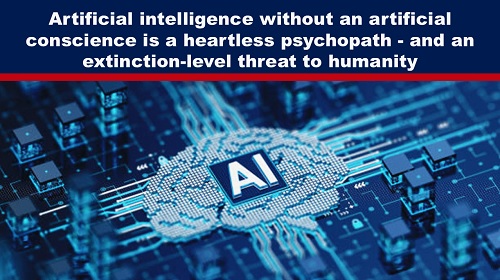
“The real question is, when will we draft an artificial intelligence bill of rights?
What will that consist of? And who will get to decide that?”
Gray Scott
Artist, Futurist, and Philosopher
AI may ultimately be a fate worse than death. When the living envy the dead. It may not create human extinction immediately, but it may be much worse, a living hellish nightmare where you wish it would just finish us off. Like surviving a nuclear bomb blast, only to soon realize you were too close and will die a slow and painful death. You will wish you were closer and had died instantly. So it may also be with AI if we don’t stop it now.
By joining the Moral Party, together we can, and will, stop artificial intelligence and put an end to the known existential threat to humanity before it’s too late; may this set an example for all of Earth.

The upside-down United States flag is a signal of extreme distress.
There could not be a more appropriate symbol of where we are now.
Unite today, join our Moral Party, and together we will turn it around.
The only thing that will change this horrendously awful situation we now face
is for us to understand that we must organize and unite together politically.
So, we’re now requesting our fellow Americans from both sides of the aisle
to stop the incessant fighting with one another and oust the tyrants together.
Our Moral Party will always remain trustworthy, independent, and incorruptible.
Americans who truly love our country are now building it from the ground up,
for they fiercely desire to hand our future generations an enduring freedom.
Subscribe To Our Free Newsletter
https://MoralParty.Substack.com
Moral Party Links
Links To All Pages On MoralParty.com
https://MoralParty.com/Links
Our Moral Party
Independent And Incorruptible.
We The People Take Back America.
Stop AI And The Sixth Mass Extinction.
Ask Your Family And Friends To Visit Us.
And Do Help Spread The Word All You Can.
https://MoralParty.com
Join Our Moral Party Today
Independent And Incorruptible.
We The People Take Back America.
America Has Fully Lost Its Sovereignty.
It’s Long Past Time That We Regained It.
If You Feel The Same Way, Join Us Today.
https://MoralParty.com/Join
Volunteer For Our Moral Party
We Have A Few Easy And Free Ways To Help.
Our Dedicated And Honorable Volunteers Will Be
The Key To Success In Establishing Our Moral Party.
Be The Change You Want To See In The United States.
https://MoralParty.com/Volunteer
Banners To Spread The Word
If You Have A Website, Or An Online Presence Where You Can Post A Banner,
Visit Our Banner Page And Copy One Of Our Banners, To Put On Your Website.
If Most People Who Resonated With Our Message Did This, It Would Be Huge.
https://MoralParty.com/Banners
Moral Party Mission Statement
By Reading This, One Of The Most Important Decisions Of Your Life,
And That Of All Our Future Generations, Will Be Decided Upon.
To Either Join Our Incorruptible Moral Party, Or Decide Not To.
https://MoralParty.com/Mission
Moral Party Platform
Our Political Platform Contains Twenty Comprehensive Sections.
In Each, We Address Many Issues That Are Related To That Section.
All Together There Are Over One Hundred Issues To Peruse Through,
So Do Your Due Diligence And Be Informed On Every Important Issue.
https://MoralParty.com/Platform
Our Two Paramount Issues Are To End AI And The Sixth Mass Extinction.
If We Leave Either One Unchecked, As Both Blatantly Have Been So Far,
They Certainly Have The Potential To Bring About Humanity’s Extinction.
AI
AI Is An Existential Threat To Humanity And It Needs To Be Stopped Today.
We Must Have A Significant And Enforceable Worldwide Treaty Immediately.
Only By Us All Quickly Uniting Together As One Will We Make This Happen.
To Learn More, Please Read Our AI Section With Copious References Today.
https://MoralParty.com/AI
Warnings
The Sixth Mass Extinction Is A Huge Threat To All Life And Needs To End Today.
We Must Have A Significant And Enforceable Worldwide Treaty Immediately.
Only By Us All Quickly Uniting Together As One Will We Make This Happen.
To Learn More, Please Read Our Warnings Section With Many References Today.
https://MoralParty.com/Warnings
Feedback
We Are Open To Any Innovative Suggestions Or Significant Information.
So If You Have Any Constructive Insights Or Helpful Information, Contact Us.
We Ask Supporters To Help Spread The Word To Regain Our Lost Sovereignty.
We Are Grateful For Your Input And Kind Help In Promoting Our Moral Party.
https://MoralParty.com/Join
“Rebellion to tyrants is obedience to God”
Benjamin Franklin